
MIT's pix2pred Teaches Robots to Plan Multi-Step Tasks From Just a Few Videos
MIT and Princeton researchers teach robots to invent their own symbolic rules from a handful of video demos, enabling zero-shot planning on tasks never seen at training time.
 Pro
Takeaways
- pix2pred learns symbolic world models from as few as 3-12 human video demonstrations, enabling a robot to plan novel multi-step tasks zero-shot.
- A VLM proposes 100+ candidate predicates; a hill-climbing optimizer subselects a compact, useful subset -- skipping this step causes complete failure.
- The system outperforms direct VLM planning (ViLa) on 4 of 5 domains, especially on long-horizon tasks (15-30 steps) where ViLa degrades sharply.
- Tested on a real Boston Dynamics Spot robot across Cleanup and Juice domains, achieving 3/3 success on novel goal compositions in Cleanup.
- Training uses only human-perspective video -- no robot interaction or environment resets needed, making real-world data collection practical.
- Key limitations: VLM predicate misclassification is the main failure mode; object descriptors must be manually specified; hill-climbing is slow at scale.
Teaching a robot to wipe a table is easy. Teaching it to figure out that it first needs to dump a bin to retrieve the eraser, then wipe, then put the eraser back -- in a room it has never seen -- is a fundamentally different problem. A new paper from MIT, Princeton, and the RAI Institute tackles exactly this, introducing a method called pix2pred that lets robots learn structured, interpretable world models from just a handful of human video demonstrations.
The gap between watching and generalizing
Modern imitation learning is good at copying. Show a robot enough examples of a task and it will reproduce the motion. But ask it to handle a novel goal, more objects, or a different room, and performance collapses. The core issue is that pure imitation has no internal model of why things work -- it just pattern-matches to training data.
The alternative is symbolic planning: represent the world as a set of logical facts (predicates), define how actions change those facts (operators), and use a planner to find a sequence of actions that achieves a goal. This approach generalizes beautifully -- but historically required engineers to hand-craft every predicate and operator. Traditional robot task planning uses hard-coded symbolic world models that cannot adapt to novel environments. The question pix2pred answers is: can a robot invent those symbolic rules itself, directly from pixels?
What pix2pred actually does
The system works in two phases -- a training phase and a deployment phase -- and the key insight is using a Vision-Language Model (VLM) not as a planner, but as a predicate factory.

Here is the step-by-step flow:
- Propose candidates. The VLM watches each demonstration (a sequence of images annotated with skill names and object descriptors) and proposes a large pool of candidate predicates -- things like
NoObjectsOnTop(?table),IsEraser(?obj), orCooked(?patty). To maximize coverage, the model is also prompted to generate synonyms and antonyms of every predicate it proposes, so the pool can easily exceed 100 distinct concepts. - Label truth values. Each candidate predicate is evaluated on every state in every demonstration by querying the VLM with the image and the predicate string. The VLM outputs True, False, or Unknown. Chain-of-thought prompting and set-of-marks image annotation (labeling objects in the image with their names) proved critical for accuracy here.
- Subselect via hill-climbing. A planning-efficiency objective scores candidate predicate subsets. A greedy hill-climbing algorithm iteratively adds the predicate that most improves the score -- essentially asking: "does adding this predicate help me explain the demonstrations more compactly?" This prunes redundant and noisy predicates down to a small, useful set.
- Learn operators. Given the selected predicates, the system learns PDDL-style operators -- rules of the form "if these facts are true, executing this skill will make these facts true/false." This is the symbolic world model.
- Deploy with a planner. At test time, the VLM evaluates the current predicates from a live camera image to get the current abstract state. A classical PDDL planner then finds a sequence of operators that achieves the goal, and the robot executes the corresponding low-level skills.

A key engineering detail: the hill-climbing optimizer uses a "soft" precondition intersection to handle VLM labeling noise. Rather than requiring a predicate to hold in 100% of relevant transitions, it only requires it to hold in more than 80% -- making the learned operators robust to occasional VLM errors.
What it learns, concretely
The predicates pix2pred invents are semantically meaningful and minimal. In the Cleanup domain (clearing a table and wiping it), the system invents just six predicates from six demonstrations:
IsOnFloor0-- is this object on the floor?IsEraser0-- is this object an eraser?Holding0-- is the robot holding this object?NoObjectsOnTop1-- is this table surface clear?IsOn0-- is this object on this surface?HandEmpty0-- is the robot's hand empty?
That compact set of six concepts is enough to plan a multi-step task in a completely new room with new objects. In the Juice domain (operating a cold-press juicer), the system discovers predicates like JuiceMachineOpen0, InsideWasteValveRegion0, and NearJuiceValve0 -- concepts that are genuinely hard to specify manually but emerge naturally from watching demonstrations.
Benchmarks and results
The method can generalize aggressively, applying its learned world model to solve problems with a wide variety of object types, arrangements, numbers of objects, and visual backgrounds, as well as novel goals and much longer horizons than those seen at training time. Concretely, the team tested across five domains:

- Kitchen (sim): Boil water by placing a kettle on a burner and turning a knob. 3 demos, 2-step plans.
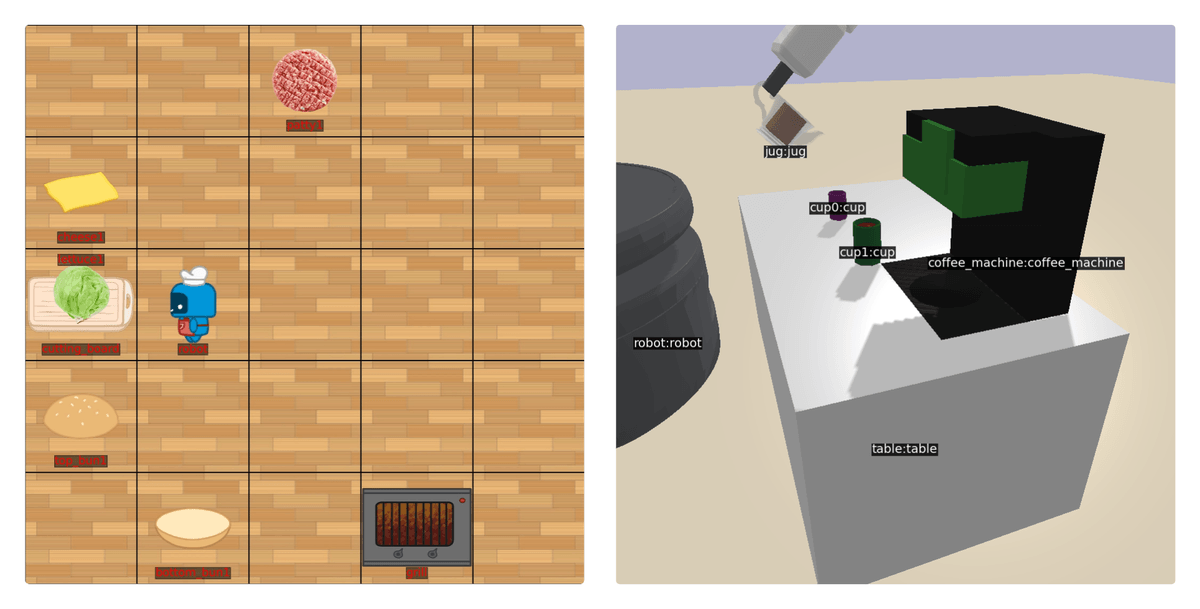
- Burger (sim): Assemble burgers in a grid world. Tests require stacking extra patties, making multiple burgers, and combining ingredients never combined at training time. Plans up to 30 steps.
- Coffee (sim): Dispense coffee into cups. Test tasks add more cups and novel poses.
- Cleanup (real Spot robot): Clear objects and wipe a table. Test tasks include novel rooms, more objects, and goals requiring composition across demonstrations.
- Juice (real Spot robot): Operate a cold-press juicer. Test tasks introduce new fruits, rooms, and goals like emptying a full cup before running the machine.
pix2pred outperforms prior approaches on 4 of 5 simulated domains, often by a wide margin. The main baseline, ViLa (a VLM that plans directly without learning abstractions), performs comparably on the 2-step Kitchen task but degrades sharply on longer-horizon tasks. In the Burger domain, ViLa fails to handle initial states where the robot starts holding an object -- because it never saw that in training. pix2pred invents a HandEmpty predicate and handles it naturally.
In the real world, results are similarly strong. On the Cleanup domain, pix2pred achieves 3/3 success across all five generalization test variants. ViLa-fewshot matches on some variants but fails completely on novel goal compositions. On the harder Juice domain, pix2pred achieves 2/3 or better on four of five variants, while ViLa-fewshot fails on three of five.
The real breakthrough
What makes pix2pred genuinely novel is not just that it uses a VLM -- it is the generate-then-subselect architecture. Prior work either had the VLM directly pick predicates (which leads to bloated, redundant sets that overfit) or required the robot to interact with the environment to discover predicates online. pix2pred focuses on learning abstract symbolic world models that facilitate zero-shot generalization to novel goals via planning -- entirely from offline, embodiment-agnostic demonstrations like human videos, with no environment resets required.
The ablation results drive this home. When the VLM is allowed to directly select predicates without the hill-climbing optimization, it consistently picks too many -- including redundant concepts like both Cooked(?patty) and Raw(?patty) and Available(?patty). This bloats the operator set and causes overfitting. The "no subselect" ablation (using all 100+ proposed predicates) fails entirely across domains.
Where it breaks down
The authors are candid about limitations. The most common failure mode in real-world experiments is not a bad world model -- it is the VLM misclassifying a predicate at test time. For example, the Juice domain required manually marking the table surface to help the VLM recognize whether cups were positioned under specific valves, because no predicate name they tried was reliably evaluated from images alone.
Other known limitations:
- Manual object specification: Every test task requires a human to provide unambiguous text descriptors for all objects in the scene. This is time-consuming in real deployments.
- Full observability assumed: The system assumes all relevant objects are visible in all states -- a strong assumption that breaks in cluttered or partially occluded scenes.
- Slow optimization: The hill-climbing procedure can take many seconds per candidate predicate evaluation, and scales poorly as the number of demonstrations or predicate pool size grows.
- Pre-segmented skills required: Demonstrations must already be annotated with named skill boundaries. Learning from raw, unsegmented video is left for future work.
What this unlocks
The practical implication is a new path for deploying robots in open-ended environments. Instead of engineering a symbolic world model by hand (which requires deep domain expertise and breaks when the environment changes), you collect a small number of human video demonstrations -- no robot required -- and let pix2pred build the model. The resulting system can then handle novel goals, new objects, and different rooms without retraining.
The authors also position pix2pred as complementary to online learning methods like VisualPredicator: the final subset of predicates is selected by maximizing an approximate planning metric; a subset receives a higher score if it enables the planner to find plans that are similar to successful demonstrations while requiring fewer planning resources. pix2pred could initialize a world model from offline data, which is then refined online by methods that learn from robot interaction. Code will be made available via the project's open-source release.