
MIT's Physics-Aware Transformer Predicts Rogue Waves 15 Steps Before They Strike
MIT researchers combine finite-time Lyapunov exponents with Transformer forecasting to predict rare turbulent bursts far earlier than statistical methods allow.
 Pro
Takeaways
- MIT team unveils a data-driven framework predicting extreme events in chaotic systems using dynamics-informed precursors.
- Reduced-order FTLEs computed via OTD modes track instability growth without needing governing equations.
- Transformer with sparse attention maps FTLE history to future observable values over long lead times.
- Tested on Kolmogorov flow: FTLE precursor beats Fourier baseline across F1, AUC at all horizons.
- Output-weighted MAE loss amplifies rare events by dividing errors by target probability density.
- Code available on GitHub; applicable to turbulent, geophysical, and multiscale dynamical systems.
Predicting rare, high-impact events in chaotic systems, think rogue waves, sudden power grid failures, or bursts of atmospheric turbulence, has long been a wall for data-driven forecasting. These events happen too infrequently for statistical models to learn from, and the warning signs are usually buried in fleeting mechanical instabilities rather than obvious patterns. A new paper from MIT's Katsidoniotaki and Sapsis proposes a workaround: build precursors that explicitly track the physics of the instability, then hand them to a Transformer.
The framework, described in Dynamics-Informed Deep Learning for Predicting Extreme Events, extends practical prediction horizons well beyond what Fourier-based baselines achieve, and does so without ever needing the governing equations of the system.
Why statistical precursors fall short
Extreme events are rare yet high-impact episodes, associated with abrupt changes in the state and dynamics of a system, that arise across a variety of natural and engineering systems, including oceanic rogue waves, extreme weather, shocks in power grids, and sudden market drawdowns. The problem is that these excursions may develop rapidly and often exhibit weak or ambiguous precursory signatures.
Purely data-driven predictors, reservoir computers, LSTMs, attention models, learn associations between past states and upcoming bursts. But these precursors are typically association-based, they rely on a large number of extremes for training, whereas dynamics-based precursors are constructed to explicitly quantify the underlying dynamical pathways to extremes. If your dataset only contains a handful of extremes, association-based learning has almost nothing to fit to.
The mechanism: track the instability, not the burst
The authors take a geometric view. The system spends most of its time on a background attractor, but occasionally enters a region where dynamics become strongly nonlinear and perturbations grow explosively along specific directions. These transient instabilities are what actually cause extreme events. If you can measure how fast perturbations are amplifying right now, you have a physically meaningful early-warning signal.
The classical tool for this is the finite-time Lyapunov exponent (FTLE), which quantifies how much an infinitesimal perturbation grows over a finite time window. The catch: the direct computation of FTLEs in high-dimensional systems is computationally prohibitive, as it requires evaluating the full Cauchy-Green tensor. For a turbulent flow with thousands of degrees of freedom, this is a non-starter.
The workaround is Optimal Time-Dependent (OTD) modes, an adaptive orthonormal basis that continuously aligns itself with the directions of fastest transient growth. A key property of the OTD modes is their exponentially fast alignment with the transiently most unstable directions. Instead of computing FTLEs in the full state space, you compute them inside a small OTD subspace, often just six dimensions, that captures the dominant instability directions.

How the pipeline works
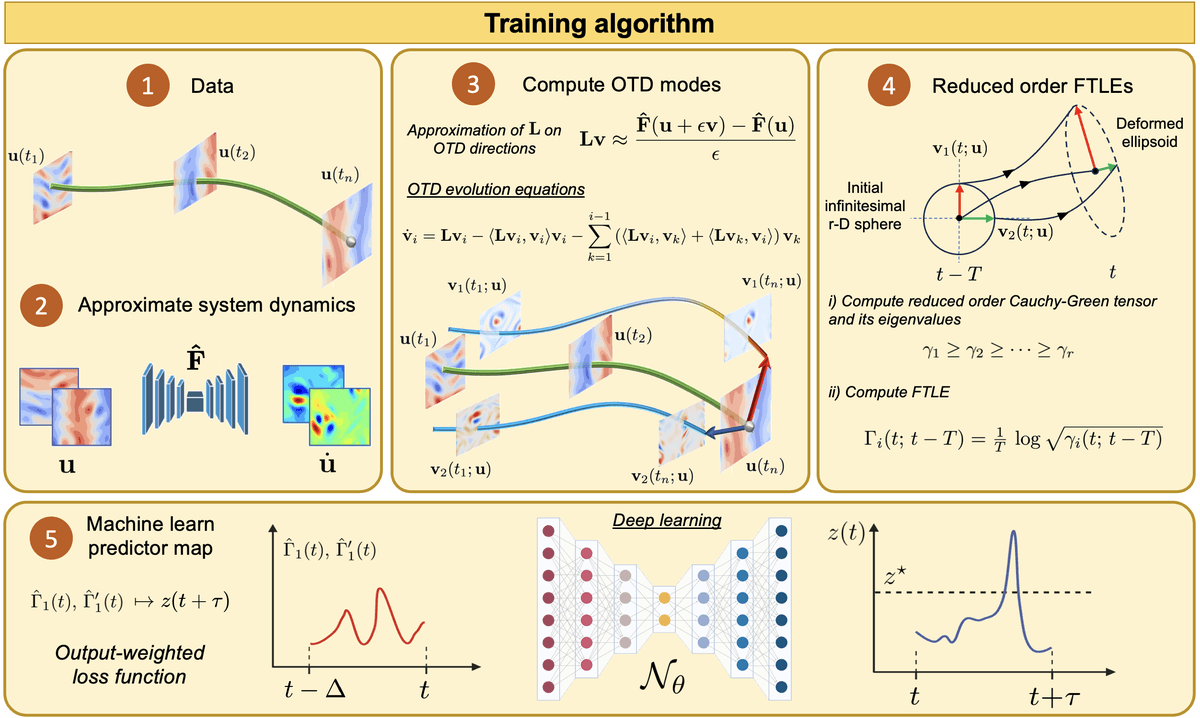
Everything runs from state snapshots alone, no equations required. The pipeline has five steps:
- Learn the dynamics. A neural surrogate approximates the vector field F(u) mapping states to time derivatives. The authors compare a Fourier Neural Operator, a ResUNet++, and a plain residual CNN, with FNO winning on all Sobolev-norm error metrics.
- Approximate Jacobian-vector products. Rather than build the full linearized operator, they use a finite-difference trick:
Lv ≈ (F(u + εv) - F(u))/ε. This avoids ever materializing the Jacobian. - Evolve OTD modes along the trajectory using the learned Jacobian action.
- Compute reduced-order FTLEs by projecting the linearized operator into the OTD subspace and integrating the resulting r×r system.
- Forecast with a Transformer. Feed the leading FTLE and its time derivative into an Informer-style Transformer that predicts the future observable over a lead time τ.
The Transformer uses sparse probabilistic attention, dropping complexity from O(n2) to roughly O(n log n), which matters when the lookback window is long. Training uses an output-weighted MAE that divides each sample's loss by its probability density, forcing the model to pay disproportionate attention to rare high-magnitude events.
Results on Kolmogorov flow
The testbed is 2D Kolmogorov flow at Re=40, a canonical intermittent-turbulence system where extreme energy-dissipation bursts appear as sudden spikes against a quiet background. The team generated 300,000 snapshots over 30,000 time units, using 70% for training. Extreme events are defined as dissipation values exceeding the mean by more than two standard deviations.
The baseline is a Fourier-mode precursor, specifically the (1,0) mode, which prior work identified as an effective indicator of upcoming dissipation bursts. Across F1, precision-recall AUC, an adjusted-AUC skill metric, and absolute deviation in extreme-event count, the FTLE-based predictor wins at every horizon tested (τ = 2, 5, 7, 10, 12, 15).

The gap is largest at longer horizons. At τ=10, the FTLE model reproduces dissipation peaks with accurate timing, amplitude, and frequency. At τ=15, where the Fourier baseline essentially loses temporal alignment and starts overestimating fluctuations, the FTLE forecasts remain coherent with ground truth, missing some events but capturing the timing and magnitude of most large excursions.

The tail statistics tell a similar story. The FTLE forecasts preserve the heavy-tailed distribution of energy dissipation up to τ around 10-12, while Fourier-based forecasts show tail attenuation and probability mass drifting toward moderate values.
What is genuinely new here
Prior work has used OTD modes for extreme-event indicators, and prior work has combined attention models with rare-event loss functions. The contribution is the full data-driven pipeline: computing FTLEs, a physically grounded but expensive quantity, from raw snapshots via a learned surrogate and adaptive subspace, then coupling the resulting mechanism-aware precursor to a Transformer trained with rarity-weighted loss.
The important structural point: the learned dynamics F-hat is never used to forecast the future state directly. It only serves to compute the local linearized behavior needed for OTD evolution. Any long-horizon rollout error stays out of the prediction path.
What it is good for, and what it is not
- Good fit: high-dimensional systems where extremes arise from internal transient instabilities, turbulent flows, geophysical dynamics, structural loading under coherent forcing.
- Poor fit: systems where extremes come from external forcing or discrete jumps unrelated to local instability geometry. Market crashes driven by exogenous news do not have OTD modes to track.
- Data requirements: needs time-resolved state snapshots with sampling fine enough to estimate time derivatives. Coarsely sampled data would require inferring a discrete flow map instead.
The code and reproduction scripts are available at the authors' GitHub repository. For teams working on rare-event forecasting in physical systems, the pipeline offers a template for injecting mechanistic knowledge without having to write down governing equations by hand.