
MIT's ExCellGen Turns a Phone Video Into 3D Scenes in 2 Seconds
A new framework turns casual phone or drone footage into fully editable 3D worlds, trains in under 10 minutes, and generates fresh scenes in under 2 seconds.
 Pro
Takeaways
- ExCellGen generates photorealistic 3D scenes from a single casual video in under 2 seconds after brief per-scene training.
- The pipeline combines 3D Gaussian Splatting, sparse voxels, and Generative Cellular Automata for controllable synthesis.
- Per-scene training finishes in under 10 minutes on complex real-world exemplars from phones or drones.
- A sparse patch-based consistency step remaps Gaussians from the exemplar to preserve photorealistic appearance.
- Their lightweight network is 4.21 MB versus 468.19 MB for the original cGCA architecture, avoiding overfitting.
- Code and an interactive GUI editor are available on GitHub.
Building convincing 3D scenes has always been the awkward cousin of image generation. While diffusion models spit out photorealistic pictures on demand, 3D content creation still involves painstaking manual modeling or slow, GPU-hungry pipelines. A new paper called ExCellGen proposes a refreshingly practical middle ground: hand it a single casual video, wait less than 10 minutes, and start generating variations of that scene in under two seconds each.
The system, built by researchers at MIT, Seoul National University, and ETH Zurich, does not try to be a universal 3D generator. Instead, it learns from one exemplar clip and then lets you author endless variations of that specific look inside an interactive GUI. Code is available on GitHub.
The dataset problem nobody solved
Photorealistic 3D generation has been bottlenecked by data. Available 3D datasets are often synthetic and composed of object-centric meshes with simple textured appearance, while existing real-world datasets are mostly confined to specific distributions, including indoor scenes, urban footage, or object-centric captures. Foliage, fuzzy edges, and the messy geometry of the actual world are exactly what mesh-based methods handle worst.
Prior exemplar-based approaches like Sin3DGen produce nice results but are slow (1 to 3 minutes per scene) and typically require a clean mesh to guide generation, which defeats the point of working from casual captures. ExCellGen sidesteps the whole global-dataset question by training a tiny generative model per scene.

Splats, voxels, and cellular automata walk into a bar
The pipeline stitches together three ideas, each doing a job the others cannot. First, the raw video gets reconstructed into 3D Gaussian Splatting, which enables fast retrieval and rendering and leads to a photorealistic appearance. Splats are explicit and composable, which matters later when the system needs to shuffle them around.
Second, those millions of irregular Gaussians get abstracted into a sparse voxel grid at 64³ resolution, with each occupied voxel carrying an 8-dimensional feature vector that mixes appearance (from spherical harmonics) with DINO semantic features. This is the representation the generator actually operates on.
Third, and this is the clever part, they adapt Generative Cellular Automata (GCA) to synthesize new voxel volumes. GCA is a generative model that treats a 3D shape like a cellular automaton: starting from an initial state, GCA generates a complete shape by iteratively sampling intermediate states until reaching a final state. The kernel is implemented as a U-Net with sparse convolutions, and only updates cells in the neighborhood of already occupied cells via local update rules similar to cellular automata. Because it only touches occupied neighborhoods, it scales beautifully to sparse 3D grids.

How it actually runs
Step by step, here is what happens when you feed the system a phone video:
- Reconstruct the scene as 3D Gaussians augmented with DINO semantic features (reduced to 8 channels via PCA).
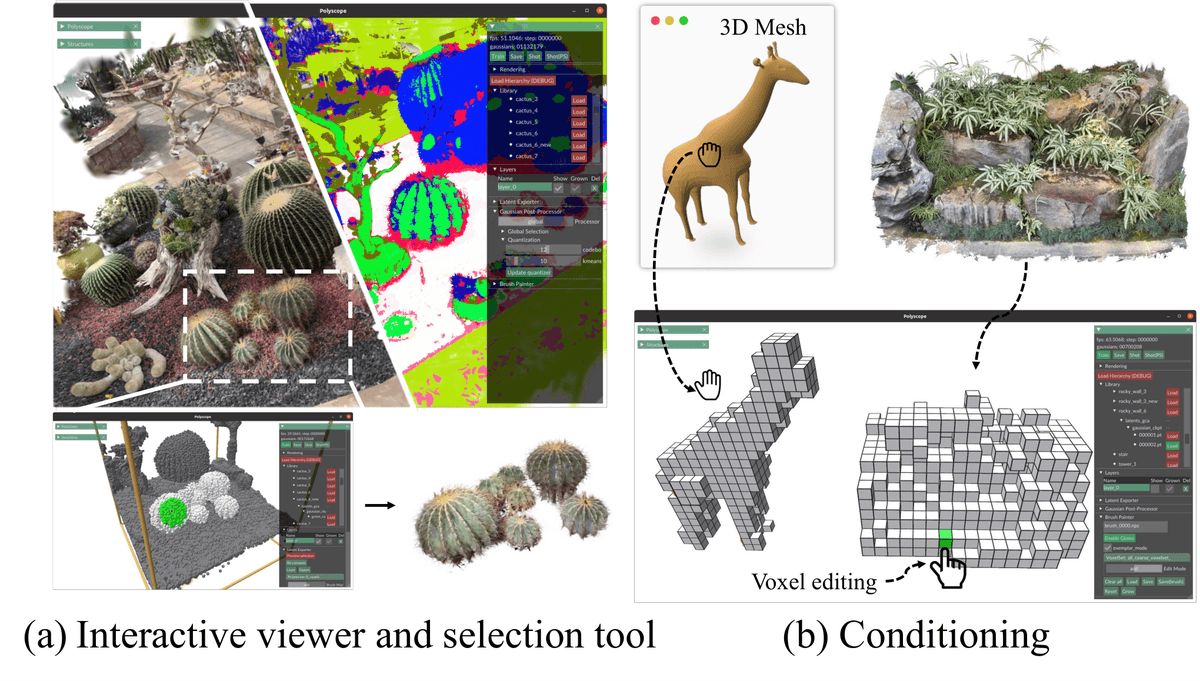
- Use k-means on those semantic features so the user can click to select regions of interest in the GUI.
- Voxelize the selected Gaussians into a fine 64³ grid and a coarse 16³ conditioning grid.
- Train a per-scene GCA on random crops of the voxel volume with padding tricks to avoid boundary artifacts (finishes in under 10 minutes).
- At generation time, the user provides coarse voxels, either copied from the exemplar, from a mesh, or hand-edited, and GCA grows them into a full fine-resolution volume.
- A sparse patch-based consistency step matches each generated voxel patch to the most similar exemplar patch, then transports the original 3D Gaussians into place.
That final patch step matters more than it sounds. Naively copying the nearest-neighbor voxel produces spatial garbage because neighboring cells are chosen independently. The team uses a patch distance that combines occupancy overlap and feature similarity, then runs 7 iterations with a voting mechanism that lets geometry grow or shrink slightly within a bounded distance λ_patch = 2.
What the numbers actually show
Training the generative kernel from a single exemplar takes under 10 minutes, even for complex inputs, and generation runs in under 2 seconds, even for large scenes. The ablation against the original cGCA architecture is striking: their trimmed-down network is 4.21 MB vs. 468.19 MB, training 6.25 min vs. 23.40 min, and inference 199.98 ms vs. 328.74 ms. The larger cGCA just memorizes the exemplar.

Where it fits and where it breaks
This is not a text-to-3D system and it is not trying to compete with Objaverse-scale generators. Its niche is fast, controllable authoring from one captured scene. Realistic use cases include:
- Populating game or VFX environments with variations of a real location.
- Appearance transfer, painting the look of a real garden onto a mesh from a modeling tool.
- Rapid iteration on landscape or vegetation blocking where mesh workflows are slow.
- Compositing multiple exemplars into a single scene inside the provided GUI.
The limitations are honest. The model cannot extrapolate far from the exemplar distribution, so drastically different input geometry produces artifacts. Because it operates on axis-aligned voxels, structured scenes (buildings, straight edges) sometimes show misalignments and cracks at patch boundaries. And since generation is only conditioned on coarse voxels, complex scenes with repeated coarse geometry can produce out-of-place details, essentially the GCA has no global view of what it is building.
The real breakthrough is not any single component but the recognition that you can trade universal priors for speed and control. By committing to per-scene training and combining a neural growth model with classical patch synthesis, the pipeline delivers interactive rates on 3D content that previously took minutes per sample, all from a video you shot on your phone.