
MIT's CMA-ES-IG Teaches Robots Your Preferences 1000x Faster
CMA-ES-IG teaches robots your preferences by showing you visually distinct, improving options — no expertise required, and it scales to high-dimensional spaces where existing methods break down.
 Pro
Takeaways
- CMA-ES-IG combines evolutionary search (CMA-ES) with information gain to show users robot trajectories that are both visually distinct and progressively improving.
- The key mechanism: K-means clustering on a large Gaussian sample forces presented options to be perceptually diverse, reducing ranking noise from users.
- At 32 dimensions, CMA-ES-IG generates queries ~1000x faster than pure Information Gain (5.3 ms vs 6256 ms), making real-time interaction feasible.
- In a real-world user study, participants significantly preferred CMA-ES-IG over both baselines for teaching a JACO arm and a Blossom social robot.
- Tradeoff: pure IG still wins on accuracy in low-dimensional spaces (under ~10D); CMA-ES-IG dominates at 16D and above.
- Code is open-source and works with any trajectory representation (VAEs, autoencoders, hand-crafted features).
Getting a robot to behave the way you want it to is surprisingly hard. Not because the robot can't move well, but because translating a human's fuzzy, personal preferences into a reward function is a genuinely unsolved problem. Researchers at MIT and USC have now published a new algorithm, CMA-ES-IG, that tackles this from a fresh angle: instead of just optimizing for how accurately the robot learns your preferences, it also optimizes for how good the teaching experience feels to you.
The gap nobody was measuring
The standard approach to preference learning works like this: show a user a few robot behaviors, ask them to rank the options, update the robot's internal model, repeat. Two families of algorithms dominate this space:
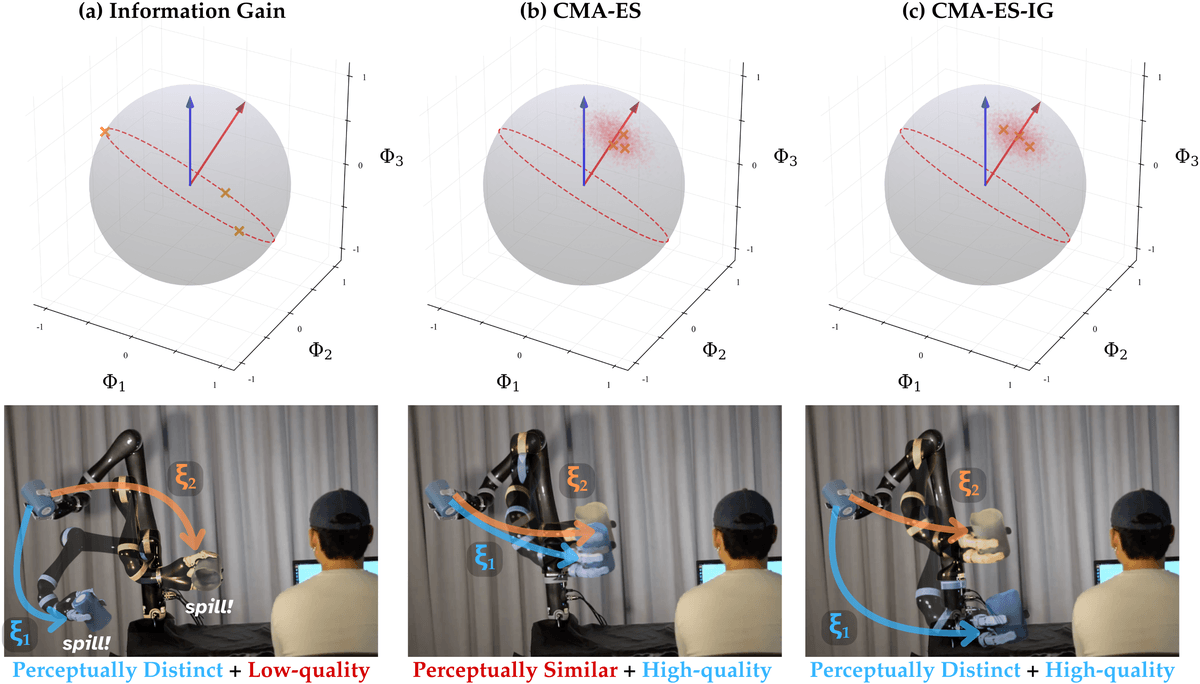
- Information Gain (IG) methods , pick trajectories that are maximally informative about the user's hidden reward function. They're great at learning quickly, but the trajectories they suggest don't necessarily get better over time. Users watch the robot do weird, seemingly random things and wonder if it's learning at all.
- CMA-ES (Covariance Matrix Adaptation Evolution Strategy) , a derivative-free optimizer that iteratively searches for high-reward behaviors. It improves visibly over time, but tends to sample trajectories that look nearly identical to each other, making them hard for users to rank reliably.
Optimizing for information gain results in trajectories that are easy to distinguish for the user, but do not achieve high rewards. Using CMA-ES results in trajectories with higher rewards, but they are not easy for the user to distinguish. CMA-ES-IG is designed to get both at once.
How it works
The core insight is elegant. CMA-ES naturally samples candidate behaviors from a multivariate Gaussian distribution centered on the current best estimate of the user's preference. The problem is that most samples cluster near the mean, producing behaviors that look almost the same to a human observer.
CMA-ES-IG fixes this with a single, clean addition: instead of directly showing the user raw samples from that Gaussian, it runs K-means clustering on a large batch of samples and presents the cluster centroids as the query. This forces the presented options to be spread out across the sampling space, making them perceptually distinct and easy to rank, while the underlying CMA-ES update still drives the distribution toward higher-reward regions over time.
The algorithm in pseudocode is almost trivially simple:
# CMA-ES-IG core loop
while user_not_done:
    S = sample(D_samples, from=Gaussian(mu, C))  # large batch
    Q = kmeans(S, k=K).cluster_centroids         # diverse subset
    ranking = ask_user_to_rank(Q)                # human feedback
    belief = bayesian_update(belief, ranking)    # update reward model
    mu, C = cma_es_update(mu, C, ranking)        # evolve distribution
The Bayesian belief update and the CMA-ES distribution update run in parallel, giving the algorithm both a principled probabilistic model of the user's preferences and an evolutionary search that keeps improving trajectory quality.
Tested across four simulated domains and two real robots
The team evaluated CMA-ES-IG against pure IG and pure CMA-ES across a range of tasks designed to stress-test different aspects of the algorithm:
- Lunar Lander , finding a preferred spaceship landing trajectory, with features from a randomly initialized neural network
- Highway Driving , learning preferred lane-change styles, with features from a variational autoencoder (VAE) trained on driving data
- Robot Face Design , selecting preferred facial expressions for a screen-based robot, using hand-crafted appearance parameters
- Robot Voice Design , picking a preferred text-to-speech voice, using 512-dimensional speaker embeddings compressed to 4D via PCA
They also ran real-world experiments: 14 participants taught a JACO2 robotic arm how to hand them objects (a marker, cup, and spoon) and a Blossom social robot how to gesture happiness, sadness, and anger.

The results: a clear winner at scale
The simulation results tell a nuanced story. In low-dimensional spaces (4D, 8D), pure IG is still the most accurate at recovering the user's true preference weights. But as dimensionality grows, the picture flips hard:
- At 16 dimensions, CMA-ES-IG significantly outperforms IG on both alignment and regret
- At 32 dimensions, CMA-ES-IG beats both baselines on accuracy metrics
- Across all dimensions, CMA-ES-IG generates higher-quality trajectory queries , meaning the options shown to users are better on average, not just the final result
The computational gap is even more striking. For 32-dimensional problems, CMA-ES-IG (5.3 ms) generated queries approximately 1000 times faster than Infogain (6256 ms). This matters enormously for real-time interaction, where a multi-second pause between rankings would kill the user experience.
This scalability advantage is consistent with known properties of derivative-free optimizers. Prior empirical findings show that derivative-free optimizers such as CMA-ES are often more competitive in moderate- to high-dimensional optimization problems (roughly 10–500 dimensions), whereas Bayesian Optimization methods tend to perform better in low-dimensional spaces. Production-scale preference learning systems routinely use high-dimensional embeddings , YouTube's recommendation system, for instance, used 256-dimensional embeddings.
Users actually preferred it
The real-world user study is where CMA-ES-IG's design philosophy pays off most clearly. Participants rated each algorithm on two dimensions:
- Behavioral Adaptation (BA) , did the robot seem to be learning and improving based on my input?
- Ease of Use (EOU) , were the trajectories easy to compare and rank?
CMA-ES-IG was significantly more adaptive than Infogain (p = .009) with a medium effect size, and was rated as significantly more adaptive than the CMA-ES baseline (p = .033) with a small to medium effect. Users also found CMA-ES-IG significantly easier to use than standard CMA-ES, because the K-means diversity step ensures options are visually distinct enough to rank confidently.
In the forced-ranking question at the end of each session, users ranked CMA-ES-IG as the best algorithm on average (M=1.48), followed by CMA-ES (M=.89), and Infogain as the least preferred (M=.63). The effect sizes here are large (Hedges' g = 1.26 vs CMA-ES, 1.75 vs Infogain), which is notable given the small sample of 14 participants.

Where it falls short
The paper is upfront about its limitations. The algorithm currently requires a pre-existing dataset of diverse robot behaviors to search over , generating that dataset from scratch is non-trivial and domain-specific. The user study was also conducted with university students, not the populations (e.g., people with limited mobility) who would benefit most from personalized assistive robots.
There's also a fundamental accuracy tradeoff: in low-dimensional preference spaces, pure information gain still outperforms CMA-ES-IG on accuracy metrics. If your feature space is small and well-defined, IG remains the sharper tool for pure preference recovery.
The real breakthrough: UX as a first-class objective
The deeper contribution here isn't the specific algorithm , it's the framing. Existing techniques focus on generating trajectories for users to rank that maximize the outcome of the preference learning process, but the generated trajectories do not appear to reflect the user's preference over repeated interactions. CMA-ES-IG is one of the first systems to treat the process of teaching a robot as something worth optimizing directly, not just the final learned model.
This matters because adoption is the real bottleneck for assistive robotics. A robot that learns perfectly but feels broken to the user during training will never be used. The open-source code is available, and the algorithm is modular enough to plug into any system that already uses a learned trajectory representation , VAEs, autoencoders, contrastive embeddings, or hand-crafted features all work out of the box.
Future directions the authors flag include integrating CMA-ES-IG with quality-diversity optimization to generate behavior datasets on the fly, and extending it to cross-task representations so a robot can transfer what it learned about your preferences in one context to a new one.