
MIT Rewires How LLMs Fight Hallucinations Before They Ever Appear
MIT researchers fix a core flaw in conformal LLM hallucination control by calibrating the sampling distribution itself, not just filtering outputs after the fact.
Takeaways
- MIT paper proposes sampling from a calibrated LLM posterior instead of post-hoc filtering to control hallucinations with formal guarantees.
- Prior conformal methods delete low-confidence claims after generation, producing incoherent outputs; this method reweights the generation distribution itself.
- An off-policy calibration algorithm learns a threshold τ from base-model samples only, requiring no re-calibration when the scorer changes.
- An abstention atom (probability mass β on "I don't know") ensures the posterior is always well-defined, even when the model has no high-confidence completions.
- On the MATH benchmark, the method produces complete, correct proofs at high target factuality levels where the MH baseline degrades to truncated, incomplete outputs.
- No code is publicly available yet; the paper is available at arxiv.org/abs/2606.03731.
Hallucination control in LLMs has largely followed the same playbook: generate text, score the individual claims, then surgically remove the ones that look suspicious. It works well enough on paper, but a new paper from MIT argues this approach is fundamentally broken in a subtle way. By treating generation and filtering as separate steps, post-hoc methods can produce outputs that are grammatically intact but logically incoherent, stripped of the very context that made the remaining claims meaningful. Worse, no amount of post-hoc filtering can actually steer the model toward better responses. It can only make existing responses shorter.
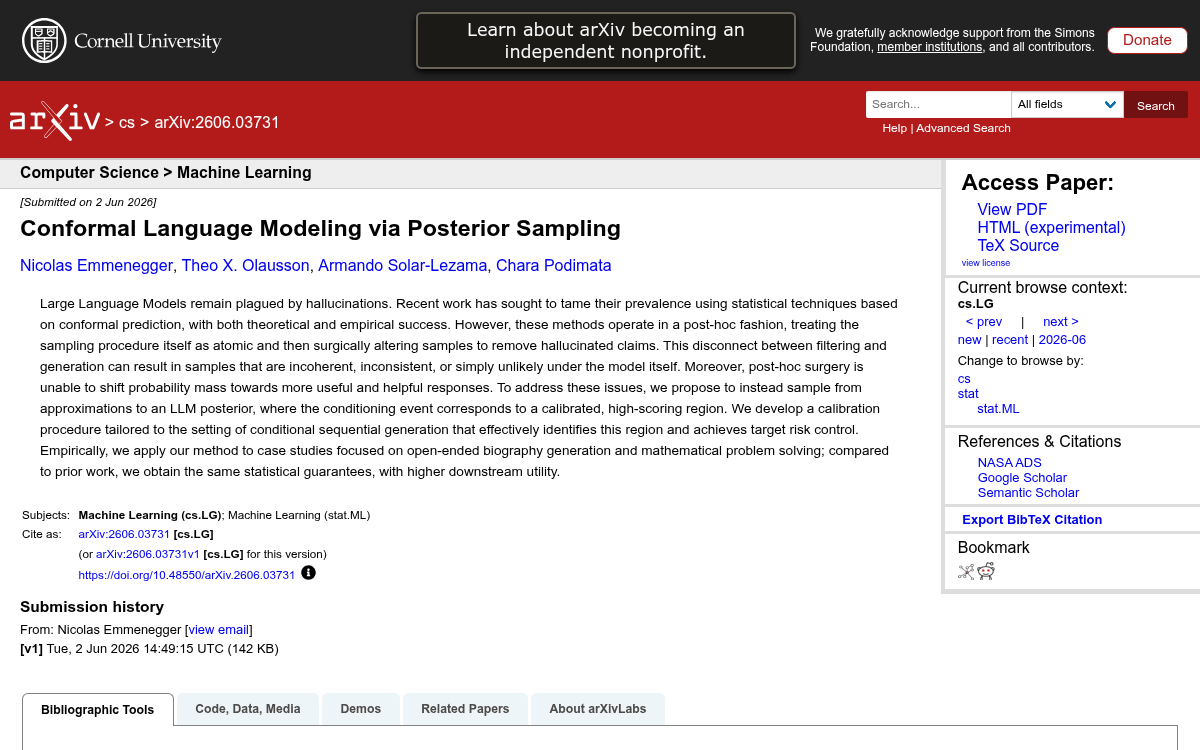
Conformal Language Modeling via Posterior Sampling, from Nicolas Emmenegger, Theo Olausson, Armando Solar-Lezama, and Chara Podimata, proposes a fundamentally different approach: instead of filtering outputs, calibrate the sampling distribution itself so that the model is more likely to generate high-quality responses in the first place.
Why filtering breaks down
To understand the problem, it helps to know what conformal prediction actually does. Conformal prediction (CP) is a statistical framework that provides distribution-free, finite-sample guarantees on error rates. Applied to LLMs, prior work uses it to calibrate a post-hoc filter: generate a response, score each claim for factuality, then delete claims that fall below a learned threshold. The threshold is chosen from a calibration set so that the expected hallucination rate stays below some user-specified level α.
The guarantee is real, but the outputs can be a mess. These methods operate in a post-hoc fashion, treating the sampling procedure itself as atomic and then surgically altering samples to remove hallucinated claims. This disconnect between filtering and generation can result in samples that are incoherent, inconsistent, or simply unlikely under the model itself. Consider a math proof: if you delete step 3 because the scorer was uncertain about it, steps 4 through 10 may no longer follow. The filtered output is technically "safer" but practically useless. Moreover, post-hoc surgery is unable to shift probability mass towards more useful and helpful responses.