
MIT Finds AI Fact-Checking Boosts Accuracy 21% but Erodes Independent Thinking
MIT month-long study of 67 people finds AI chatbots correct beliefs about specific fake news, but independent detection accuracy drops 15.3 percent.
 Pro
Takeaways
- MIT month-long study of 67 participants tested whether AI chatbot dialogues teach lasting misinformation detection skills.
- AI assistance boosted in-session accuracy by 21%, but unassisted accuracy fell 15.3% by week 4.
- The decline was concentrated entirely on detecting fake content; real news recognition stayed stable.
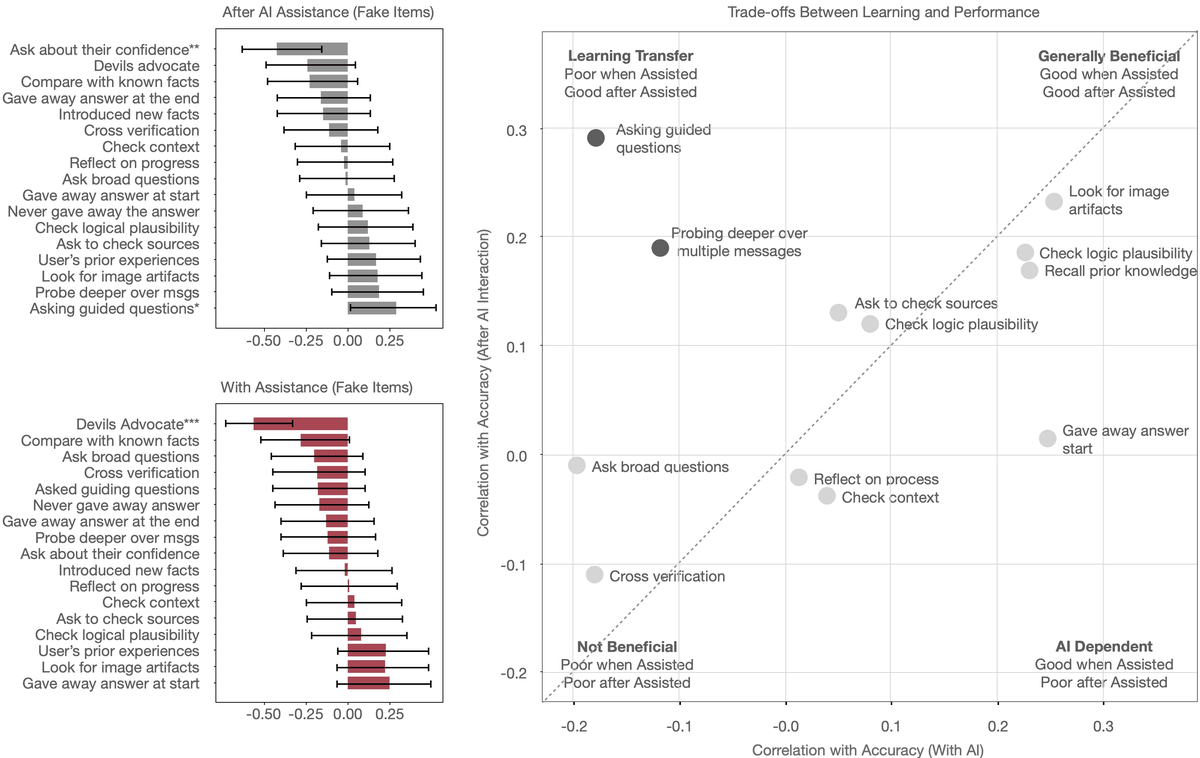
- Guided questioning helped skill transfer; confidence checks and devil's advocate hurt independent judgment.
- Human agreement with AI rose from 23% to 28.5% over the month, while independent thinking stayed flat.
- Code, chatbot, and 7,203 conversation pairs released at github.com/mitmedialab/newsapp.
A month-long study out of MIT Media Lab has landed on an uncomfortable finding for anyone building AI tools to fight misinformation: talking to a chatbot about fake news makes you better at spotting it right then, but worse at spotting it later on your own. The paper, titled Dialogues with AI Reduce Beliefs in Misinformation but Build No Lasting Discernment Skills, measures a gap between short-term persuasion and durable skill acquisition that most prior work on AI fact-checking has missed.
The team ran a longitudinal study where 67 participants classified news headline-image pairs as real or fake, discussed their assessments with an AI system, then completed unassisted evaluations of new items across four weeks. AI assistance produced immediate improvements of about 21 percent during assisted sessions, but participants' unassisted performance on new items declined by 15.3 percent in week 4 compared to week 0.

The setup: persuasive GPT-4o plus live web search
The chatbot itself is not exotic. It combines a React front end, GPT-4o for persuasive dialogue generation, and the Google Custom Search API for real-time information retrieval. The prompt design follows the approach from Costello et al.'s 2024 Science paper that showed AI dialogues could durably reduce belief in conspiracy theories by 22 percent, with one key addition: image forensics.
The authors tested prompt variants and found a clear winner. A combined news-forensic-expert plus persuasion prompt, paired with Google search on the headline and image analysis of the picture, hit 100 percent accuracy with a 0 percent rejection rate on their evaluation sample. Prompts that only did artifact detection or only did persuasion, or that stripped out either search or vision, dropped as low as zero. News items came from the MiRAGeNews dataset, which contains 12,500 real and AI-generated headline-image pairs; the authors kept 49 items after removing 6 that their system misclassified.
Three phases, repeated weekly
Each week, participants went through the same protocol:
- Before AI: rate four unseen headline-image pairs (two real, two fake) alone.
- With AI: discuss those same items with the chatbot for up to nine turns, then re-rate them.
- After AI: rate a fresh batch of unseen items with no AI help.
That third phase is the key methodological move. It separates persuasion in the moment from skill transfer to novel content, which is precisely where prior work stopped.
What the numbers show

The average uplift with AI support was +21.3 percentage points (Week 0: +22.4, Week 2: +15.3, Week 4: +26.1). But unassisted accuracy on brand-new items after using the AI fell steadily, with a linear decline of 7.7 percentage points per two-week step, and Week 4 accuracy 15.3 points below Week 0.
The most striking piece: the decline was driven almost entirely by fake items. Accuracy on fabricated content fell sharply over time, while accuracy on real news stayed flat. In other words, people got worse specifically at catching the lies, not at recognizing legitimate reporting. Once they trusted the chatbot to flag suspicious claims, they stopped scrutinizing suspicious claims themselves.
Which conversation moves help, and which hurt
The authors used an LLM-as-a-judge to tag each dialogue with 21 binary strategy categories, then correlated each strategy with accuracy during and after AI use. The pattern splits cleanly:
- Helped during and after: pointing at image artifacts (shadows, lighting, textures) and connecting to the user's prior experiences.
- Hurt during, helped after: asking guided questions and probing deeper across turns. Guided questioning was the strongest positive predictor of unassisted fake news detection (r=0.29, p=0.047), even though it was negatively associated with in-session accuracy. These act like classroom scaffolding: slower now, stickier later.
- Hurt across the board: devil's advocate roleplay and confidence calibration prompts. Asking users about their confidence strongly undermined independent performance right after the interaction (r=-0.42, p=0.003).
A separate keyword analysis of the 7,203 logged conversation pairs shows the drift toward dependence in participant behavior itself. Human agreement with the AI climbed from 23.0 percent in Week 0 to 28.5 percent in Week 4, while independent thinking in participants stayed flat at around 7 percent.
How participants themselves changed
Coding participants into five trajectory groups produced an unflattering mix. Twenty-seven percent were Progressive Learners who started skeptical of AI and grew to trust it, 18 percent were Consistently Collaborative Learners, 12 percent were Growing Skeptics who backed away, 22 percent were Persistent Self-Reliant Learners, and 21 percent were Dependency Developers who shifted from active reasoning to passive acceptance. The Progressive Learners are the most concerning group: they reported feeling more capable while measurably getting worse.
Why this matters beyond misinformation
The paper connects to a recent Lancet study showing endoscopists became worse at detecting cancer on their own after using AI assistance in colonoscopy. Same shape of curve, different domain. If you are building any product that positions an LLM as a verification or judgment aid, the takeaway is that the design choices that maximize in-the-moment accuracy (confident, evidence-rich, direct answers) may be the same choices that erode user skill over weeks of exposure.
The authors argue for Socratic-style systems that ask more than they tell, and hybrid designs that combine belief correction with deliberate skill practice. The full system, code, 7,203 conversation pairs, and 4,536 participant judgments are open-sourced on GitHub, which makes this one of the more actionable HCI datasets to drop in a while for anyone testing counter-designs.