
MIT Builds a Math Framework That Rewires How Engineers Design Drones
A new framework extends monotone co-design with probability distributions and staged decision policies, capturing risks that interval bounds cannot express.
 Pro
Takeaways
- MIT researchers extend monotone co-design theory from interval bounds to full probability distributions over design problems.
- Uses Quasi Measurable Spaces to sidestep classical measurability obstructions on function spaces of DPs.
- Multi-stage adaptive decisions are formalized as chains of Markov kernels that compose in the same categorical structure.
- All standard co-design operations (series, parallel, feedback, union, intersection) remain compositional under distributions.
- UAV case study compares non-adaptive, partly adaptive, and fully adaptive designs across actuator and battery choices.
- No code released; computation uses Monte Carlo, with variance-reduced compositional estimators listed as future work.
Designing a delivery drone forces engineers into a tangle of coupled choices: which actuator, which battery chemistry, which perception stack, at what weight, at what cost. Every choice ripples through the others, and most real specifications are uncertain. A new paper from MIT's Laboratory for Information and Decision Systems proposes a mathematical framework that lets engineers reason about those uncertain, staged decisions compositionally, rather than collapsing everything into worst-case bounds.
The work, Distributional Uncertainty and Adaptive Decision-Making in System Co-design by Yujun Huang and Gioele Zardini, extends the monotone co-design theory Zardini's group has developed for years. That theory offers a compositional way to model systems as Design Problems (DPs), which represent trade-offs between functionalities and resources within partially ordered sets. The new contribution replaces coarse interval bounds with full probability distributions over these design problems, and lets later choices depend on earlier observations.
Why intervals were never quite enough
Monotone co-design models each subsystem as a relation between what it provides (functionalities) and what it requires (resources), both placed in partially ordered sets. Subsystems compose in series, parallel, or feedback, and the whole system inherits mathematical properties that make optimization tractable.
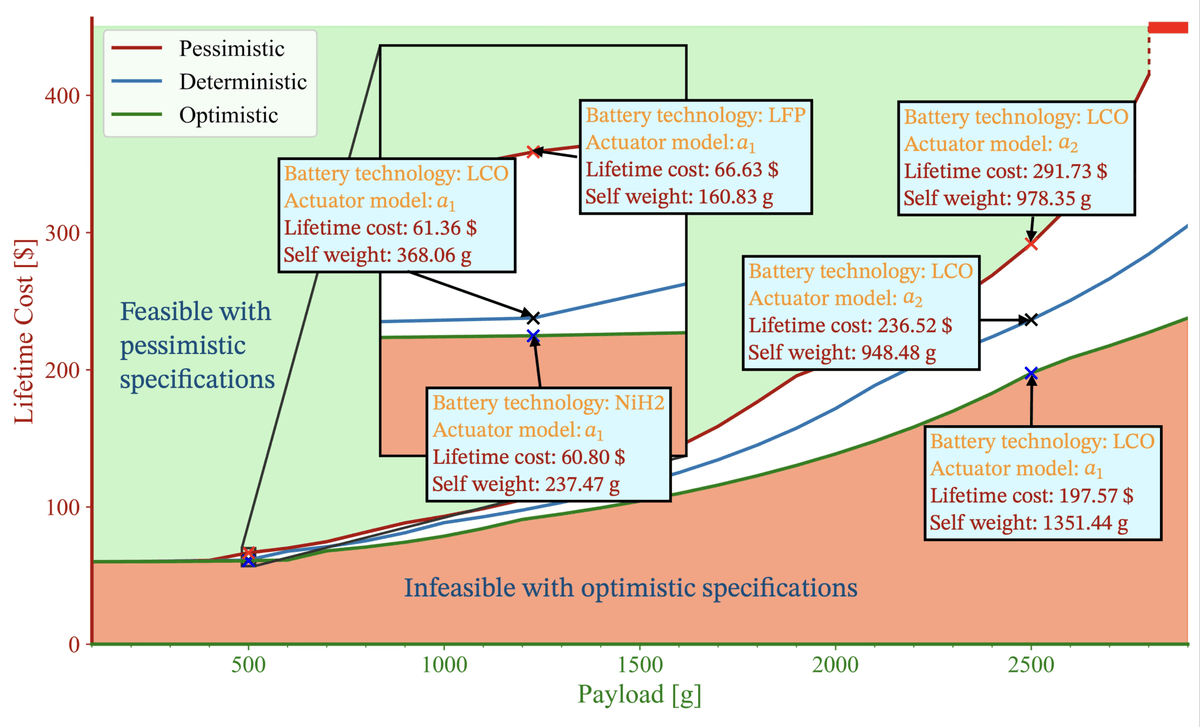
Prior work handled uncertainty with interval bounds: an optimistic best-case DP and a pessimistic worst-case DP. That works for robust reasoning, but the authors argue it hides two things engineers actually care about. First, intervals cannot express probabilistic risk, so an almost-always-safe design looks identical to a uniformly conservative one. Second, they cannot represent staged decisions where the designer commits to some choices, observes an outcome, and then picks the next component based on what happened.
Their perception example is concrete: a UAV designer picks a camera from a catalog, but the manufacturer only guarantees distributions over field of view and noise. The chosen sensor is a random sample from that distribution, and the perception algorithm can be tuned once the sensor is in hand. Intervals miss this because they treat every decision as either here-and-now or fully wait-and-see, with no middle ground.
Distributions over design problems, without measurability nightmares
The core technical move is to model each uncertain subsystem as a probability distribution over design problems. Naively, you would put a sigma-algebra on the space of DPs and use classical measure theory. The paper shows this fails: a formal impossibility result establishes that no sigma-algebra on the space of DPs makes all the required operations (composition, feasibility evaluation, constant injection) measurable simultaneously. This is the same obstacle that classically blocks higher-order probability on function spaces.
To sidestep it, the authors build on Quasi Measurable Spaces and Quasi Universal Spaces, a formalism where random variables are treated as primary objects and sigma-algebras are derived from them. In plain terms: instead of asking which sets are measurable, they fix which maps from a sample space count as random variables, and derive the rest. This yields a cartesian-closed category where function spaces and evaluation maps behave well.
On top of this, they prove that all the standard co-design operations (series, parallel, feedback, union, and intersection) lift cleanly to distributions. You can build a stochastic model of a whole system by composing the stochastic models of its parts, and the math still works.

Adaptive design as Markov kernels
The second major piece is adaptivity. Design in the real world happens in stages: commit to some parts, watch what unfolds, decide the next thing. The paper formalizes this as a chain of Markov kernels. At each stage, an observation model describes how specifications evolve, and a decision policy picks the next implementation, possibly randomly, based on what has been seen so far.
Because these kernels compose in the same categorical structure as the co-design operations, two layers of adaptivity work together:
- Policy-level adaptivity, where later component choices can condition on earlier observations.
- Co-design-level adaptivity, where compositions like union and intersection can be interpreted as either "choose after observing" or "be robust to whatever happens."
The framework also defines queries and observations that pull useful quantities out of a distribution over DPs. Examples include the probability that a functionality/resource pair is feasible, inner and outer confidence bounds that generalize interval uncertainty, and distributions over the minimal resource needed to satisfy a given set of functionalities.
A UAV case study, with three flavors of adaptivity
The paper instantiates all of this on a task-driven UAV delivery problem, adapted from prior work on embodied intelligence co-design. The UAV must complete delivery missions over its lifetime; the designer picks among three actuator models and eight battery chemistries (NiMH, NiH2, LCO, LMO, NiCad, SLA, LiPo, LFP), with a fixed perception stack.
Parameters are treated as truncated Gaussians whose 90% confidence intervals match a plus-or-minus 5% deviation from nominal values. The joint distribution over the sample space is the product of all marginals, and system-level distributions of minimal lifetime cost are estimated by Monte Carlo sampling.
The interesting comparison spans three adaptivity levels for the discrete choices:
- Non-adaptive: Actuator model and battery chemistry are committed to before any random outcome is observed; only continuous decisions (operating point, battery weight) happen after.
- Partly adaptive: The actuator is chosen first, then the battery technology is picked after the actuator's realized specifications are observed.
- Fully adaptive: All parameters of all actuators and batteries are observed, then the pair is chosen.
Results show something intervals cannot reveal: more adaptivity can substantially cut expected lifetime cost for payloads near the feasibility boundary, yet the upper tails of the cost distribution may not improve and can even worsen. That trade-off between average performance and rare-but-severe outcomes is exactly the kind of risk-sensitive information designers need, and it is invisible to worst-case reasoning.

What is genuinely new here
The headline is distributional co-design, but the real contribution is subtler. The authors claim this is the first framework that simultaneously handles general distributional uncertainty over compositional design models, supports multistage adaptivity, and remains closed under the standard co-design compositions. Other approaches in stochastic optimization or contract-based design handle probabilistic risk, but usually give up compositionality or restrict themselves to a single scalar objective. Existing co-design tools kept compositionality but only supported intervals.
Moving from intervals to distributions also changes what confidence bounds mean. The paper distinguishes inner bounds, which guarantee the design result stays inside an interval with at least probability p, from outer bounds, which cap the probability of falling outside on either side. Inner bounds compose across a co-design graph when parameters are independent, though the composed confidence level degrades multiplicatively. The UAV example makes this concrete: 30 uncertain scalars at 90% each give a conservative joint guarantee around 4%, even though empirical realizations fall inside the bound far more often.
Where the framework is thin
This is a foundations paper, not a solver. There is no released code or model, and computation currently relies on Monte Carlo sampling of the composed system. The authors flag several missing pieces for future work:
- Compositional estimators and variance-reduced sampling that exploit the co-design graph structure.
- Direct support for standard risk measures like chance constraints and CVaR-type objectives in the query layer.
- Policy synthesis under partial observations, and an end-to-end learning loop that updates specification distributions from data.
- Conditioning and disintegration, which are not part of the basic structure and would be needed for Bayesian updates.
The theory also assumes mild regularity: posets are Souslin spaces with Borel order relations, which covers finite discrete orders, R-to-the-n with the usual topology, and complete separable metric spaces with closed order. Broad enough for typical engineering applications, but not universal.
Who should care
If you work on system-level design for anything safety-critical (robotics, aerospace, mobility systems), this is the direction the underlying language is moving. A related paper from the same lab on scalable co-design via linear design problems suggests the ecosystem around monotone co-design is growing beyond theory into tractable computation. Distributional co-design gives you a principled way to say "my design meets its target 95% of the time" instead of "my design meets its target under the worst realistic parameters," and to reason about how much that number improves if you can defer a decision until more information arrives.
For anyone building automated design tools, the framework provides a common language that stitches together heterogeneous subsystems, multi-objective trade-offs, probabilistic risk, and staged decisions in one categorical structure. That has not existed before, and it opens a path toward risk-aware compositional design software that goes well beyond current interval-based tools.