
MIT and TU Munich's ACTOR Solver Beats Robot Path Planning's Worst Local Minima
A new ADMM-based solver called ACTOR jointly searches spatial and temporal domains, finding smoother trajectories in non-convex environments without careful warm starting.
 Pro
Takeaways
- ACTOR is a new ADMM-based solver from TU Munich and MIT for trajectory optimization in non-convex environments.
- It introduces a spatio-temporal allocation graph that jointly optimizes discrete routing and continuous smoothness.
- Converges reliably from naive straight-line initializations, avoiding complex warm-start pipelines used by prior methods.
- Primal updates solve a closed-form QP; slack updates are shortest-path searches on a DAG.
- Scales linearly with segments and sets, versus combinatorial or exponential growth for MIQP and NLP baselines.
- Read the full paper on arXiv for full derivations and benchmarks.
Trajectory optimization in cluttered environments has long been a game of unhappy compromises. You either solve a nonlinear program that gets stuck in bad local minima, or you decouple the problem into a discrete path search followed by continuous smoothing, giving up global optimality in exchange for tractability. A team from TU Munich and MIT is proposing a middle path with ACTOR (ADMM-based Continuous Trajectory OptimizeR), a solver that jointly reasons over discrete routing and continuous smoothness in a single loop.
The core claim is unusually strong for this space: the solver's structural robustness ensures reliable convergence from naive initializations, removing the bottleneck of complex warm starting in non-convex environments. In practice that means you can hand it a straight line through a maze and it will still find a smooth, feasible trajectory.
Why non-convex planning is painful
The safe region of space around obstacles is non-convex, which breaks most well-behaved optimizers. Nonlinear-programming approaches like OBCA are susceptible to infeasible local minima, affecting their reliability. Mixed-integer formulations can model the geometry exactly by assigning each trajectory segment to one of many convex regions, but the combinatorial nature of the mixed-integer problem makes it NP-hard and any algorithm that finds the global solution suffers from non-polynomial worst-case runtime.
The workaround most robotics pipelines use is decoupling: run A* or RRT* on an occupancy grid, carve out a safe corridor, then smooth a trajectory inside it. It works, but the smoother is blind to alternative routes and the initial path search is blind to dynamics like velocity and acceleration bounds. You often ship a trajectory that is locally polished but globally mediocre.
The trick: an allocation graph plus ADMM
ACTOR's key structural idea is what the authors call a spatio-temporal allocation graph. Free space is decomposed into a union of convex sets (boxes, balls, polyhedra), and the graph encodes every valid way to assign trajectory segments to those sets over time. Each path in the graph corresponds to a feasible solution, and for a given path of binary assignments the safe set becomes convex and the problem reduces to a convex QP.

On top of this graph, the authors run the Alternating Direction Method of Multipliers, a classic technique that splits a hard problem into a sequence of easier subproblems glued together by dual variables. ACTOR's three updates each map to something with a known efficient solution:
- Primal update: an equality-constrained quadratic program over polynomial (Bezier) control points, solved in closed form as a minimum-control-effort problem. Because the matrices remain unchanged between iterations, the factorization can be performed offline and online evaluation only involves sparse matrix multiplications.
- Slack update: projection of each segment onto every candidate convex set, followed by a shortest-path search over the allocation graph to pick the cheapest assignment. Since the allocation graph is a directed acyclic graph, the shortest path reduces to a simple dynamic programming iteration.
- Dual update: a gradient-ascent step on the Lagrange multipliers that gradually enforces consistency between the smooth primal solution and the discrete slack projection.
The elegance is that the discrete route selection and the continuous smoothing talk to each other every iteration, rather than being run once in sequence. The route can change as the trajectory gets smoother, and vice versa.
How it stacks up in experiments
The authors benchmark against three representative baselines: OBCA, a direct nonlinear program that enforces collision avoidance through obstacle constraints solved with IPOPT, and SafeC, a safe-corridor optimizer used in prior work solved with SNOPT, plus a Graph of Convex Sets convex-surrogate method.
Three findings stand out:
- Escapes bad basins. On a U-shaped obstacle initialized with a straight line into the cavity, OBCA follows local descent directions and converges to an infeasible stationary point from which it cannot escape, while ACTOR routes around because the allocation graph encodes global connectivity.
- Finds globally better trajectories. On a wall-with-multiple-gaps scenario, only ACTOR converges to the globally optimal trajectory by jointly taking spatial and dynamic constraints into account, matching a MIQP solved to global optimality.
- Scales linearly. Against a commercial MIQP solver and the NLP-based safe-corridor formulation, runtimes for both the MIQP and NLP solver grow combinatorially or exponentially, while ACTOR is factorization-free with per-iteration complexity linear in the number of sets and trajectory segments.

A practical bonus: because ACTOR does not need a hand-crafted safe corridor, free space can be decomposed in a simple and naive manner, and the graph formulation enables a much larger admissible solution space, allowing ACTOR to recover a substantially smoother trajectory than a corridor-based approach whose solution remains restricted to the pre-selected safe corridor. That eliminates a whole preprocessing step that most planning pipelines currently obsess over.
Where it fits and where it does not
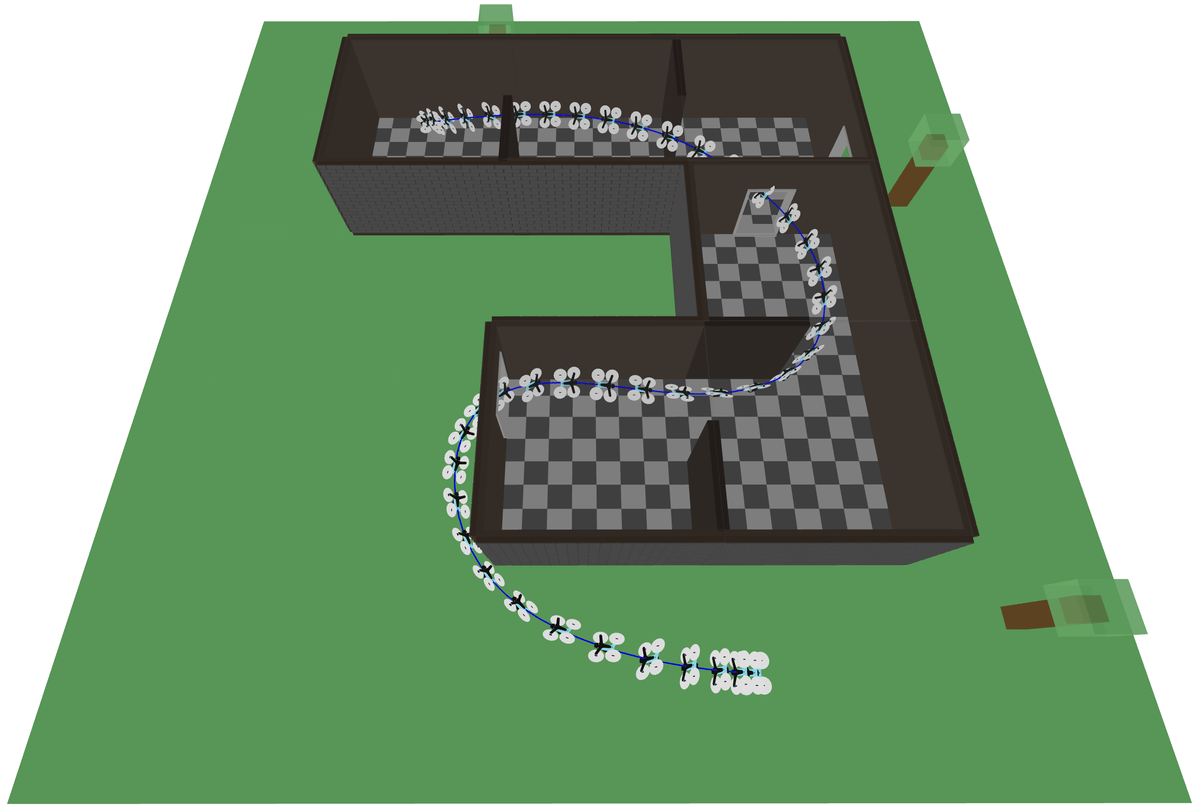
ACTOR is a good match for robot motion planning problems where you have a reasonable convex decomposition of free space and want smooth, dynamically feasible trajectories: quadrotor flight, mobile robot navigation, manipulator planning around obstacles. The authors demonstrate it on a quadrotor minimum-snap problem with velocity and acceleration bounds, showing convergence from a naive initial guess.
The honest caveats: there is no general guarantee that ADMM will converge to a globally optimal point for non-convex set constraints, and it must be considered a local optimization method. Completeness only holds in the unbounded case, meaning derivative bounds on velocity or acceleration can in principle render some paths infeasible without the solver knowing. The convex-hull property of Bezier curves also makes safety constraints conservative, so tight passages may require more segments than a nonlinear solver would need.
No public code release is mentioned in the paper. The reference implementation is in Python and NumPy, while the baselines use optimized C or C++, which makes the runtime advantage even more notable and suggests a compiled version could push the scaling story further.