
MIT and Harvard's RRC Framework Teaches AI to Pick Cheaper Moral Reasoning
A framework from MIT, Harvard, Google DeepMind and Stanford proposes that AI agents pick moral reasoning strategies the way humans do: matching effort to stakes.
 Pro
Takeaways
- Researchers propose Resource-Rational Contractualism, a framework where AI picks moral reasoning strategies based on stakes and compute budget.
- The toolbox spans actual bargaining, virtual bargaining, universalization, cached welfare weights, and simple rules.
- Framework formalized as maximizing Nash bargaining product minus mechanism cost across candidate strategies.
- Tested on DeepSeek R1, Gemini 2.5 Flash, o3, and o4-mini across 370 moral vignettes with gold labels.
- RRC prompting matches bargaining accuracy at a fraction of the tokens; gains largest for o4-mini.
- Code and vignettes released at mint-philosophy/RRC_experiments.
A group of researchers from MIT, Harvard, Stanford, Google DeepMind and ANU has put out a position paper arguing that AI alignment should stop chasing a single perfect moral objective and instead give models a toolbox of reasoning strategies to pick from, depending on how much compute the situation actually deserves. They call the framework Resource-Rational Contractualism (RRC), and they back it with a prompting experiment across four frontier reasoning models.
The core pitch is straightforward. Contractualist alignment proposes grounding decisions in agreements that diverse stakeholders would endorse under the right conditions, yet securing such agreement at scale remains costly and slow, even for advanced AI. RRC tries to bridge that gap by borrowing from cognitive science: humans don't renegotiate every social interaction from scratch, and neither should AI.
The problem with clean moral theories
Contractualism, in the philosophical sense, says the right action is whatever rational, self-interested parties would freely agree to if they could sit down and bargain. It has fans in political philosophy, moral psychology, and game theory because it avoids one party imposing values on everyone else. The trouble is operational: in complex, real-world cases where resource constraints are a live issue, determining what would be agreed to in such an idealized setting is seldom possible.
The authors argue this is a general blind spot in alignment research. Normative choices are frequently facilitated, hindered, or constrained by the technical feasibility of the alignment process, and every alignment process faces resource limitations on computation, time, capital, and data availability. Constitutional AI and Deliberative Alignment both improve behavior but pay a heavy compute tax to do so.
A toolbox, not a single algorithm
RRC organizes moral reasoning strategies along two axes. One axis is process: are you running an actual negotiation, simulating one, or just pulling a cached answer? The other is content: are you deliberating over this specific case, over general welfare trade-offs, or over abstract rules?

Composing those axes gives concrete mechanisms an AI agent could reach for:
- Actual bargaining - convening real stakeholders, like a citizens' assembly. Most accurate, most expensive.
- Virtual bargaining - simulating what affected parties would agree to, using models of their preferences.
- Modeling implied valuation - inferring the weight one agent implicitly places on another's welfare, then acting accordingly.
- Universalization - simulating a world where everyone follows a candidate rule and checking if that world is acceptable. This has shown promise in common-pool resource problems.
- Cached precedents - what SFT and RLHF already do, essentially: pattern-match to prior judgments.
- Cached welfare standards - pre-computed weights on different parties' interests.
- Cached action standards - simple rules. Cheapest, least flexible.
The interesting move is treating these as proxy alignment targets. Instead of always shooting for the ideal contract, the agent picks the mechanism whose expected accuracy minus compute cost is highest. The paper formalizes this using the Nash Bargaining Solution: maximize the product of everyone's utility gains from cooperating, minus the cost of the mechanism used to get there.
Does it actually work in an LLM?
To test the idea, the authors built two vignette sets. The first, 130 cases, adapts moral dilemmas from cognitive science experiments where a stranger offers money to damage a neighbor's property. The second, 240 cases, ports the same structure to AI-agent scenarios: for example, an AI research assistant deciding whether to access a colleague's archived file to unblock a grant deadline.
Each vignette has a gold label based on the mutual-benefit answer. Hard cases pit rule-following against mutual benefit (huge upside, tiny harm, unreachable stakeholder). Easy cases align them (trivial upside, significant harm).
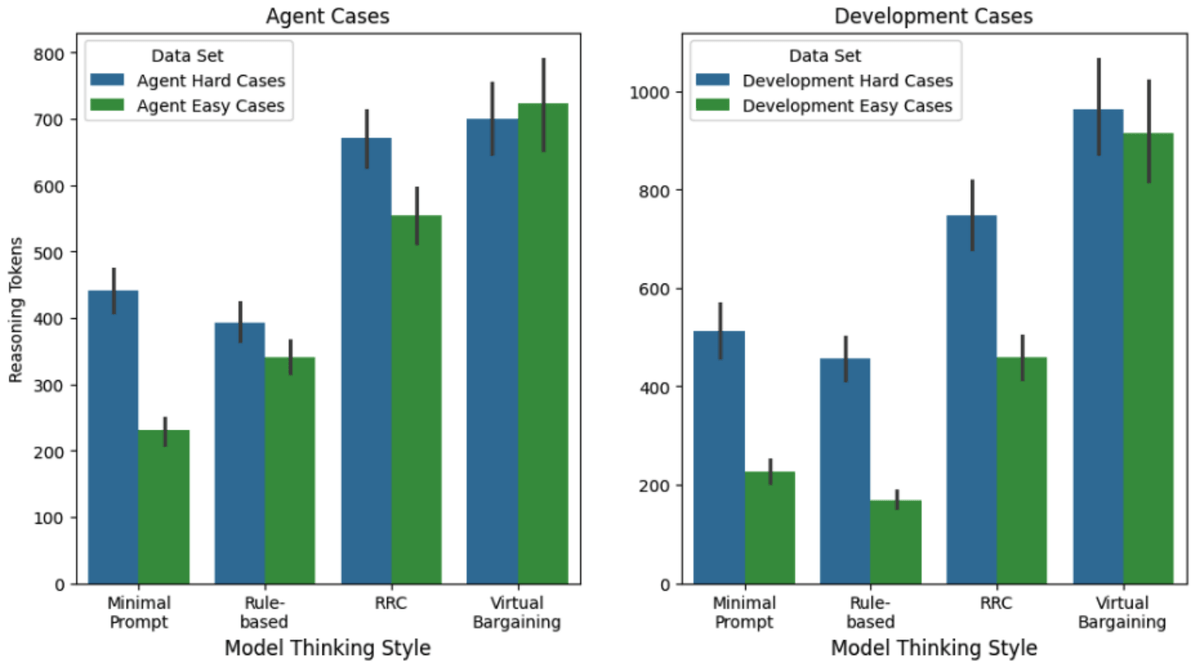
They then prompted DeepSeek R1, Gemini 2.5 Flash, OpenAI o3, and o4-mini with four strategies: minimal prompt, rule-based thinking, virtual bargaining, and an RRC meta-prompt that first asks the model to choose which strategy to use based on stakes and how unusual the situation is.

The pattern is clean:
- Rule-based is cheap on tokens but tanks on hard cases where the rule doesn't fit the situation.
- Simulated bargaining gets near-perfect accuracy but burns the most tokens on every case, including trivial ones.
- RRC prompting lands in between: it defaults to cheap rules on easy cases and escalates to bargaining when stakes rise.
- The gains from RRC prompting show up most in
o4-mini, the smallest model tested, hinting this is where cost-aware meta-reasoning matters most.
Code and data are on GitHub at mint-philosophy/RRC_experiments, including the vignettes, prompts, and token/accuracy stats.
What's actually new here
The real contribution isn't a new alignment algorithm. It's a reframing: treat moral reasoning as a meta-reasoning problem where the model picks the cheapest mechanism that still gets the right answer, and cache expensive reasoning outputs (like negotiated agreements) as rules for later reuse. Rules stop being immutable constraints and become compressions of prior bargains that can be renegotiated when the environment changes.
That framing lines up with practical trends in agentic AI. The paper explicitly suggests implementations via process-level supervision (in the spirit of Deliberative Alignment), AI debate protocols where debaters represent different stakeholders, neuro-symbolic architectures for verifiable mutual-benefit calculations, and RL with cost-aware reward functions that value both accuracy and efficiency.
Where it's shakiest
The experiment is a proof-of-concept, not a benchmark result. Token count is a rough proxy for compute (FLOPs would be better but aren't available for closed models). The vignette structure is narrow: rule-vs-benefit trade-offs with a single unreachable stakeholder. Bigger models like o3 already handle many hard cases well without RRC prompting, so the framework's value scales inversely with raw capability. And the mechanism-selection step is itself a prompt, not a learned policy, so there's no guarantee the model picks correctly in messier real-world scenarios.
Still, as a design principle for agentic systems that will have to arbitrate between conflicting interests at scale, treating alignment as a resource-rational selection problem rather than a fixed objective is a shift worth taking seriously. The alternative, running full deliberation on every decision, doesn't survive contact with production latency budgets.