
MirrorDrift Uses a Cheap Roadside Mirror to Push Robots 6 Meters off Course
Researchers show a swiveling planar mirror can quietly drift LiDAR SLAM by up to six meters, defeating a secure automotive LiDAR without any laser injection.
 Pro
Takeaways
- MirrorDrift attacks LiDAR SLAM using an actuated planar mirror, no laser injection required (paper).
- Induces up to 6.03 m localization error on Hesai AT-128, a production-grade secure automotive LiDAR.
- Optimized mirror placement increases average pose error by 6.1x versus random placement in simulation.
- Breaks three popular SLAM stacks: FAST-LIO2, KISS-ICP, and GLIM, including IMU-fused ones.
- Hardware is a planar mirror plus a Dynamixel MX-28 servo oscillating the yaw angle.
- First SLAM-targeted physical attack that defeats built-in LiDAR interference-mitigation defenses.
Physical attacks on LiDAR have historically meant one thing: firing precisely timed laser pulses at a sensor to inject fake returns. A new paper flips that assumption on its head. MirrorDrift shows that a cheap planar mirror, mounted on a servo and left by the roadside, can quietly corrupt LiDAR SLAM enough to push a robot meters off course, even when the LiDAR has state-of-the-art anti-spoofing hardware.
The framework, dubbed MirrorDrift, actively exploits specular reflections using an actuated mirror placed by an adversary, and requires no external signal injection while continuously disrupting scan matching through reflection-induced ghost points. That distinction matters because the security community has spent years hardening LiDAR against injection attacks; MirrorDrift sidesteps those defenses entirely by abusing the sensor's own laser pulses.
Why injection attacks are running out of runway
LiDAR SLAM systems estimate a robot's pose by matching consecutive point clouds, an operation that fundamentally assumes the geometry in front of the sensor is stable and truthful. Previous work, including the authors' own SLAMSpoof attack, has manipulated that assumption by injecting adversarial laser pulses into a victim LiDAR. But newer sensors fight back with timing obfuscation, pulse coding, and interference rejection.
Although not designed specifically for security, these mechanisms significantly increase the difficulty of signal injection attacks, and prior SLAM spoofing demonstrations have been limited to earlier-generation sensors. The MirrorDrift authors argue that mirrors offer a fundamentally different route: specular reflections from mirrors and glass generate virtual returns from the LiDAR's own emitted pulses, producing ghost points and point dropouts without any external signal injection, and because this phenomenon arises from the LiDAR's fundamental ranging process itself, it cannot be mitigated by interference rejection mechanisms designed to suppress external optical signals.

How a swiveling mirror bends a scan-matching pipeline
The core physics is straightforward. When a LiDAR beam hits a mirror, it bounces to whatever is behind the sensor's angular expectation, and the reported point ends up somewhere inside the virtual space behind the mirror plane. A stationary mirror already causes SLAM drift, but SLAM systems can partially absorb static errors because the geometry is consistent frame to frame. The attack becomes far more damaging when the mirror moves.
The mirror position and nominal orientation are optimized by maximizing an objective function, and to induce false point-to-point correspondences across frames, the mirror is periodically oscillated in the yaw direction. In other words, ghost points shift between scans, so when the SLAM front end tries to align frame N to frame N+1, it locks onto the wrong correspondences and computes a biased pose delta. Small biases compound into meters of drift.
MirrorDrift bundles three optimization knobs into a single framework:
- Placement. Where to put the mirror along the victim's path so the ghost points fall inside the SLAM system's active field of view and downsampling grid.
- Alignment. The nominal surface orientation that maximizes the reflection ratio of beams the SLAM front end actually uses.
- Actuation. A periodic yaw oscillation that keeps the false correspondences fresh across consecutive scans.
The hardware is unglamorous by design. The device actuates a planar mirror so that its yaw angle varies over time, and consists of a planar mirror, a Dynamixel MX-28 servo motor, and a mounting fixture. No custom laser rig, no timing circuits, no synchronization with the victim sensor.
Numbers that should worry anyone shipping LiDAR SLAM
The authors evaluate against three open-source SLAM stacks that dominate current research and deployments. They focus on scan-matching-based LiDAR SLAM because their attack directly targets the data association and registration process, evaluating on KISS-ICP as a LiDAR-only method, and FAST-LIO2 and GLIM as representative LiDAR-IMU fusion methods. Importantly, the LiDAR-IMU systems get attacked too, so an inertial measurement unit alone is not a get-out-of-jail card.
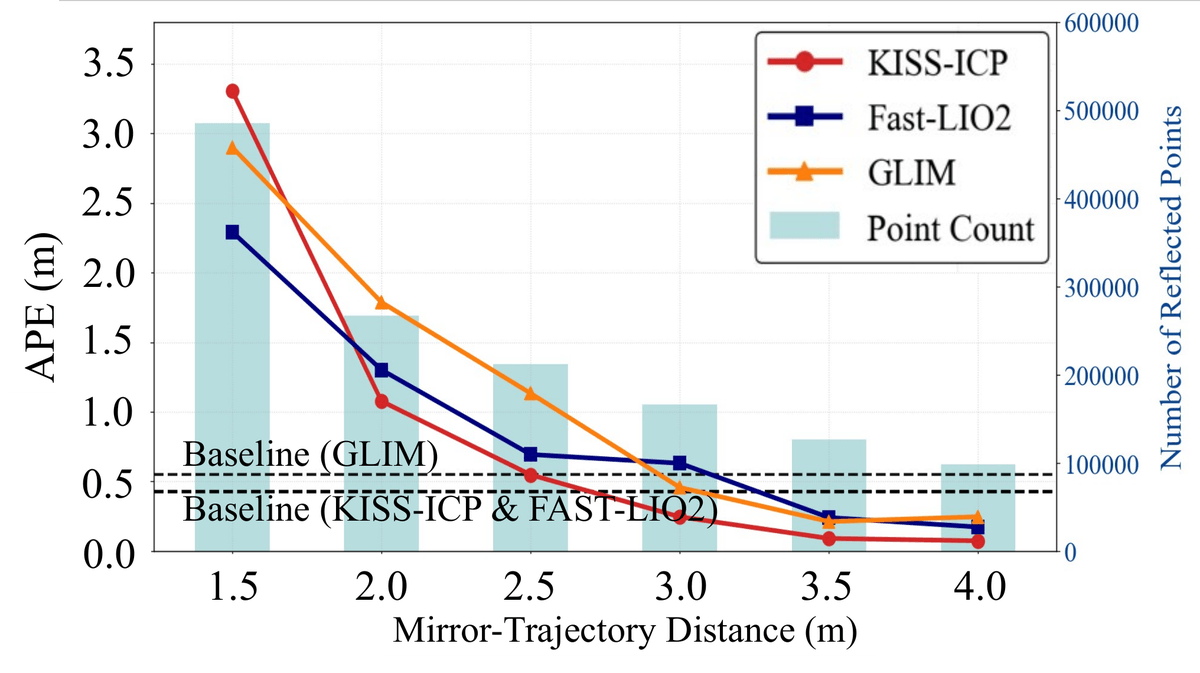
In simulation, they compare optimized placement against random placement and a no-mirror baseline. Compared to random placement, the optimized design increases the average pose error by 6.1x, and in real-world experiments the attack produces up to 6.03 m APE across three LiDAR SLAM algorithms on AT-128, a state-of-the-art automotive LiDAR with built-in interference mitigation, representing the first experimental SLAM-targeted attack against such secure LiDAR systems.

The simulator that powers the placement optimization was itself validated against real data. The team fixed a VLP-32c, placed a 1.0 m by 0.4 m planar mirror vertically on the floor with its center aligned to the LiDAR height, captured a reference point cloud with the mirror present, then removed the mirror and applied the simulator to the background to yield a simulated point cloud. The reference and simulated clouds closely overlap, yielding a Chamfer Distance of 0.028176 m. That fidelity is what lets the attacker search placement offline before deploying the mirror.
What this actually breaks, and what it does not
The realistic threat is not obvious phantom obstacles that trigger emergency braking. It is quiet, sustained localization drift. A delivery robot that thinks it has traveled three meters when it has actually traveled five will miss a curb, cross a lane boundary, or hand off waypoints incorrectly. Across three widely used LiDAR-SLAM algorithms, the attack induced at least 3.4 m localization error, causing severe trajectory deviations that pose a critical safety risk.
A few honest limitations sit under the results:
- The attack presumes the adversary can place a physical mirror on or near the victim's path, which is easier for delivery robots and warehouse AGVs than for highway vehicles.
- Evaluations use fixed routes; success in arbitrary, feature-rich urban environments has not been shown.
- Defenses that fuse LiDAR with camera or radar, or that explicitly detect specular surfaces, are not deeply studied here.
The real breakthrough
Beyond the headline numbers, MirrorDrift moves the SLAM security conversation past a comfortable assumption. Vendors have been treating interference rejection and pulse coding as the endgame for LiDAR attacks. This work shows that the geometry of specular reflection, which is baked into how ToF LiDAR works, is a channel those defenses cannot close. Any hardening story now has to include mirror-aware perception, whether that means detecting reflective surfaces during mapping, tagging specular risk zones, or requiring cross-sensor consistency checks before trusting scan-matching updates.
The paper does not appear to release attack code, which is arguably the responsible choice for offensive robotics research. But the mirror-reflection simulator and the placement objective are described in enough detail that defenders can reproduce the setup and start benchmarking countermeasures against a threat model that, until now, most SLAM stacks were not built to survive.