
MiroMind's MiroThinker-H1 Beats OpenAI and Anthropic With 43% Fewer Steps
MiroMind's new research agent family verifies its own reasoning at every step, hitting 88.2% on BrowseComp while using fewer interaction rounds.
 Pro
Takeaways
- MiroMind released MiroThinker-1.7 and H1, research agents built for long multi-step reasoning tasks.
- MiroThinker-H1 hits 88.2% on BrowseComp using local plus global verification during inference.
- Open-source 30B and 235B checkpoints ship under Apache 2.0 with 256K context.
- Mini model gets 16.7% better performance with 43% fewer interaction rounds versus MiroThinker-1.5.
- Four-stage pipeline: mid-training, supervised fine-tuning, preference optimization, reinforcement learning on tool use.
- Code and models on GitHub; supports up to 300 tool calls per task.
A new research agent family from MiroMind is betting that the path to reliable long-horizon reasoning is not longer chains of thought, but better ones. MiroThinker-1.7 and MiroThinker-H1 introduce a verification layer that audits reasoning both step-by-step and end-to-end, producing a system that reaches more accurate answers with fewer tool calls than its predecessors.
MiroThinker-H1 posts state-of-the-art scores on deep research benchmarks in both English and Chinese, and the open-source siblings ship at 30B and 235B parameters under Apache 2.0. The release claims wins over frontier systems from OpenAI, Anthropic, and Google DeepMind on BrowseComp, BrowseComp-ZH, and FrontierScience benchmarks.
Why more tool calls stopped helping
Research agents that browse the open web, run code, and chain tools together tend to fail in a predictable way: current agent frameworks often accumulate noise and propagate errors when scaling reasoning trajectories, leading to degraded solution quality if intermediate steps are inaccurate. Each additional turn is a fresh opportunity for the model to misread a search result, pick the wrong tool, or hallucinate a citation. Once an error enters the trajectory, downstream steps compound it.
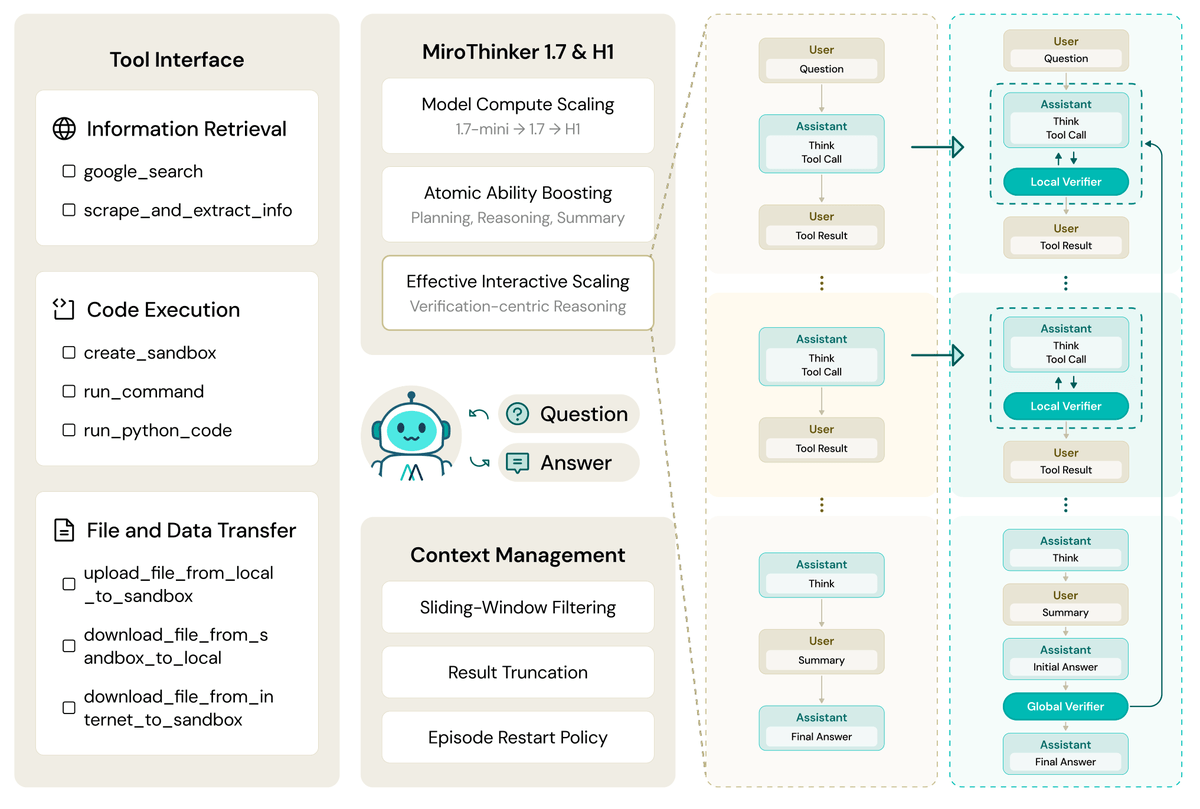
MiroMind frames this as a distinction between interaction quantity and interaction quality. Rather than simply scaling model size or training compute, MiroThinker introduces an approach called Effective Interaction Scaling, improving the quality and reliability of every reasoning step rather than blindly increasing the number of steps. The claim is backed by a striking efficiency result: compared to the prior-generation MiroThinker-1.5, MiroThinker-1.7-mini achieves 16.7% better performance with 43% fewer interaction rounds on average over five benchmarks.

A four-stage training pipeline
The base model, MiroThinker-1.7, gets its reliability from a new mid-training stage inserted before the usual fine-tuning steps. This is where the model learns agent-native skills, planning, tool selection, response interpretation, and summarization, on large volumes of synthetic data before any preference or reinforcement learning kicks in. The full pipeline runs in four stages:
- Mid-training with atomic reliability. Synthesized data covering planning, reasoning, and summarization across diverse task domains, aimed at making each individual step in an interaction more grounded.
- Supervised fine-tuning for trajectory coherence. Shapes the atomic behaviors from stage one into consistent long-chain sequences.
- Preference optimization for behavioral alignment. Pushes the model toward preferred agentic behaviors over alternatives.
- Reinforcement learning for real-world generalization. Final polish for handling out-of-distribution web content and tool responses.

MiroThinker-1.7 comes in two open-source sizes (30B and 235B parameters, Apache 2.0) trained with an agentic mid-training stage that teaches structured planning, contextual reasoning, and tool use across a 256K context window with up to 300 tool calls per task. That 300-tool-call budget is what makes tasks like deep literature surveys or multi-source financial analysis feasible in a single agent run.
The verifier that watches the reasoner
MiroThinker-H1 is the flagship system built on top of 1.7. It adds what MiroMind calls a heavy-duty reasoning mode, structured around a two-level verifier operating during inference:
- Local verification evaluates and refines intermediate reasoning decisions as they happen, so the agent can catch a bad tool call or misread page before it poisons the rest of the trajectory.
- Global verification audits the full chain of evidence before the model commits to a final answer, checking that the conclusion is actually supported by what was gathered along the way.
The design philosophy is that the reliability of reasoning ultimately depends on the system's ability to examine its own reasoning process, with the verifier serving as the key component throughout. Counterintuitively, layering in verification does not slow the agent down. Because the verifier filters out steps that produce no information gain, the H1 mode concentrates compute on interactions that actually advance the solution, resulting in shorter trajectories on average.
Benchmark results
The headline number is on BrowseComp, an open-web research benchmark. MiroThinker-H1 scores 88.2% on BrowseComp by verifying its reasoning locally and globally. The open-source 235B model, without the heavy-duty verifier, is no slouch either: the 235B model scores 74.0% on BrowseComp, 75.3% on BrowseComp-ZH, and 82.7% on GAIA-Val-165. Even the smaller 30B mini variant reaches 72.3% on BrowseComp-ZH.

Performance holds up outside general web browsing. The flagship agent MiroThinker-H1 achieves state-of-the-art performance on deep research as well as specialized scientific and financial benchmarks, including FrontierScience-Olympiad and FinSearchComp. The MiroMind team also published sample runs where the agent predicted a February 2026 gold price within 0.08% error 15 days ahead, and correctly called the Super Bowl LX winner a month in advance.
What it is good for, and what it is not
The strongest use cases are the ones MiroMind targeted directly: literature reviews, financial due diligence, competitive analysis, and any workflow where an agent must gather evidence from many sources and defend a conclusion. The verifier design is specifically aimed at cutting hallucinated reasoning chains, so tasks where a wrong-but-confident answer is worse than a slower correct one benefit most.
The tradeoffs are also worth understanding. Heavy-duty mode is exactly that, heavy-duty. It is a solver built for deliberate, long-chain work, not for the low-latency chat use cases where quick, plausible answers are enough. And while the open-source 1.7 checkpoints are permissively licensed, the H1 verification system itself remains proprietary to MiroMind. If you want the 88.2% BrowseComp behavior, you go through their platform; if you want to run locally, you get the 74.0% open-source version, which is still competitive with much larger closed systems.
Why the broader shift matters
The interesting story here is not really the leaderboard numbers. It is that a mid-sized team has produced a research agent that beats frontier lab systems by explicitly refusing the scale-more-tokens playbook. Two design choices carry the weight: making the base model reliable at the atomic step level through mid-training, then wrapping inference in a verifier that questions every decision. By verifying decisions at both the local step level and the global trajectory level, the system reasons more like a careful human expert than a stochastic text predictor.
For anyone building agentic systems on top of open models, the takeaway is architectural rather than parametric. The gains here come from where verification lives in the loop and how mid-training shapes agent primitives, both of which are reproducible ideas that do not require frontier-scale compute to try.