
Mirai Trains AR Image Models 10x Faster Without Changing Inference
A new training framework injects future-token signals into autoregressive image models, cutting convergence time by up to 10x with zero inference cost.
 Pro
Takeaways
- Mirai adds a foresight loss to AR image training, aligning hidden states to future tokens without changing inference.
- Two variants: Mirai-E uses the model's own EMA, Mirai-I uses frozen DINOv2 features.
- Cuts LlamaGen-B FID from 5.34 to 4.34 on ImageNet 256x256 class-conditional generation.
- Up to 10x faster convergence for Mirai-I, 5x for Mirai-E versus the LlamaGen baseline.
- Aligning on the 2D grid beats 1D raster order; injecting at layer 8/12 works best.
- Accepted at CVPR 2026; naive multi-token prediction at the output head actually hurts.
Autoregressive image generators like LlamaGen borrowed a trick from language modeling: turn an image into a sequence of discrete tokens and train the model to predict the next one. It works, though not as well as diffusion, and training is famously slow. A new paper argues the reason is philosophical as much as technical, and proposes a fix that leaves the model architecture and inference loop untouched while dramatically speeding up training.
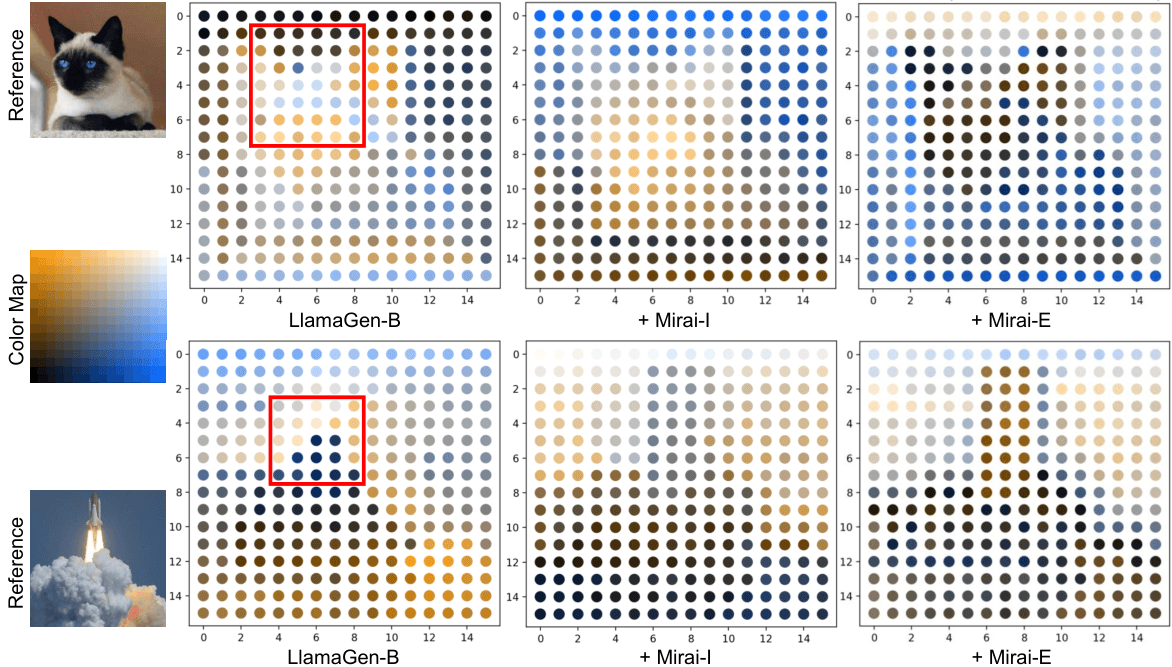
The method is called Mirai (Japanese for "future"), and its central claim is that purely causal supervision constrains global consistency and slows convergence. The authors show that letting the model peek at future tokens during training, but never at inference, produces sharper, more globally coherent images and shaves off most of the compute budget.
Why next-token prediction breaks on pixels
In language, next-token prediction works because text is roughly one-dimensional and locally coherent. Images are not. When you flatten a 2D image into a raster-scan sequence of VQ-GAN codes, two tokens that sit next to each other on the grid can be dozens of positions apart in the sequence. The authors point out that the parrot generated by the LlamaGen-B baseline exhibits an unnatural pose with a disconnected head, exactly the failure mode you would expect from a model that only sees one token ahead.
The paper frames this as a missing training-time signal called foresight: any auxiliary supervision that depends on future-side tokens. The idea is to change what hidden states are asked to represent during training, while decoding remains strictly left-to-right at inference.
Three design decisions that actually matter
Before proposing a method, the authors run controlled diagnostics along three axes to figure out what actually helps. The findings are more interesting than the final method: