
Minnesota Researchers Reveal Who Actually Benefits When Clinical Trials Show Nothing
A new framework brings doubly robust, ML-compatible estimators to heterogeneous complier causal effects, revealing who actually benefits from treatment and why
 Pro
Takeaways
- Researchers introduce a framework for estimating heterogeneous treatment effects within principal strata (compliers, never-takers, always-takers) using the principal ignorability assumption instead of the exclusion restriction.
- Four estimators are proposed: a T-learner baseline, a doubly robust subset estimator, an EIF-based estimator, and a one-step estimator -- all compatible with cross-fitting and flexible ML methods.
- The one-step estimator achieves the same robustness as the EIF approach but is more numerically stable, requiring only a two-stage pipeline; the EIF estimator struggles in small samples (n<2000).
- Applied to the Camden Coalition hotspotting RCT, the framework shows that while the overall ATE is null, 75.3% of compliers are estimated to benefit, with prior hospitalizations and sex as key effect modifiers.
- Simulations confirm robustness: subset and one-step estimators remain consistent under partial nuisance misspecification; the T-learner fails when outcome models are wrong.
- No public code is released; the framework is currently limited to binary intermediate variables, with continuous extensions noted as future work.
When a randomized trial reports a null result, the story is rarely over. The Camden Coalition's hotspotting program -- an intensive care management intervention for high-cost hospital patients -- showed no average benefit on readmissions. But a secondary analysis revealed that patients who actually engaged with the program did benefit. The question that remained unanswered: is that because engagement selects for people who would benefit anyway, or because the program genuinely works differently for different people? A new paper from researchers at the University of Minnesota tackles exactly this problem, introducing a rigorous framework for estimating heterogeneous principal causal effects -- treatment effect variation within latent compliance subgroups.
The hidden structure inside every trial
In any randomized trial where participants can comply or not comply with their assigned treatment, the population splits into latent groups called principal strata. These compliance types -- compliers, always-takers, never-takers, and defiers -- are determined by the joint potential compliance behaviors under both control and treatment groups, and are predetermined before randomization, which permits defining causal effects within subpopulations partitioned by compliance types. The key insight is that these strata are defined by potential behavior, not observed behavior, so you can never directly see who belongs to which group.
The standard approach estimates one number per stratum -- the Complier Average Causal Effect (CACE), also called the Local Average Treatment Effect (LATE). When treatment non-compliance is present in RCTs, the CACE is a more representative measure of treatment efficacy than the average treatment effect. But a single average hides everything interesting: does the program work uniformly well for all compliers, or does it work brilliantly for some and not at all for others? The new paper by Zhang, Doss, and Huling estimates the full Conditional Principal Causal Effect (CPCE) -- the treatment effect as a function of individual covariates, within each stratum.
Why this is hard
Estimating heterogeneous effects within principal strata is harder than standard heterogeneous treatment effect (HTE) estimation for a fundamental reason: stratum membership is never observed. You can observe whether someone took the treatment, but you cannot observe what they would have done under the counterfactual assignment. This creates a latent mixture problem.
The dominant workaround has been the exclusion restriction (ER) assumption from instrumental variable (IV) methods, which says that treatment assignment only affects outcomes through actual treatment receipt. But ER is often implausible. In the hotspotting trial, patients knew their assignment -- the trial was not double-blinded -- making ER a stretch. The authors instead adopt principal ignorability (PI), which assumes that observed baseline covariates are rich enough to explain away any dependence between stratum membership and potential outcomes. Under PI, the latent mixture problem collapses into an observed one.
Formally, PI requires:
- The mean potential outcome under treatment is the same for always-takers and compliers, conditional on covariates X
- The mean potential outcome under control is the same for never-takers and compliers, conditional on X
This is a strong but often more defensible assumption than ER, especially in unblinded trials or observational studies with rich covariate data.
Four estimators, a spectrum of robustness
The paper's core contribution is a suite of four estimators for the CPCE function, each with different robustness guarantees. Robustness here means: how many of the nuisance models (propensity score, principal scores, outcome regressions) can be wrong before the estimator breaks?
The key identification result (Theorem 2.1) shows that under PI and monotonicity, the CPCE for each stratum reduces to a simple contrast of observed conditional means:
- Compliers (U=10): τ¹⁰(x) = μ₁₁(x) − μ₀₀(x)
- Never-takers (U=00): τ⁰⁰(x) = μ₁₀(x) − μ₀₀(x)
- Always-takers (U=11): τ¹¹(x) = μ₁₁(x) − μ₀₁(x)
where μ_zs(x) = E[Y | Z=z, S=s, X=x] is the outcome mean in each observed (treatment, intermediate) cell. This is analogous to how the CATE equals the difference of treated and control outcome means under standard ignorability.
Building on this, the four estimators are:
- T-learner: Directly plugs in estimated μ_zs functions and takes their difference. Simple, but sensitive to model misspecification and group imbalance.
- Subset estimator: Applies the DR-learner of Kennedy (2023) to a specific observed subset of the data for each stratum. Achieves double robustness -- consistent if either the subset propensity score or the outcome regression is correctly specified.
- EIF estimator: Uses the full efficient influence function (EIF) for principal causal effects over the entire dataset. Theoretically appealing but requires a three-stage estimation procedure and is numerically unstable in small samples.
- One-step estimator: Starts from a preliminary estimate (e.g., the T-learner) and applies an influence-function correction. Achieves the same robustness as the EIF estimator but is more stable in practice, requiring only a two-stage procedure.

The robustness hierarchy is subtle. The subset and one-step estimators are consistent if either the outcome models are correct or the score models (propensity + principal scores) are jointly correct. This is a form of double robustness even though three nuisance functions appear in the problem. Full triple robustness -- where any two of three nuisances can be wrong -- is only achievable for the marginal PCE, not the conditional CPCE.
How it works, step by step
For the subset and one-step estimators, estimation follows a two-stage cross-fitted pipeline compatible with any ML method:
- Stage 1 (nuisance estimation): Estimate the propensity score π(x), principal scores p₁(x) and p₀(x), and stratum-specific outcome regressions μ_zs(x) using one fold of data. Any flexible learner works here -- random forests, gradient boosting, LASSO, GAMs.
- Stage 2 (pseudo-outcome regression): Construct a doubly-robust pseudo-outcome for each unit using the Stage 1 estimates, then regress it on covariates X using a held-out fold. The resulting function is the estimated CPCE.
The EIF estimator requires a three-way split: one fold for nuisances, one for the denominator regression, and one for the final pseudo-outcome regression -- which reduces effective sample size per fold and makes cross-fitting less convenient.
Pointwise confidence intervals follow naturally: because the plug-in bias term is asymptotically negligible relative to the oracle regression error under smoothness conditions, standard errors from the second-stage regression are valid for inference.
Simulations confirm the theory
The authors test all four estimators across four nuisance misspecification regimes: all correct, only scores correct, only outcomes correct, and all wrong. Key findings:
- The T-learner fails whenever outcome models are misspecified
- The subset and one-step estimators remain consistent under partial misspecification, matching theory
- The EIF estimator has high variance at small sample sizes (n=1000) but catches up at larger n
- When all models are misspecified, subset and one-step still outperform the alternatives

A third simulation study reveals an important practical trade-off: when observed subsets are highly unbalanced (e.g., 69 units with (Z=0,S=1) vs. 535 with (Z=1,S=1)), the subset estimator degrades while the one-step estimator remains stable. This makes the one-step estimator the safer default in real-world settings.
Applied to the hotspotting trial
The methods are applied to the Camden Coalition Healthcare Hotspotting RCT, which randomized 774 superutilizer patients to intensive follow-up or standard care, with 30-day hospital readmission as the outcome. The overall ATE was estimated at -0.025 (95% CI: -0.087, 0.038) -- essentially null, consistent with the original trial report. The complier average treatment effect, however, was -0.078 (95% CI: -0.163, -0.004), a modest but statistically significant reduction in readmissions among compliers.
The CPCE analysis goes further, revealing substantial individual-level variation even within the complier stratum:
- 75.3% of compliers have negative unit-level effect estimates (i.e., estimated to benefit)
- ~8.9% have significantly negative effects; only 0.13% have significantly positive effects
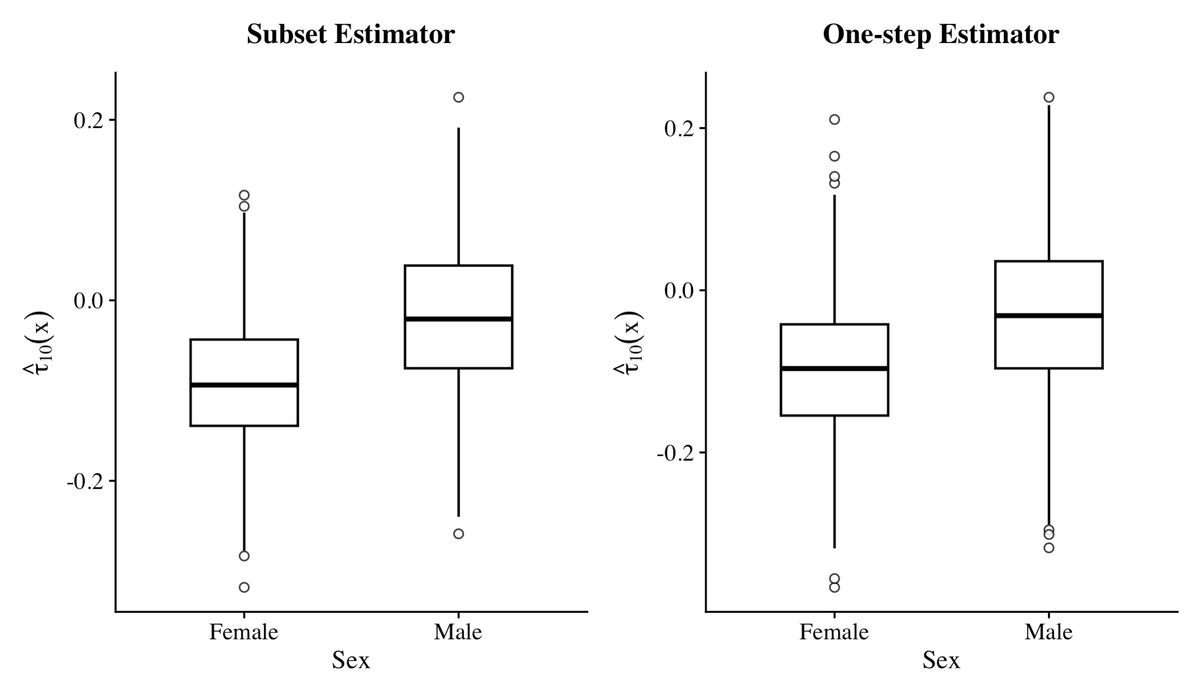
- The top predictors of heterogeneity are prior inpatient admissions in the past 180 days, length of the index hospital stay, and sex
- Female compliers show larger estimated benefits than male compliers, consistent with prior engagement analyses
- Education level, previously linked to engagement, shows no significant effect on the CPCE once compliance is established

This decomposition is precisely what the framework is designed to deliver: it separates heterogeneity in who engages from heterogeneity in how well the treatment works for those who do engage.
What it can't do (yet)
The framework has real limitations worth noting:
- Binary intermediate variables only: The current theory requires S ∈ {0,1}. Extensions to continuous post-treatment variables are flagged as future work.
- Principal ignorability is untestable: Like all identifying assumptions in this literature, PI cannot be verified from data alone. The framework is only as credible as the richness of the covariate set.
- High-dimensional regimes: The smoothness-based error bounds degrade in high dimensions (the curse of dimensionality). The paper provides theory for this regime but does not fully solve it.
- No code release: No public implementation is currently available alongside the paper, though the methods are compatible with standard R packages (grf, SuperLearner, tmle).
For practitioners working on trials with non-compliance -- job training programs, public health interventions, digital product experiments -- this framework offers a principled path from "the average effect is null" to "here is who benefits and why." The one-step estimator in particular is a practical workhorse: it is stable, ML-compatible, and robust to the kinds of model misspecification that are unavoidable in real data.