
Minnesota and Princeton's Robot Routes Cables Through Clips at 92% Success
A robot combines GPT-5 for high-level planning with reinforcement learning for cable insertion, hitting 92% success on multi-clip routing tasks.
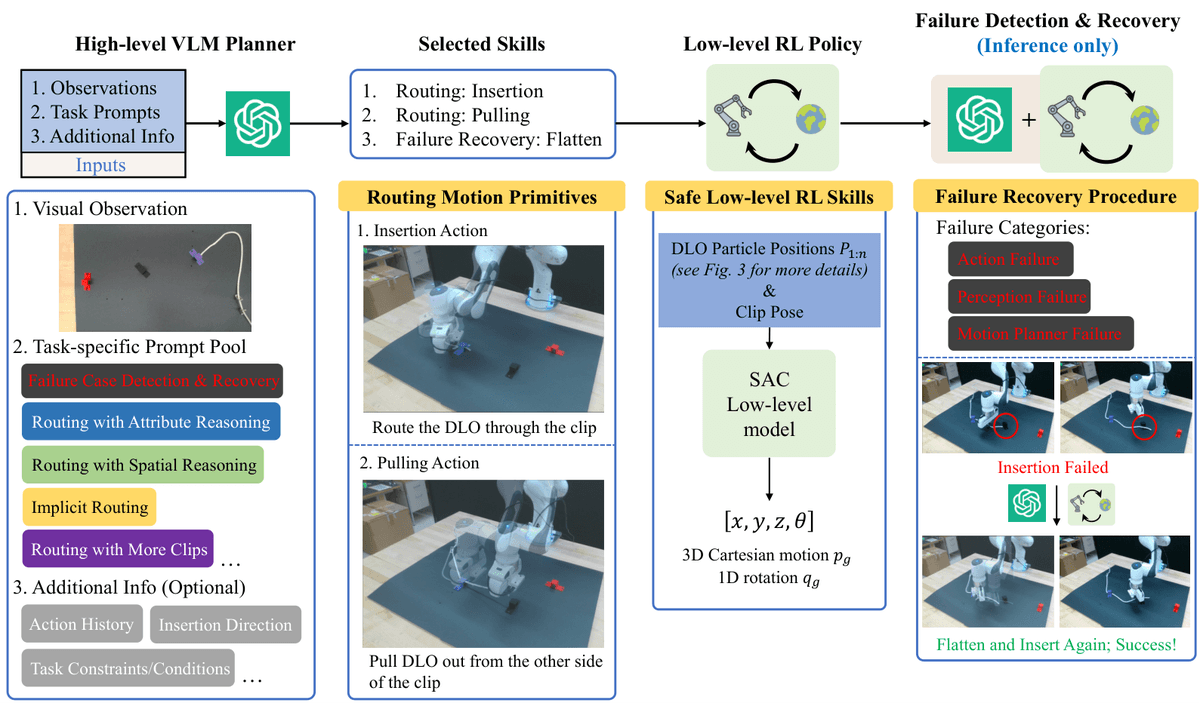
Takeaways
- Hierarchical framework combines GPT-5 planning with RL insertion, hits 92% on cable routing.
- Three skills: RL-trained Insert (SAC), plus predefined Pull and Flatten motion primitives.
- Failure recovery via Flatten reorients twisted cables back into an insertable state automatically.
- Generalizes from 3-clip to 5-clip scenes and to implicit language goals.
- Real-world Franka Panda achieves 62.5% success versus 37.5% for fixed-order baseline.
- See project page for videos; no code released yet.
Getting a robot to snake a cable through a series of clips on a desk sounds trivial until you actually try it. Cables twist, sag, and refuse to stay where you put them, and a single misaligned insertion can cascade into a stuck state that no amount of retrying will fix. A team from the University of Minnesota and Princeton has built a hierarchical framework that pairs a vision-language model with a reinforcement learning policy to solve exactly this problem, hitting an overall success rate of 92% across long-horizon routing scenarios.
The setup targets deformable linear objects (DLOs), the research term for anything rope-like. These show up everywhere from surgical tools to automobile wiring harnesses, where wires and signal lines must be routed along predefined paths within a vehicle frame while avoiding sharp bends and minimizing tension. Prior work either handled short single-skill tasks or leaned on imitation learning that collapsed the moment the scene changed.
Splitting the brain from the hands
The core idea is a clean separation of concerns. A VLM handles semantic reasoning like which clip comes next and whether the cable is stuck, while a learned low-level policy handles the millimeter-scale insertion motions where a bad decision could damage the cable or the clips.