
MINE Ditches Bayesian Weights to Make Physics Simulators 30,000x Faster
A new framework called MINE moves uncertainty quantification out of the neural network and into an offline MCMC step, cutting simulation cost dramatically.
 Pro
Takeaways
- MINE decouples Bayesian uncertainty from network design by using offline MCMC on the physics simulator instead of sampling neural network weights.
- Two emulators are provided: a pinball-loss quantile network for interval estimates and AEODE, an autoencoder ODE forward emulator.
- AEODE uses learnable frequency time embeddings and attention, hitting MSE of 2.450e-5 versus 3.231e-5 for Torchdiffeq.
- On FaIR climate model, the quantile emulator delivers 90.04% coverage and runs in 0.0006s versus 20s for Monte Carlo.
- Paper includes a Wasserstein-based stability theorem bounding deployment risk from MCMC chain approximation error.
- No public code released; framework assumes offline MCMC on the simulator is feasible for a given problem.
A research team from Lappeenranta-Lahti University of Technology and Frankfurt University of Applied Sciences has proposed a way to build fast neural surrogates for physical simulators that still carry principled uncertainty estimates, without any of the usual Bayesian machinery inside the network itself. The paper introduces MINE (MCMC Informed Neural Emulator), a paradigm that separates uncertainty quantification from network architecture entirely.
The trap with Bayesian neural nets
Neural emulators are increasingly used as cheap stand-ins for expensive physics or chemistry simulators. The standard way to add uncertainty estimates is a Bayesian Neural Network (BNN), which treats every weight as a random variable and samples from a posterior over weights. While powerful, BNNs can be difficult to scale: the weight space is high-dimensional, selecting informative priors is non-trivial, and approximate posteriors may yield miscalibrated uncertainty, especially in regimes with limited data or model misspecification.
The alternative, brute-forcing training data by sweeping parameter grids, blows up combinatorially. Consider a simulator with a runtime of one second and 20 parameters, each discretized into 10 values. A brute-force grid would require 10^20 simulator evaluations, i.e., approximately 3 x 10^12 years. Most of those evaluations would land on physically implausible parameter combinations anyway.
Sample the physics, not the weights
MINE flips the workflow. Instead of putting uncertainty inside the network, the authors run Markov chain Monte Carlo offline on the physical simulator to get a posterior distribution over the model's physical parameters. Training data for the neural emulator is then drawn from that posterior, so the network only ever sees parameter combinations that are statistically consistent with real observations.
The upshot: a posterior chain with 10^5 simulator evaluations takes on the order of a day (about 28 hours at one second per evaluation), which is tractable, and the surrogate that comes out inherits the same uncertainty behavior as the underlying physical model. They use DRAM (Delayed Rejection Adaptive Metropolis) for the sampling, which adapts its proposal covariance on the fly.
The framework is architecture-agnostic, and the authors provide two concrete instantiations:
- Quantile emulator: a small feed-forward net (two hidden layers, 20 units) trained with a pinball loss plus a non-crossing regularizer. It directly outputs the 5% and 95% quantiles of the posterior predictive distribution, so you get interval estimates with a single forward pass.
- AEODE forward emulator: a novel autoencoder-based neural ODE that maps parameters and initial conditions straight to full solution trajectories on a fixed time grid, without step-by-step integration.
Inside AEODE
AEODE takes the neural operator route rather than the classical Neural ODE route. It uses an encoder-decoder pair around a latent representation, with two design choices that matter:

- Learnable frequency time embedding: time steps are projected into a higher-dimensional space using sine and cosine functions with learnable frequencies, which lets the network capture oscillatory dynamics like chemical reactions.
- Time-conditioned attention: the latent trajectory is built by attention over time-embedded latent states, which the authors interpret as learning a data-driven approximation to the propagator kernel of the underlying dynamics.
Training uses MSE plus first- and second-order derivative losses, an identity loss on the autoencoder, and a total-mass conservation term to enforce physical consistency.
Numbers that matter
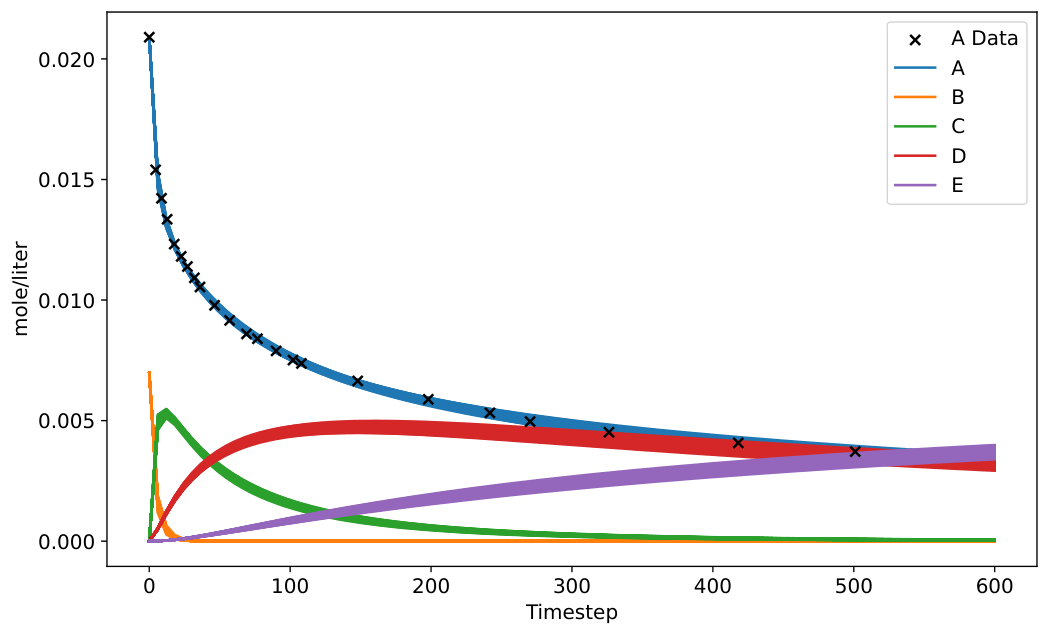
The authors test on two systems: a six-species chemical kinetics ODE (the Himmelblau problem) and the FaIR simple climate model, which has 20 physical parameters and drives global temperature projections from greenhouse gas emissions.
On the FaIR quantile emulator, the coverage matches the target almost exactly: the mean 90% coverage was 90.04%. The average interval size of the empirical test data was 1.2907, and the average interval size of the Neural Network was 1.3024, scoring an absolute difference of 0.0117. Runtime is where it really pays off, with the feed-forward quantile emulator running in 0.0006 seconds versus roughly 20 seconds for the equivalent empirical sampling at 5,000 draws.
For AEODE on the chemical kinetics problem, the paper reports it beats two established baselines on error metrics:
| Method | MSE (10^-5) | MAE (10^-3) | Runtime (10^-5 s) |
|---|---|---|---|
| Torchdiffeq | 3.231 | 3.552 | 5.1 |
| ChemiODE | 2.582 | 3.356 | 8.2 |
| AEODE (this work) | 2.450 | 3.064 | 9.5 |
Overall, AEODE achieves roughly a 10x speedup versus conventional numerical solvers, thanks to its end-to-end differentiable, GPU-optimized design.
What is genuinely new
The theoretical contribution is a Wasserstein-based stability bound that ties deployment risk to training risk plus an explicit penalty proportional to the 2-Wasserstein distance between the training distribution and the deployment distribution. Practically, that gives you a quantitative story for why finite MCMC chains converge to the ideal deployment behavior, and how much performance you lose when the chain is short.

When to reach for it
MINE is most useful when the simulator is expensive but MCMC on it is still feasible, when the physical parameters have meaningful priors or constraints, and when you need low-latency uncertainty summaries at inference time, such as financial climate risk portfolios that need real-time posterior intervals across many scenarios.
It is less useful when the simulator is so expensive that even offline MCMC is out of reach, in which case you would need multi-fidelity or surrogate-assisted sampling on top. AEODE also had trouble reproducing a sharp spike in the posterior distribution of one chemical species, which the authors flag as an open issue. No public code release is mentioned in the paper.