
Mindverse Computing's PhasorFlow Bridges Classical AI and Quantum Computing on Ordinary Hardware
A new open-source library encodes data as complex phasors on the unit circle, borrowing unitary math from quantum computing but running on regular CPUs.
 Pro
Takeaways
- PhasorFlow is a new open-source Python library that computes on the unit circle using unitary gates, available on GitHub.
- Inputs are encoded as complex phasors
exp(iθ), then processed through a 22-gate library across four categories. - Ships three primitives: Phasor Circuits, Variational Phasor Circuits (VPC), and a Phasor Transformer with DFT-based token mixing.
- VPC matches dense baselines on EEG motor-imagery tasks with a fraction of the parameters, per the paper.
- Authors admit VPC hits a parity ceiling and the Phasor Transformer is competitive but not superior to attention.
- Best fit is oscillatory data: biosignals, finance, climate, neuromorphic tasks, industrial telemetry.
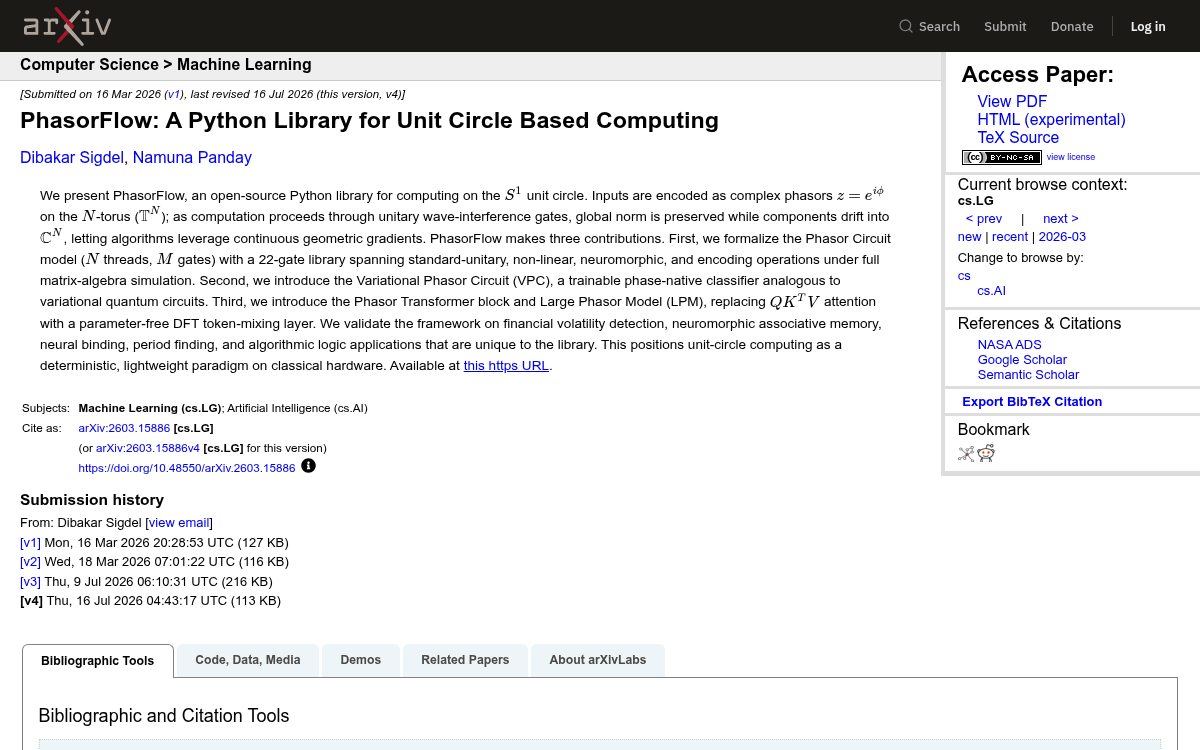
A new open-source Python library called PhasorFlow proposes a third computational paradigm that sits between classical deep learning and quantum simulation. Instead of pushing real-valued tensors through dense matrix multiplies, it represents every input as a point on the unit circle, a complex number of the form z = exp(iθ), and evolves the state through unitary wave-interference gates on classical hardware.
The library, released alongside an arXiv paper by Dibakar Sigdel and Namuna Panday of Mindverse Computing, is a bet that a lot of real-world data, such as EEG signals, financial volatility, and time series, is fundamentally oscillatory and would be better modelled by geometry that is oscillatory too.
Why bits and qubits leave a gap in the middle
Classical digital computers operate on discrete bits, points on a zero-dimensional manifold, while qubits live on a complex projective line that supports superposition and entanglement through unitary operations on exponentially scaling Hilbert spaces. The authors argue there is useful territory in between: a continuous, one-dimensional manifold (the unit circle S^1) that is richer than a bit but far cheaper than a qubit.
The motivation is not purely aesthetic. Many natural and artificial systems are inherently oscillatory or cyclical, which makes traditional Euclidean representations less effective, and continuous dynamical systems often present complex periodic boundary interactions that are difficult to isolate with standard dense linear layers. Phase, frequency coupling, and synchronization tend to appear as emergent artifacts inside a neural net rather than as first-class state variables.
How a phasor circuit actually runs
PhasorFlow borrows its programming model from quantum SDKs. It adopts a circuit-based programming model in which a user defines a circuit of M gate operations, taking design inspiration from Qiskit, but unlike quantum simulators, PhasorFlow circuits are evaluated analytically through direct matrix multiplication, yielding deterministic outputs without sampling noise.
The mechanics roughly work like this:
- Encode each input feature as a phasor
z_k = exp(iφ_k)on the N-torusT^N, one thread per input dimension. - Apply a sequence of unitary gates. Global norm is preserved while individual components drift into the ambient complex space, allowing algorithms to natively leverage continuous geometric gradients for predictive learning.
- Read out or pull back to the unit circle for the next block.
The library formalizes the Phasor Circuit model with N unit circle threads and M gates, and ships a 22-gate library covering Standard Unitary, Non-Linear, Neuromorphic, and Encoding operations with full matrix algebra simulation. Because everything is a unitary matrix product on complex vectors, the runtime is fully deterministic and works on a CPU or GPU without quantum hardware or shot-based sampling.
Three building blocks worth knowing
The paper packages the ideas into three concrete artifacts:
- Phasor Circuits: the base primitive, a differentiable circuit of unitary and non-linear gates over complex phasor states.
- Variational Phasor Circuit (VPC): an analogue to Variational Quantum Circuits that enables optimization of continuous phase parameters for classical machine learning tasks. Inspired by variational quantum circuits, it replaces dense real-valued weight matrices with trainable phase shifts, local unitary mixing, and structured interference in the ambient complex space.
- Phasor Transformer: a block that replaces expensive QK^TV attention with a parameter-free, DFT-based token mixing layer inspired by FNet. Each block combines trainable phase-shift layers with deterministic global DFT token mixing, preserving long-range coupling with subquadratic complexity and significantly fewer trainable parameters than dense attention counterparts.
What the experiments actually show
The authors validate the framework across a spread of tasks that play to its oscillatory strengths. Evaluations cover spatial classification, time-series prediction, financial volatility, neuromorphic tasks, and, for the VPC, real motor-imagery EEG, where it matches standard baselines at a fraction of their parameters.
Crucially, the paper is unusually candid about limits. The VPC is characterized as a parameter-efficient phase-linear classifier with a parity ceiling that depth cannot raise, and the Phasor Transformer benefits from depth before saturating, competitive but not superior. This positions unit-circle computing as a deterministic, lightweight paradigm on classical hardware. In other words, do not expect it to beat a large dense transformer on general language modeling. Expect it to beat dense baselines on parameter count and determinism for signal-shaped problems.
Where it earns its keep
The most compelling use cases are exactly the domains where phase information dominates. For many real-world sequences, including biosignals, finance, climate, and industrial telemetry, predictive structure is often carried by phase synchronization, oscillatory coupling, and cross-scale frequency interactions, and a large phasor model can therefore be a game changer for time-series modeling by moving these quantities from emergent latent artifacts to primary state variables.
A follow-up paper on Variational Phasor Circuits for BCI classification already puts this to work. Shallow and depth-scaled VPC models achieve strong BCI classification performance with drastically fewer trainable parameters than standard dense baselines, while also serving as a plausible front-end encoding layer for future phasor-quantum pipelines.
The real breakthrough
The novelty is less any single benchmark number and more the framing. PhasorFlow establishes unit circle computing as a principled computational paradigm, occupying a unique position on what the authors call the Geometric Ladder of Computation, more expressive than discrete bits, yet fully deterministic and classically executable unlike qubits. It gives researchers a well-typed sandbox to prototype phase-native architectures today, on ordinary hardware, using the same circuit vocabulary they would eventually port to quantum devices.
The code and gate library are already public on GitHub, making it straightforward to drop a VPC layer into an existing PyTorch pipeline or benchmark the Phasor Transformer against FNet and standard attention on a favorite time-series dataset.