
Microsoft's MMTU Benchmark Reveals GPT-5 Scores Only 69% on Real Spreadsheet Tasks
MMTU exposes a critical blind spot in AI evaluation: frontier models score just 69% on 28K expert-level table tasks spanning spreadsheets, databases, and data pipelines
 Pro
Takeaways
- MMTU is a new benchmark with 28,136 questions across 25 tasks covering real expert-level table work: data cleaning, schema matching, table joins, formula prediction, and more.
- Even the best model, GPT-5, scores only 69.6%; DeepSeek-R1 scores 57.9%, revealing substantial room for improvement across all frontier models.
- Reasoning models outperform chat models by 10+ percentage points, largely due to stronger coding skills and ability to decompose complex table tasks.
- A key finding: models fail at reading tables "vertically" -- accuracy drops from 81% with 5 columns to 43% with 50 columns, even for simple cell retrieval.
- Models are not robust to column shuffling, despite tables being semantically permutation-invariant -- a fundamental structural weakness in LLM table understanding.
- Code and data are fully open-source: GitHub and Hugging Face; accepted at NeurIPS 2025.
Every time a data analyst writes a formula in Excel, cleans a messy CSV, or figures out which columns from two different databases actually mean the same thing, they are performing tasks that LLMs are increasingly expected to handle. The problem is that nobody has been rigorously testing whether models can actually do this work at a professional level -- until now. A team from Microsoft Research and the University of Michigan has released MMTU (Massive Multi-Task Table Understanding and Reasoning Benchmark), a large-scale evaluation that exposes a significant gap between how capable frontier models appear on standard benchmarks and how well they actually perform on real-world table tasks.
The gap nobody was measuring
The AI benchmarking ecosystem is rich for language, math, and code. But existing evaluations of table tasks remain narrow in scope, primarily focusing on NL-to-SQL and Table-QA, and fail to reflect the broader spectrum of real-world tasks that professional users face. This is a meaningful blind spot. Spreadsheets, relational databases, and computational notebooks are the backbone of how organizations store and process data, and the tasks professionals perform on them go far beyond asking questions or writing SQL queries.
MMTU comprises 28,136 complex table-centric questions over 61,763 real tables, in 25 distinct task categories. Each question has a standardized format of "Instruction, Input-Table(s), Ground-truth answer". The benchmark was accepted at NeurIPS 2025 in the Datasets and Benchmarks Track.

25 tasks, decades of research
The benchmark's scope is what makes it different. Rather than inventing new tasks, the authors conducted a systematic survey of computer science research from venues like SIGMOD, VLDB, and PLDI over the past two decades. They selected tasks that are: (1) real user-facing challenges that require expert-level skill, (2) objectively evaluable with unique ground-truth labels, and (3) grounded in actual real-world data tables -- not synthetic or perturbed data.
The 25 tasks are grouped into 10 categories:
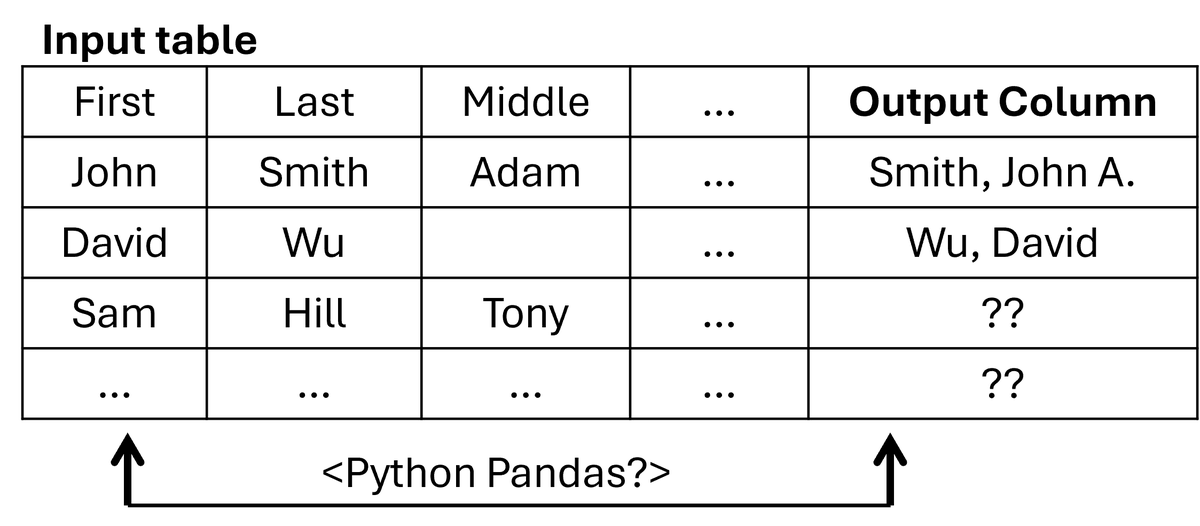
- Table Transform -- synthesizing SQL or Pandas code to reshape a table, given example inputs/outputs or a target schema
- Table Matching -- entity matching (do two rows refer to the same real-world thing?), schema matching (do two columns mean the same concept?), and header-value matching
- Data Cleaning -- imputing missing values, detecting erroneous cells, and converting unstructured lists into relational tables
- Table Join -- identifying equi-join relationships (foreign keys) and semantic joins between related tables
- Column Transform -- synthesizing transformation programs from input/output examples, predicting spreadsheet formulas from context
- Column Relationships -- discovering arithmetic, functional, and string relationships between columns (e.g.,
Profit = Sales - Cost) - Table Understanding -- a table-adapted "needle in a haystack" test for cell retrieval
- NL-2-Code -- translating natural language to SQL
- Table QA & Fact Verification -- answering questions and verifying claims against tables
- KB Mapping -- linking table columns and cells to knowledge-base ontologies
A majority of these real-world tasks -- all except NL-to-code, Table-QA, and KB-mapping -- have not been used to evaluate foundation models before. The benchmark draws from 52 diverse datasets, with a cap of 1,000 questions per dataset to maintain diversity.

Even GPT-5 only scores 69%
The headline result is striking. Reasoning models such as GPT-5, o3, and Gemini-2.5-pro significantly outperform chat-oriented models, with OpenAI GPT-5 achieving the best score at 69.6%, highlighting the challenging nature of MMTU. Among open-source models, DeepSeek R1 attains the best performance with a score of 57.9%, which while strong, reveals a potential gap between leading proprietary and open-source models.
The full leaderboard tells a clear story about the reasoning gap:
| Model | Type | MMTU Score | Cost/Question |
|---|---|---|---|
| GPT-5 | Reasoning | 69.6% | $0.017 |
| o3 | Reasoning | 69.1% | $0.015 |
| GPT-5-mini | Reasoning | 66.7% | $0.003 |
| Gemini 2.5 Pro | Reasoning | 66.5% | $0.008 |
| DeepSeek-R1 | Reasoning | 57.9% | $0.002 |
| GPT-5-Chat | Chat | 57.7% | $0.005 |
| DeepSeek-V3 | Chat | 55.5% | $0.001 |
| GPT-4o | Chat | 50.7% | $0.010 |
| Llama-3.3-70B | Chat | 45.4% | $0.002 |
| Llama-3.1-8B | Chat | 26.8% | $0.00003 |
Reasoning models outperform chat models by over 10 percentage points on average. The analysis of traces generated by reasoning models reveals that they excel on MMTU over chat models because of their strong coding skills and abilities to break complex tasks on large tables into a sequence of more manageable sub-tasks with smaller table context. From a cost-efficiency perspective, lightweight reasoning models like GPT-5-mini and Gemini-2.5-Flash are quite competitive in terms of both quality and cost, making them cost-effective choices for complex table tasks.
Where models break down
The benchmark's error analysis reveals four main failure modes, each pointing to a different structural weakness:
- Table understanding (38%) -- Models misread table context, such as filling in an abbreviated name when all other values in the column use full names, or miscounting column indices in large tables.
- Reasoning and coding (28%) -- Models generate SQL or Pandas code that is "close" but misses important details requiring holistic reasoning over the full column context.
- Knowledge errors (18%) -- Models hallucinate facts, especially in knowledge-base mapping tasks where they invent entity references that do not exist.
- Other (15%) -- Format extraction failures, timeouts, and ambiguous ground truth.
One finding stands out as particularly fundamental. LLM performance consistently declines as table context length increases. Despite recent advances in long-context LLMs, long contexts remain a significant challenge for tables. The team designed a table-specific variant of the classic "needle in a haystack" test -- where you hide a fact inside a long document and ask the model to retrieve it. Frontier models now score perfectly on the standard text version of this test. But today's frontier LLMs still face substantial challenges in correctly identifying a cell value within a two-dimensional table, especially when the number of columns exceeds 25, where accuracy quickly falls below 0.5.
The asymmetry is revealing: with 50 rows and 5 columns there is a reasonable accuracy of 0.81, but with 5 rows and 50 columns the accuracy drops to 0.43, underscoring the challenge LLMs face when reading "vertically" in the column direction. This makes intuitive sense -- language models are pretrained on one-dimensional text that reads left-to-right, not two-dimensional grids that also need to be read top-to-bottom.
A second structural weakness: LLM performance degrades under table-level perturbations such as row or column shuffling, even when these changes are semantically invariant. Column shuffling leads to a steeper decline than row shuffling, suggesting that language models remain sensitive to the structural ordering of tables.

What this means in practice
MMTU is directly relevant to anyone building AI-assisted data tooling. The tasks it covers map directly to real product features:
- Spreadsheet copilots that suggest formulas or clean data
- Database assistants that auto-detect join relationships or flag data errors
- ETL pipeline tools that infer transformations from example inputs/outputs
- Data catalog systems that match schemas across different data sources
- Notebook assistants that help analysts reshape or aggregate tables
The benchmark also highlights where reasoning models earn their premium. Tasks requiring code generation -- column transforms, table transforms, NL-to-SQL -- show the largest gap between reasoning and chat models. If you are building a data pipeline copilot, the evidence here strongly favors reasoning-class models, with GPT-5-mini and Gemini-2.5-Flash offering a compelling cost-to-performance ratio for production use.
The benchmark does have real limitations worth noting. It only includes tasks that can be objectively evaluated, which means subjective but important tasks like table summarization, data generation, and enrichment are excluded. It also does not yet support multi-modal input, even though human experts naturally read tables visually as two-dimensional grids -- a direction the authors flag for future work.
Getting started
The evaluation code is available in the official NeurIPS 2025 benchmark paper repository, with MMTU 1.0 publishing 28,136 questions that have undergone a quality filtering process. The evaluation code is on GitHub and the dataset is on Hugging Face. The evaluation framework supports execution-based scoring for SQL and Python generation, and structured output comparison for tasks like schema matching. Note that the benchmark involves automated code execution for some complex table tasks such as NL-2-SQL and data transformation, so running it requires a sandboxed environment -- Docker configs are included in the repo.
For teams building on top of LLMs for any kind of data work, MMTU provides the most comprehensive picture yet of where models actually stand. The 31-point gap between the best model (69.6%) and a perfect score is not a rounding error -- it is a roadmap of unsolved problems in structured data reasoning.