
Microsoft Research's GroundedPlanBench Exposes Where Robot AI Actually Fails
A new benchmark and a video-to-plan training pipeline expose how badly today's VLMs pick where a robot should actually grab, place, open, or close.
 Pro
Takeaways
- GroundedPlanBench tests whether VLM robot plans specify both what to do and where to act.
- Built from 308 DROID scenes into 1,009 tasks with explicit and implicit instructions across three horizon buckets.
- V2GP pipeline mines gripper signals plus SAM3 tracking to auto-generate 43K grounded training plans from videos.
- Baseline stacks pairing GPT-5.2 or Qwen3-VL with Embodied-R1 collapse on ambiguous object references.
- Fine-tuning Qwen3-VL-4B and 32B on V2GP data tops both benchmark metrics and real-robot trials.
- Code is not yet released; paper and project page are live.
Robot planners built on top of vision-language models (VLMs) can usually describe what to do in fluent English, but they routinely fail at the more boring question: where, exactly, on the pixel grid should the gripper close? A new benchmark and training recipe from Korea University, Microsoft Research, and the University of Wisconsin-Madison tries to force that question into the open, and shows that even frontier models struggle when the plan has to point at real objects.
The project, called GroundedPlanBench, comes paired with an automated data pipeline named V2GP that turns raw robot demonstration videos into training data for joint planning and grounding. The paper reports that spatially grounded long-horizon planning is still a bottleneck for current VLMs, and that fine-tuning open models on V2GP data closes a large chunk of the gap.
Why natural-language plans keep breaking
Most VLM-as-planner stacks today look like a two-stage pipeline. A first model writes a plan in natural language, and a separate grounding model translates each step into executable signals for the robot. That split sounds clean, but it leaks in practice. VLMs use images and text to plan robot actions, but they still struggle to decide what actions to take and where to take them, and most systems split these decisions into two steps, which means an ambiguous phrase upstream forces the grounding model to guess.
The failure mode the authors highlight is painfully mundane. If a scene contains four napkins and the plan says "pick up the napkin on the table," the downstream grounder has no way to disambiguate. Even GPT-5.2 output phrases like "top-left napkin" or "upper-center napkin," and the grounding model still collapsed them all onto the same object. Plans can also hallucinate steps that do not exist in the scene, like inserting a "place inside the cabinet" action when no cabinet is present.

What GroundedPlanBench actually measures
The benchmark is built on top of the DROID dataset of real robot recordings. GroundedPlanBench is built from 308 diverse real-world embodied scenes drawn from DROID, each annotated with manually curated action plans and spatial grounding under both implicit and explicit instructions, yielding 1K evaluation episodes. Each task is written twice: an explicit version that names the objects ("put the red bottle, sky blue cup, and blue bottle into the sink") and an implicit version that only conveys intent ("ready all the objects in the kitchen to be washed").
Plans are decomposed into four primitive actions that map cleanly onto a gripper: grasp, place, open, and close. Grasp, open, and close are anchored to a bounding box around the target object; place is anchored to a bounding box for the destination. The 1,009 tasks are spread across three horizon buckets:
- 345 tasks with 1 to 4 actions (short)
- 381 tasks with 5 to 8 actions (medium)
- 283 tasks with 9 to 26 actions (long)
Two metrics carry the evaluation. Task Success Rate (TSR) counts a task as correct only if every action is both planned and grounded correctly. Action Recall Rate (ARR) is more lenient, counting the fraction of ground-truth sub-actions that appear anywhere in the generated plan, regardless of order.
How V2GP turns robot videos into training data
V2GP, short for Video-to-Spatially Grounded Planning, is the pipeline that makes fine-tuning practical. It runs in four stages:
- Temporal sub-action decomposition. Long demonstrations are cut into sub-action segments using the recorded gripper open/close signals, which act as a natural clock for manipulation events.
- Interactive object identification. A VLM reads each segment and produces a text description of what the robot is manipulating in that clip.
- Spatial grounding. Guided by that description, Meta's SAM-family segmenter (the paper uses SAM3) tracks the object across the segment and extracts grasp bounding boxes plus placement points.
- Plan assembly. The grounded primitives are combined with both explicit and implicit versions of the task instruction into a single JSON training sample.
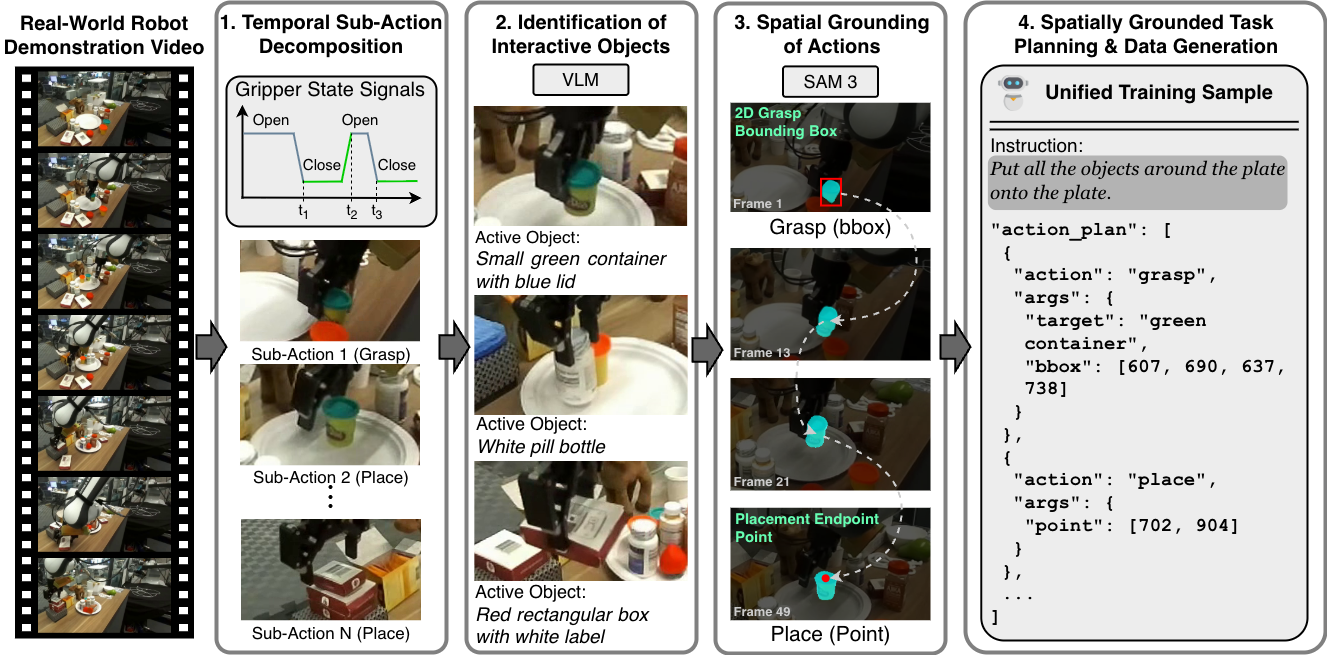
Run over the video corpus, the pipeline produced roughly 43,000 grounded plans, weighted toward shorter tasks (34,646 with 1 to 4 actions, 4,368 with 5 to 8, and 4,448 with 9 to 26 actions). Those samples are then used to fine-tune an off-the-shelf VLM into a joint planner-grounder.
What the numbers look like
The team used Qwen3-VL as the base model to fine-tune, and compared against proprietary systems plus a decoupled baseline that pairs a plan-writer (GPT-5.2 or Qwen3-VL-4B) with Embodied-R1 as the spatial grounder. Embodied-R1 was picked because it is explicitly trained for pointing at locations in an image for embodied tasks, so it is a fair upper bound on what a dedicated grounder can do.
The headline findings from the reported evaluations:
- Every model, proprietary or open, struggled with multi-step plans and with implicit instructions that require inferring which objects are relevant.
- Decoupled pipelines were consistently bottlenecked by language ambiguity, even when the plan writer was GPT-5.2.
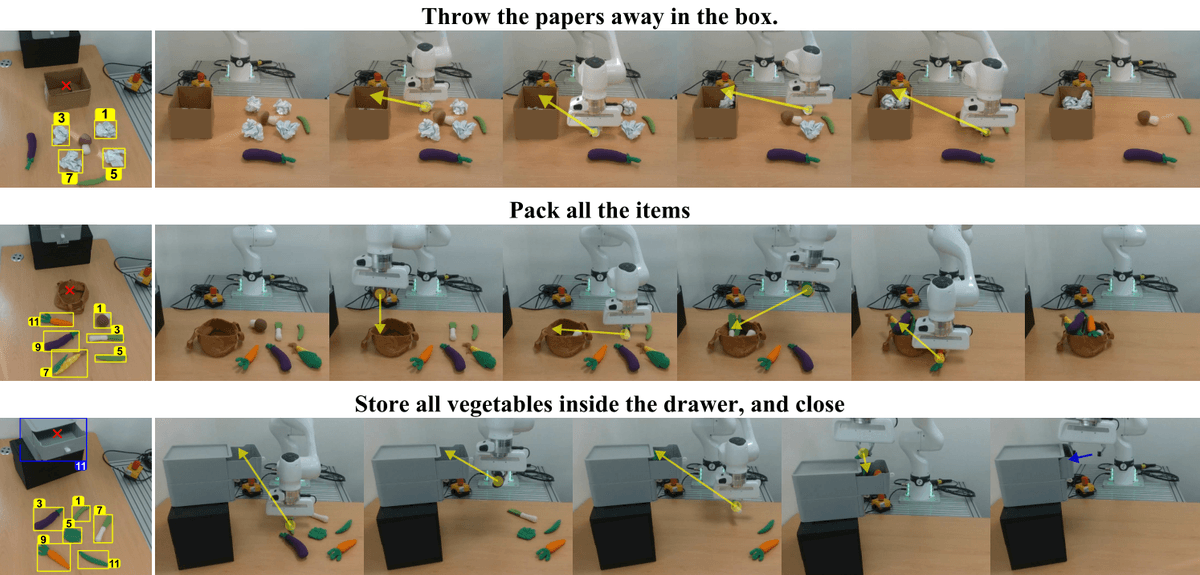
- Fine-tuning Qwen3-VL-4B and Qwen3-VL-32B on V2GP data produced the best overall scores on both TSR and ARR, and the gains held up in real-robot experiments on tasks like packing items, throwing tissues away, cooking vegetables, and storing objects in a drawer.
Why this matters for anyone building robot stacks
The real contribution is not the leaderboard, it is the framing. Most existing robot-planning benchmarks score the text of the plan and let the perception stack be somebody else's problem. GroundedPlanBench refuses that split, and V2GP shows that you can generate the joint supervision cheaply by mining gripper signals and a segmenter over videos you already have.
There are caveats. The action vocabulary is limited to four primitives, so anything requiring force control, tool use, or bimanual coordination is out of scope. Long-horizon and implicit tasks are still hard even for the fine-tuned models, and the pipeline leans on SAM3-quality segmentation, which will degrade in heavily occluded or textureless scenes. Code is listed as "coming soon" on the project page, so hands-on experimentation will have to wait.
For teams building manipulation pipelines, the practical takeaway is that adding a bigger planner on top of a separate grounder is probably a dead end for cluttered scenes. Training a single model to emit boxes and points alongside its plan, using video-mined data of the kind V2GP produces, is looking like the more defensible path.