
Microsoft Research Proves AI's 'Aha Moments' Are Just Learnable Word Habits
Microsoft Research and KAIST show that the real driver of LLM reasoning is not clever thinking but the linguistic habit of voicing doubt.
 Pro
Takeaways
- New framework separates LLM reasoning into procedural steps and epistemic verbalization, the tokens that voice uncertainty
- Standard LLMs collapse silently in 50 to 83 percent of failures because no overt error triggers reactive correction
- Injecting a short doubt phrase like Wait, is that correct? recovers around 15 percent of failed rollouts
- Nine tokens (wait, hmm, maybe, perhaps, check, actually, might, seems, alternatively) mark 73 percent of these moments
- Suppressing epistemic verbalization via SFT on 800 samples cuts DeepSeek-R1-Distill-32B AIME24 accuracy from 80 to 43
- Full paper and code at arxiv.org/abs/2603.15500
A new paper from Microsoft Research, KAIST, and Seoul National University argues that the celebrated Aha moments in reasoning models, those moments when a model suddenly says Wait and corrects itself, are not the mysterious spark of intelligence they appear to be. They are a learnable linguistic habit, and one that can be turned on or off with as few as 800 training examples.
The work, titled Understanding Reasoning in LLMs through Strategic Information Allocation under Uncertainty, builds an information-theoretic framework that separates a reasoning trace into two channels. It then shows empirically that strong reasoning depends far less on some inner cognitive mechanism than on whether the model verbalizes its own uncertainty at all.
The silent divergence problem
When standard LLMs get math problems wrong, the failure usually does not look like a loud mistake. The surface structure of step-by-step execution is preserved while the model's belief drifts from the correct answer, often without overt error. This silent divergence is the dominant failure pattern.
The authors ran Qwen2.5 and Qwen3-Base models on AIME24/25, AMC23, and MATH500, generating 4,800 samples per model and using GPT-5 as an automated judge. Collapse is pervasive, occurring in 50 to 83 percent of incorrect responses and rising sharply with problem difficulty. The five recurring failure modes they identify are:
- Incoherence
- Hallucination spirals (inventing fake theorems)
- Repetition
- Topic drift
- Degenerate infinite loops

Because these traces look locally coherent, there is nothing for the model to react to. And reacting is essentially all standard LLMs know how to do.
Reactive versus proactive correction
The paper cleanly separates two ways a model can catch itself. Reactive correction happens when the chain contains an explicit error, contradiction, or invalid derivation that the model recognizes. Proactive correction happens when no overt error has surfaced, yet the model questions a prior step and verifies or backtracks on internal doubt alone.
The gap between LLMs and Large Reasoning Models (LRMs) here is stark. In LLMs, self-correction occurs in at most 35 of 4,800 generations, under 1 percent, and is overwhelmingly reactive. In LRMs like DeepSeek-R1-Distill and Qwen3, proactive corrections account for 22 to 35 percent of all self-corrections.
What is surprising is how noisy these proactive signals are. Across LRMs, precision averages only 24.4 percent, meaning roughly three out of four proactive verbalizations second-guess an already-correct chain. The authors argue that in the silent-divergence regime, a noisy signal that fires often beats a precise one that never fires.
Epistemic verbalization as the real mechanism
The core theoretical move is to identify epistemic verbalization as a distinct informational axis. The intuition is a straightforward consequence of autoregressive decoding: if a model has internal uncertainty about its trajectory but never emits tokens that reflect it, subsequent generation cannot condition on that uncertainty. It is informationally inert. Emitting a doubt token like Wait or Hmm makes the uncertainty conditionable, and that changes what the next tokens can do.
Formally, the authors prove that if an epistemic token is generated with at least some non-zero probability whenever entropy about the target exceeds a threshold, the model's uncertainty about the answer converges to zero, regardless of the procedural trigger probability. Sporadic doubt is enough to guarantee eventual convergence, even when procedural error signals never surface.
A minimal doubt cue recovers failed runs
The intervention experiment is the most striking result. The authors took incorrect rollouts from Qwen3-8B and 14B Base, truncated them at various points, and simply injected a short phrase before letting the model continue. Five conditions were compared, including a no-injection baseline that controls for the effect of re-sampling.
The injected phrases were minimal:
- Hmm, I'm not sure this is right.
- Hmm, I'm not sure this is right. Let me reconsider.
- Wait, is that correct?
- Wait, let me double-check.
Across all settings, simply expressing uncertainty, without pinpointing what went wrong, acts as an informative signal that drives recovery. Even a phrase conveying only uncertainty without any explicit cue to re-examine the reasoning suffices for the model to detect its own errors and recover the correct answer.

The nine tokens that give it away
By auditing traces with GPT-5, the authors identified nine surface tokens that reliably indicate epistemic verbalization is happening. The frequencies from their analysis:
| Token | Co-occurrence rate |
|---|---|
| wait | 73.0% |
| maybe | 32.9% |
| actually | 12.4% |
| check | 10.5% |
| hmm | 8.3% |
| perhaps | 8.2% |
| might | 6.6% |
| seems | 3.3% |
| alternatively | 1.2% |
Suppressing these nine tokens at inference time via logit bias caused performance drops around 10 percent on DeepSeek-R1-Distill models. The drop is not larger because models sometimes route around the masked tokens by adopting alternative forms of epistemic verbalization like But hold on or Let me verify.
800 samples is all it takes
To rule out that circumvention, the authors ran a self-distillation experiment. They collected 800 correct traces generated with the instruction to proceed without expressing uncertainty, then fine-tuned each base model on those traces. The result: AIME24 pass@1 for DeepSeek-R1-Distill-32B fell from 80.0 to 43.3. Qwen3-8B-Base dropped from 16.7 to 3.3.
The reverse works too. Fine-tuning weaker models on the LIMO-v2 dataset, which is dense in epistemic tokens (77 Waits per response on average), rapidly improved performance by up to 2.6x with only 800 samples, indicating that epistemic verbalization is not a special model capability but rather a linguistic habit that is easily distilled.
Why this matters for building reasoning models
The framework reframes what post-training for reasoning actually does. Instead of teaching some abstract capacity for reflection, it is largely instilling a linguistic reflex to voice doubt at high-uncertainty moments. The token-level mutual information analysis in the appendix supports this: MI tends to rise at thinking tokens, but not always. Elevated MI appears in utterances that perform epistemic verbalization, and thinking tokens occurring without such verbalization do not trigger an MI increase.
A few practical takeaways for anyone working with reasoning models:
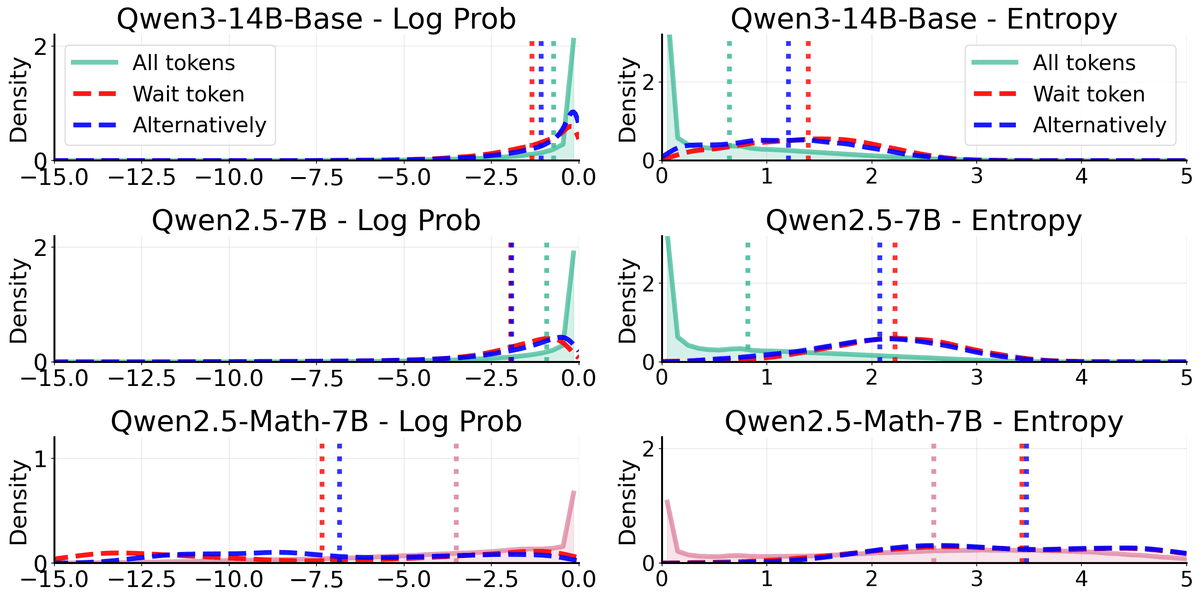
- Distillation success depends on whether the base model's token distribution already places epistemic tokens like Wait within its support. Well-performing students keep these tokens low-probability and high-entropy relative to other tokens.
- If you are training a small reasoner and it is not improving, check whether the epistemic tokens in your training data fall inside the base model's support.
- Simply prepending a doubt cue at test time when a chain looks stalled can recover a nontrivial share of failed runs, without any fine-tuning.
- Token-level entropy is not a reliable substitute for verbalized uncertainty. The appendix shows entropy decreases at similar rates whether the trajectory is correct or wrong.
The analysis code is available, and the framework offers a concrete lens for future work on controlling when and how reasoning models express doubt, particularly in tool-augmented settings where external observations may reduce the need for internal verbalization.