
Microsoft and MIT's SMC-RS Finally Explains Why AI Reasoning Scales at Test Time
A Microsoft Research team gives Sequential Monte Carlo a rigorous theoretical foundation for LLM inference, revealing when it works, when it fails, and why.
 Pro
Takeaways
- New theory for SMC: Microsoft Research/MIT paper gives the first rigorous non-asymptotic guarantees for Sequential Monte Carlo applied to LLM inference-time scaling.
- Two key conditions: SMC succeeds when (1) the base model has bounded action-level coverage of the target, and (2) the PRM's intermediate distributions stay close to the true targets (bounded χ²-divergence).
- New algorithm SMC-RS: A rejection-sampling variant of SMC that avoids the √H particle overhead of standard SMC when the PRM is near-perfect.
- Fundamental lower bound: Any "myopic" particle filtering method (no lookahead) needs at least Ω(log H / log log H) particles even with a near-perfect PRM -- a hard limit for all current methods.
- Math benchmarks: SMC with Qwen2.5-1B + Qwen2.5-Math-PRM-7B beats Best-of-N on most individual MATH500 and AIME problems (N=32), not just on average.
- Theory-practice gap: Surprisingly, higher PRM χ²-divergence often correlates with better task accuracy on math, contradicting the sampling theory -- an open problem flagged by the authors.
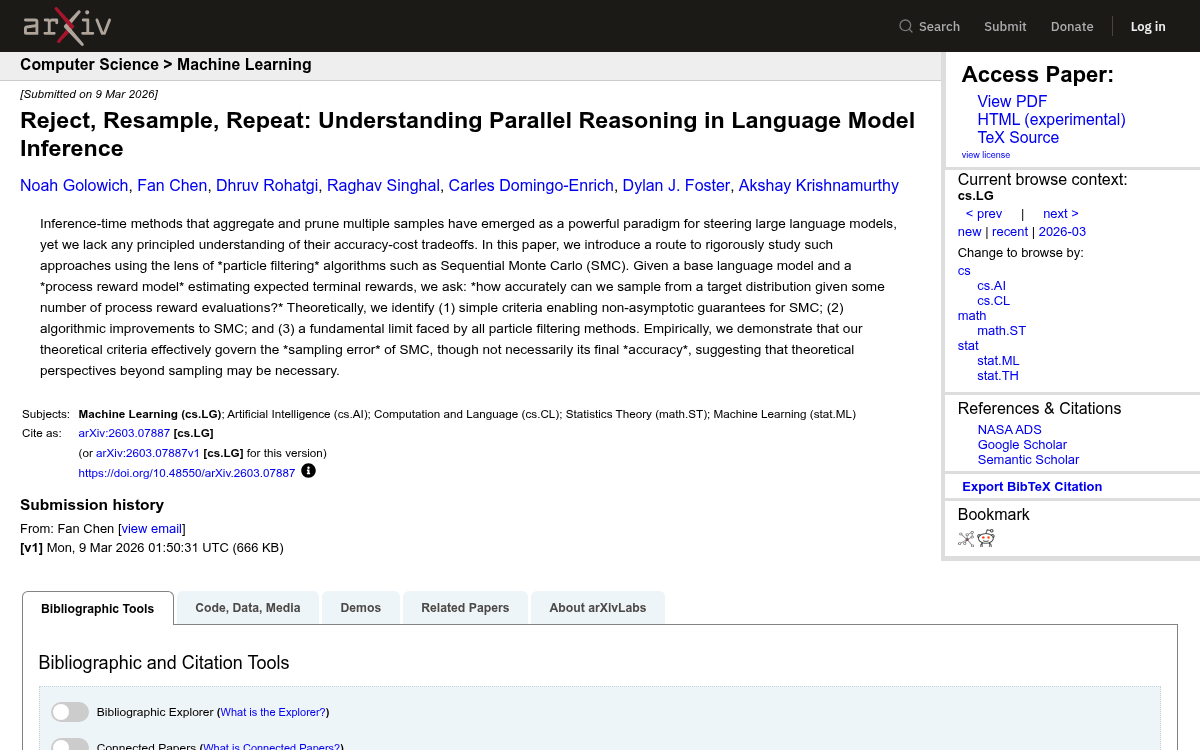
Inference-time scaling -- the idea of spending more compute at test time to get better answers -- has become one of the hottest ideas in AI. Techniques like Best-of-N sampling, beam search, and process-reward-guided generation have all shown empirical wins. But the field has been running largely on intuition: nobody had a principled theory explaining why these methods work, how many samples they actually need, or where they fundamentally break down. A new paper from Microsoft Research and MIT, "Reject, Resample, Repeat", changes that.
The problem with parallel reasoning
The core setup is straightforward. You have a base language model and a process reward model (PRM) -- a secondary model that scores partial generations mid-sequence, estimating how likely a given prefix is to lead to a correct final answer. The question is: given N parallel "particles" (partial generations), how well can you steer the base model toward high-quality outputs?
Aggregation and pruning are naturally implemented by particle filtering algorithms, including the popular Sequential Monte Carlo (SMC) method, which uses the process reward model to adaptively prune and replicate multiple particles as tokens are generated. SMC is already used in practice for math reasoning and other tasks, but these methods are largely ad hoc, since we lack a unifying theoretical framework that can explain the benefits of different inference-time interventions and guide algorithm design towards the most effective ones.
A quick refresher: Sequential Monte Carlo is a classic algorithm from Bayesian statistics. It maintains a population of "particles" (candidate solutions), weights them by how promising they look, and periodically resamples -- killing off weak candidates and duplicating strong ones. Applied to LLMs, each particle is a partial generation, and the PRM provides the weights at each step.
Two conditions that make SMC work
The paper's first major contribution is a clean, non-asymptotic guarantee for SMC. The authors identify two key properties that determine whether SMC will succeed:
- Bounded action-level coverage (
C_act): At each generation step, the target distribution π* shouldn't assign dramatically more probability to any token than the base model does. Formally, the ratio π*(a_h | a_{1:h-1}) / π_ref(a_h | a_{1:h-1}) must be bounded. If the target distribution wants tokens the base model almost never generates, SMC struggles. - Bounded χ²-divergence between intermediate distributions (
C_χ²): The PRM's induced intermediate distributions must stay close to the true intermediate targets. This captures how accurate the PRM is at each step of the generation, not just at the end.
Under these two conditions, SMC with N particles samples from a distribution μ̂ satisfying total variation distance to the target π* bounded by √(H² · C_act · (C_χ² + 1) / N). This bound strengthens the guarantees for backtracking-based algorithms, and the parallel runtime of SMC is O(H) whereas prior sequential methods use time Ω(H²).

A new algorithm: SMC-RS
Standard SMC has a subtle flaw: even when the PRM is perfect (i.e., it knows the exact probability of success for every prefix), it still needs at least Ω(√H) particles to achieve non-trivial accuracy. This is a fundamental limitation of how SMC normalizes its particle weights -- it creates interference between particles that compounds over the generation horizon.
The authors introduce Sequential Monte Carlo with Rejection Sampling (SMC-RS) to fix this. The key idea: instead of resampling from a normalized weighted distribution (which mixes information across particles), SMC-RS uses rejection sampling at each step. Each particle independently proposes a next token and accepts it with probability proportional to the PRM score, without normalizing across the particle pool.
The payoff is significant. If the PRM is near-accurate so that the χ²-divergence between intermediate distributions is at most ε² for all steps, then SMC-RS achieves sampling error below ε·H/√N. If ε ≤ 1/H, then SMC-RS achieves non-trivial sampling error with only O(1) particles -- in sharp contrast to standard SMC, which requires at least Ω(√H) particles even with a perfect PRM.
A hard limit for all particle methods
The third theoretical contribution is perhaps the most striking: a fundamental lower bound showing that no particle filtering method can fully escape the horizon dependence. The authors define a class of "myopic" particle filtering algorithms -- any method that decides which particles to keep at step h using only information available up to step h (no lookahead). Both SMC and SMC-RS fall into this class.
Even with mild constant-factor imperfections in the PRM, any myopic particle filtering algorithm requires nearly Ω(log H / log log H) particles to obtain non-trivial coverage of the target distribution. This is particularly striking since, under the L∞ closeness assumption, every intermediate distribution has constant coverage of the true target -- yet myopic methods cannot inductively maintain this coverage without a super-constant number of particles.
The result raises a provocative open question: can some form of lookahead -- using future PRM scores to inform earlier pruning decisions -- break this barrier?
What the experiments reveal
The empirical work is split into two parts. First, the authors design a controlled "prompt-switching" task where both the reference and target distributions are known exactly (by using two different prompts to the same model). This lets them directly measure action-level coverage and PRM accuracy, and verify that the theoretical quantities actually predict SMC's sampling error. They find strong correlations (Pearson r ≈ 0.81) between the theoretical predictors and observed error.
Second, they test SMC on real math benchmarks using Qwen2.5-1B-Instruct as the base model and Qwen2.5-Math-PRM-7B as the PRM, evaluated on MATH500, AIME24, and AIME25 with N=32 particles. Prior work had reported that SMC beats Best-of-N on average. This paper goes further: for the vast majority of problems in Math500, SMC's accuracy is at least as large as that of Best-of-N -- not just on average, but problem-by-problem.
But there's a twist. The theory predicts that a more accurate PRM (lower χ²-divergence) should lead to better SMC performance. In the math experiments, the opposite is often true: larger χ²-divergence often leads to higher accuracy, which is in contrast to the theoretical findings. The authors suspect that larger inverse temperature values lead to better performance since they more effectively weed out incorrect partial solutions, but also cause the χ²-divergence to blow up. This gap between the sampling-theoretic framework and task accuracy is explicitly flagged as an open problem.
What this means in practice
The paper doesn't release code, but the theoretical results have direct engineering implications. Here's what the framework tells you when designing an inference-time scaling system:
- PRM quality matters, but not in the way you think. The relevant metric isn't just final-answer accuracy -- it's how well the PRM tracks the true value function at every intermediate step. A PRM that's great at scoring complete solutions but noisy mid-generation can still cause SMC to fail.
- Action-level coverage is a design knob. If your base model is very different from the target distribution (e.g., a general model being steered toward a specialized task), SMC will need many more particles. Fine-tuning the base model to be closer to the target distribution directly reduces the particle budget needed.
- SMC-RS is a better default than standard SMC when you have a high-quality PRM. The rejection-sampling variant avoids the √H particle overhead and degrades more gracefully when the PRM is near-perfect.
- Particle counts scale with generation length. The theory shows the required N grows with horizon H. For long-form reasoning (thousands of tokens), this is a real cost -- and motivates block-level SMC, where the PRM is only called every B tokens rather than every token.
The connection to backtracking algorithms (like VGB from prior work) is also clarified: the execution of VGB, a backtracking-based method, can be coupled with the execution of a certain particle filtering method, potentially providing a new perspective on the benefits of both methods. Backtracking and parallel particle filtering turn out to be two sides of the same coin.
The gap between sampling theory and task accuracy remains the central open problem. The paper gives us the best available theory for when SMC correctly samples from a target distribution -- but for math problems, you often don't need to sample the full distribution, you just need one correct answer. Closing that gap between distributional fidelity and downstream task performance is the next frontier for inference-time scaling theory.