
Michigan's R3R Keeps 128-Drone Swarms Collision-Free With Only Local Radios
A new decentralized planner from University of Michigan proves multi-agent robot swarms can stay collision-free forever using only local, range-limited communication.
 Pro
Takeaways
- R3R is the first decentralized, asynchronous multi-agent planner with proven infinite-horizon safety under range-limited communication.
- Core idea: R-Boundedness constrains each agent's plan to a local ball, so local checks imply global safety.
- The R3R condition ties everything together:
R_comm = 3 * R_plan + delta. - Tested on up to 128 Dubins vehicles with 100% safety and 97 to 100% goal-reaching success rates.
- Compute scales with local neighbor density, not swarm size; ~1.4 ms per replan with ~5 neighbors.
- Open-source Julia code available at github.com/MarshallVielmetti/r3r_decentralized_gatekeeper.
Getting a swarm of robots to avoid each other is easy when every agent can talk to every other agent. The hard version is what happens when radios drop out, drones fly past each other's communication range, or a new vehicle joins the network mid-flight. A team from the University of Michigan has a new answer to that harder problem, and it comes with a mathematical proof that collisions can never happen, for all time.
Their framework is called R3R, and the authors claim it is the first decentralized and asynchronous framework to provide infinite-horizon safety guarantees for multi-agent motion planning under distance-based communication constraints for broad classes of nonlinear systems. In simulation, it kept 128 Dubins-style aircraft collision-free in dense city-like environments while each agent planned independently using only what its neighbors told it.
Why local planning usually breaks
Multi-agent motion planning forces a trade-off between safety, coordination, and scale. Centralized planners can produce optimal, collision-free trajectories, but they choke as the fleet grows and die if the central node fails. Decentralized approaches scale well, but existing ones generally assume every agent can share full trajectories with every other agent, or they synchronize replanning across the whole network. Neither is realistic for radio-limited drones or ground robots operating in cluttered spaces.
State-of-the-art decentralized planners the paper compares against, like MADER, DREAM, and EGO-Swarm, fundamentally assume fully-connected communication graphs and global information sharing. They also typically provide only finite-horizon guarantees, meaning safety is proven for the next few seconds of trajectory rather than forever.
The geometric trick: R-Boundedness
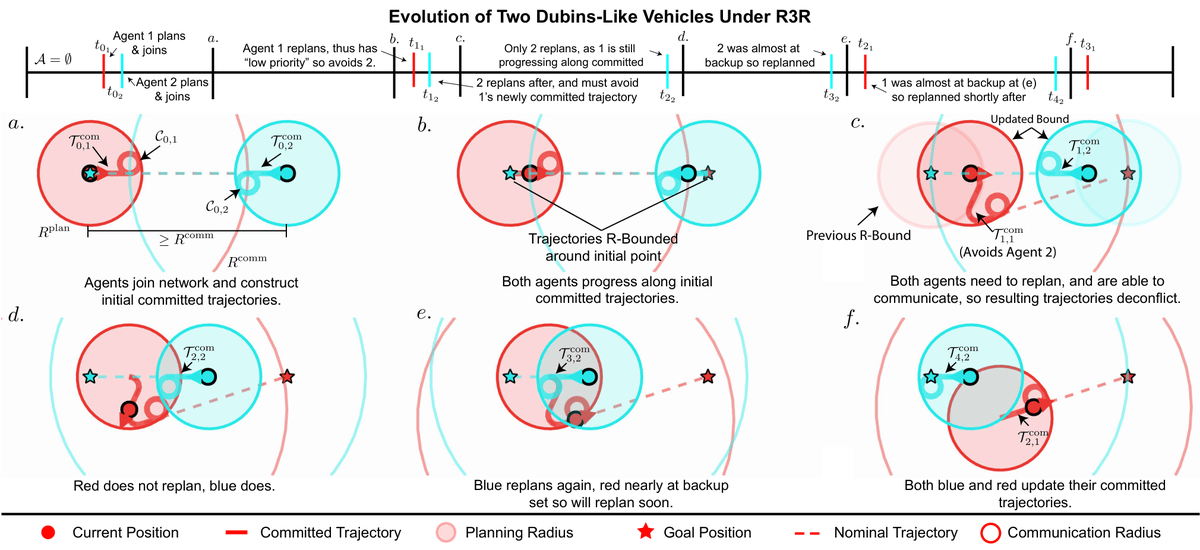
R3R's core insight is a clean geometric constraint the authors call R-Boundedness. A trajectory is R-Bounded if, from the moment an agent commits to it, the agent stays inside a ball of radius R around its starting position for all future time. That sounds restrictive, but it enables a powerful shortcut: if two agents both stay inside their own bounded balls, you can guarantee they will never collide just by checking distances at the moment of planning.
This produces what the paper calls the R3R condition, a simple algebraic relationship: R_comm = 3 * R_plan + delta, where R_comm is the communication radius, R_plan is the planning radius each agent restricts itself to, and delta is the minimum inter-agent separation. If every agent obeys this, then any pair of agents whose bounded plans could possibly collide must already be within communication range of each other. Global safety becomes a local check.

How an agent plans a step
R3R combines R-Boundedness with an earlier single-agent safety framework called gatekeeper. Each agent, whenever it feels like replanning, does roughly this:
- Collect the currently committed trajectories from all neighbors within
R_comm. - Plan a goal-directed nominal trajectory that avoids obstacles and neighbor plans.
- Stitch that nominal onto a backup trajectory (in the Dubins case, a loiter circle the agent can hold indefinitely) to form a candidate.
- Verify the candidate stays inside
R_plan, respects the safe set, and is collision-free with all neighbor commitments. - If valid, broadcast and commit. If not, keep tracking the previously committed trajectory.
Because the previously committed trajectory always exists and was already certified safe forever, failing to find a new plan is never dangerous. That property, plus a mild assumption that two neighbors don't replan at the exact same instant, is what gives the system its forward-invariant safety guarantee even as agents join, replan, and drop out asynchronously.
The numbers
The authors tested R3R on Dubins vehicles (a fixed-velocity model with bounded turning rate, representative of a fixed-wing aircraft) in three environments: an agent-swap scenario, a city-like map, and the Willow Garage floorplan. Safety was 100% across every configuration tested, and success rates (agents reaching their goals) were 100% in all but the 128-agent city-like case, which hit 97% due to deadlock rather than collision. In the 32-agent city-like simulation, agents averaged 4.7 neighbors per replanning iteration with a maximum of 10, and replanning steps took an average of 1.4 ms.
Scaling behavior is the other headline. Because each agent only reasons about neighbors inside its communication radius, computational cost tracks local agent density rather than total swarm size. Doubling the fleet in a bigger environment leaves per-agent replanning time roughly unchanged.
Against a nonlinear MPC baseline in an empty environment, R3R held safety while the baseline degraded quickly as the communication radius shrank. At R_comm = 1.0 with 16 agents, the NMPC's safety rate dropped to 37.5%, because the solver kept ending up in states with no feasible collision-free option.
The trade-offs
R3R gives up optimality for guaranteed safety under partial information. It will not produce the tightest, shortest paths that a centralized optimizer would. The R_plan bound means each agent voluntarily restricts itself to a small local ball, which can be conservative in open environments. The framework also does not resolve deadlocks on its own; the 128-agent failure case involved a group of vehicles unable to escape a congested pocket within the time limit. The current safety proof assumes ideal, bandwidth-unlimited communication and no simultaneous replans between neighbors, both of which the authors flag as future work.
Code and where to look next
The implementation is open-source in Julia, built on Agents.jl, and available at MarshallVielmetti/r3r_decentralized_gatekeeper, with the Dubins-specific RRT* planner released separately as DynamicRRT.jl. If you are working on drone swarms, warehouse robotics, or urban air mobility where radios are lossy and formal safety matters more than absolute optimality, R3R is a useful reference point for how far you can push provable guarantees using nothing but local information.