
Michigan's MDA Drops Into Any Depth Model and Kills Flying Points
Researchers from the University of Michigan introduce MDA, a lightweight mixture-density head that eliminates 'flying point' artifacts in depth estimation without changing the backbone or adding inference overhead.
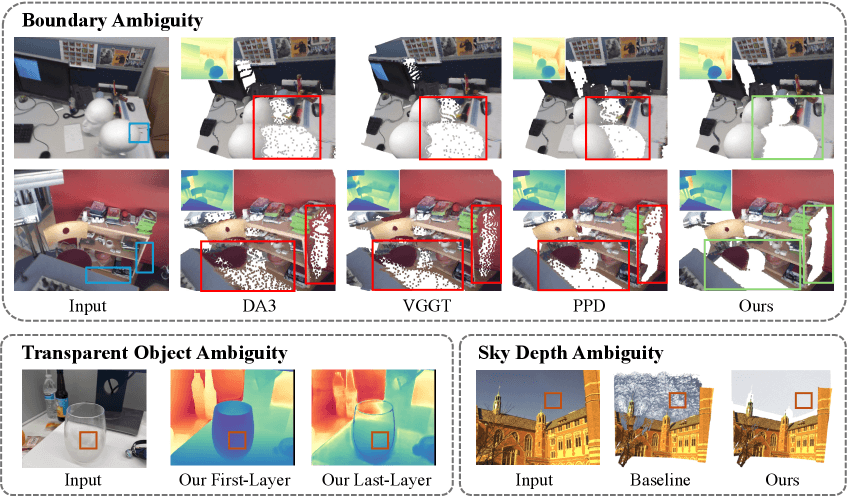
Takeaways
- Flying points fixed at the source: MDA traces the artifact to single-depth-per-pixel modeling and replaces it with a mixture density, largely eliminating the problem.
- Drop-in head replacement: Only the final conv layer changes; the backbone is untouched and inference speed is essentially identical to DA3/VGGT baselines (~33 FPS vs ~34-36 FPS).
- ~80x faster than diffusion alternatives: Competing boundary-refinement methods PPD/PPVD use multi-step denoising and run at under 2 FPS; MDA runs at full speed.
- Extends to transparent objects and sky: The same framework recovers layered depth behind glass and produces threshold-free sky segmentation as a byproduct.
- Blur-robust: MDA degrades far less than unimodal baselines as input blur increases, because mixture components stay anchored to real surfaces.
- Code and interactive demos available: github.com/biansy000/MDA and project page with 3D viewers.
Depth estimation has gotten remarkably good in recent years, but one stubborn artifact has resisted every scaling effort: flying points. These are spurious 3D points that appear in the empty space between foreground and background surfaces near object edges. Bigger models, more data, none of it fixes them. A new paper from researchers at the University of Michigan argues that's because the problem isn't scale , it's a fundamental flaw in how depth is modeled.
The work, titled Modeling Depth Ambiguity: A Mixture-Density Representation for Flying-Point-Free Depth Estimation, introduces MDA, a drop-in replacement for the final prediction layer of any depth estimator that largely eliminates flying points while running at the same speed as the original model.
One Depth Per Pixel Is the Problem
The core insight is deceptively simple. Every modern depth estimator , DA3, VGGT, and others , assigns each pixel a single depth value. That works fine for pixels sitting cleanly on one surface. But at object boundaries, a pixel's image patch straddles both a foreground and a background surface. The model can't tell which surface the pixel belongs to, so training pulls the prediction toward a compromise depth that lies on neither surface. In 3D, that compromise becomes a floating point in empty space.
The authors trace this directly to the standard loss function. The confidence-weighted L1 and L2 depth losses are mathematically equivalent to fitting a unimodal Laplacian or Gaussian distribution per pixel , a distribution with exactly one peak. At a boundary, the true depth distribution is bimodal (one peak per surface), and forcing a single-peak fit inevitably places that peak somewhere in between.

The Fix: A Mixture of Depth Hypotheses
MDA replaces the single-depth output head with a