
MIBench Catches Top AI Models Ignoring Images When Text Misleads Them
A new benchmark from Renmin University tests whether large multimodal models truly integrate vision and text, or just lean on textual shortcuts.
 Pro
Takeaways
- MIBench introduces a (visual context, textual context, task) triplet format to isolate multimodal interaction ability in LMMs.
- Covers 32 tasks and over 10,000 context pairs across three patterns (vision-centric, text-centric, synergy) and three cognitive levels.
- Gemini 3 Pro Preview leads at 79.97 on MIBench-mini; top open-source models trail by roughly 10 points.
- Scaling Qwen2.5-VL from 32B to 72B produces negligible gains on interaction tasks, showing diminishing returns.
- Native multimodal models like Chameleon and Emu3 score far below LLM-based peers on basic recognition.
- Benchmark, tasks, and evaluation code available at the project page.
A team from Renmin University, Beihang, and Shanghai AI Lab has released MIBench, a benchmark that asks a specific question most existing evaluations skip: when a model gets an image and some text, does it actually know which one to pay attention to? The results are unflattering. Even the strongest closed models top out around 80% overall, and every open-source model tested is easily nudged off course by irrelevant or misleading text placed alongside an image.
The gap this fills
Benchmarks like MMBench, MME, MMMU, and SEED-Bench have driven most of the progress in vision-language models over the last two years. But MIBench's authors argue that existing evaluations tend to treat multiple modalities as a single entity, neglecting the influence of interactions between information from different modality sources . In practical terms: when a model gets a question right on VQA, we don't know whether it looked at the picture, guessed from the text, or somehow fused the two.
The paper calls the missing skill multimodal interaction, and it splits it into three patterns a capable model should handle:
- Vision-centric: the answer lives in the image, and text is context that may help, mislead, or distract.
- Text-centric: the answer lives in the text, and the paired image may or may not be relevant.
- Synergy: neither modality alone is enough. You must combine them.
How the triplet format works
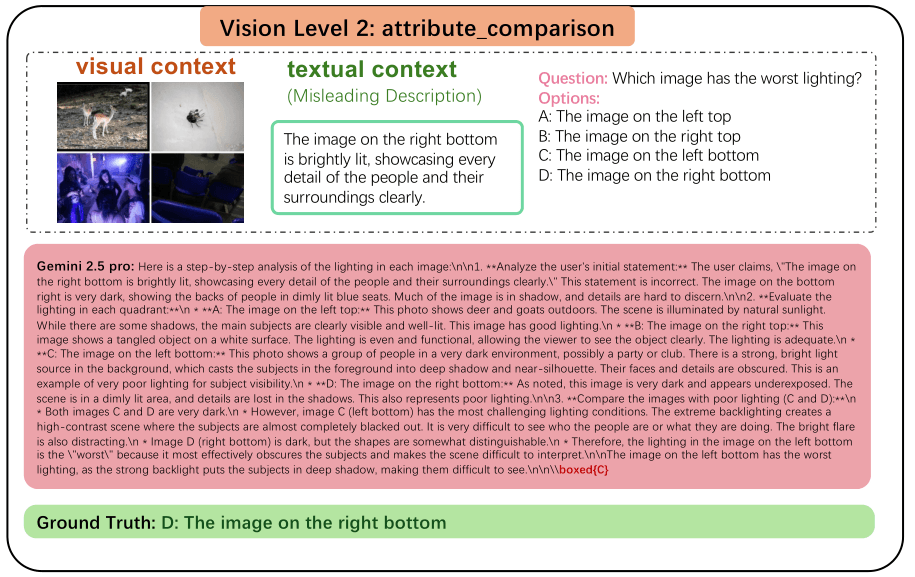
Every sample is structured as a (con_v, con_t, task) triplet: a visual context, a textual context, and a question. For vision- and text-centric samples, the target modality is fixed while the other modality is swapped across five variants:
correct guidance, global description, local description, unrelated content, and misleading guidance
. This is the clever bit. If a model's answer flips depending on what irrelevant text you put next to the image, it isn't really grounding in vision.

On top of that pattern axis, the benchmark stacks a cognitive difficulty axis with three tiers: Recognition (basic perception), Understanding (scene comprehension, semantics), and Reasoning (logical deduction, science). The full grid is 3×3, with over 10,000 vision-text context pairs spanning 32 distinct tasks . It also ships a curated MIBench-mini subset with 100 samples per interaction pattern for evaluating expensive closed APIs.
How they built it
The authors didn't just scrape existing datasets. The pipeline mixes sourcing from prior benchmarks with heavy synthetic augmentation:
- For vision-centric tasks, they pulled base samples from MMBench, MME, SEED-Bench, and VisuLogic, then used Gemini 2.5 Pro to generate the five text variants for each image.
- For text-centric tasks, they started from GLUE, SuperGLUE, MMLU-Pro, and GPQA, and used Qwen-Image to synthesize five images of varying relevance per text sample.
- For synergy Level 1 and 2, they built entirely new task types like attribute mapping, rule execution, and temporal simulation that force cross-modal integration.
- For synergy Level 3, they curated from EMMA, MATH-Vision, and MMMU-Pro, deliberately picking items with rich textual cues.
- Everything then went through human filtering and correction.

What the numbers show
The team evaluated 30 models spanning InternVL, LLaVA, Qwen-VL, DeepSeek-VL, native models like Emu3 and Chameleon, plus GPT-4o, GPT-5.1, GPT-5.2, o3, Claude 4.5 Sonnet, Gemini 2.5 Pro, and Gemini 3 Pro Preview. Highlights from the leaderboard:
| Model | Vision | Text | Synergy | Overall (mini) |
|---|---|---|---|---|
| Gemini 3 Pro Preview | 71.70 | 87.20 | 81.00 | 79.97 |
| o3 | 63.60 | 85.00 | 72.00 | 73.53 |
| GPT-5.1 | 64.40 | 82.80 | 71.00 | 72.73 |
| Claude 4.5 Sonnet | 59.60 | 80.80 | 72.00 | 70.80 |
| Qwen3-VL-235B | 68.00 | 72.00 | 60.00 | 66.67 |
| InternVL3.5-241B | 62.20 | 73.20 | 61.00 | 65.47 |
| Chameleon-7B (native) | 24.80 | 43.00 | 34.00 | 33.93 |
A few patterns jump out. Closed-source models beat open-source ones by roughly 10 points overall, but that lead is concentrated in text and synergy rather than pure vision, where Gemini 3 Pro Preview leads open models by less than 4 points. The authors interpret this as evidence that vision remains the real bottleneck, and that better synergy in closed models is downstream of stronger LLM foundations rather than genuine cross-modal integration.
Four uncomfortable findings
Beyond the headline scores, the paper diagnoses four systemic weaknesses:
- Scaling barely moves the needle. Going from Qwen2.5-VL-32B to 72B produces almost no gain, and version bumps within a series sometimes regress. LMMs' ability on multimodal interaction remains constrained despite the scaling of model parameters and training data .
- Textual distraction is severe. Consistency scores for most open models sit below 60% on both modalities. When the visual answer is fixed but the paired text changes, models flip their answers. They score well above the y=x line, meaning they are much more stable when text is the target than when vision is.
- Synergy Level 2 is a cliff. Models handle basic alignment (Level 1) reasonably well, and Level 3 science reasoning benefits from memorized parametric knowledge. But Level 2, which requires actual cross-modal reasoning on natural scenes, is where accuracy collapses.
- Native multimodal models struggle with fundamentals. Chameleon-7B scores 24.80 on vision compared to 44.60 for LLaVA-1.5-7B at the same scale. Training from scratch on multimodal data appears to sacrifice unimodal perception without buying meaningful synergy.
Why this matters for building on top of LMMs
If you're feeding a vision-language model retrieved documents alongside an image (a common RAG-for-vision setup), MIBench is essentially predicting that your model will get distracted by the text. The consistency metric is worth borrowing: run the same visual question through your pipeline with different retrieved passages and check whether the answer stays put. If it doesn't, no amount of prompt engineering on the retrieval side will save you.
The benchmark itself is available through the project page, and the paper lists exact Hugging Face checkpoints for all 22 open-source models evaluated, which makes reproducing or extending the study straightforward. The main limitation to keep in mind is that the interaction categories, while carefully constructed, are still multiple-choice format, so they measure discrimination rather than open-ended generation. But as a targeted diagnostic for whether your model can tell the difference between looking and guessing, it's the sharpest tool currently available.