
MH-RG DeepONet Beats Vanilla Wave Solvers by 9x With Physics-Aware Heads
A new DeepONet variant channels initial-state physics through three residual gates and multiple low-rank heads, cutting wave prediction error by up to 9x.
 Pro
Takeaways
- MH-RG DeepONet conditions wave predictions via three residual gates driven by compact initial-state descriptors
- Design inspired by Schrodinger vs Heisenberg picture split between state and observable evolution
- Low-rank multi-head extension adds several conditioned response channels without parameter explosion
- Cuts full-field MSE ~9x vs vanilla DeepONet on 1D focusing NLSE soliton collision benchmark
- Also wins on 2D damped Gross-Pitaevskii trapped condensate with translation, breathing, and decay
- Code and data promised on publication; see arxiv.org/abs/2604.11972
Neural operators like DeepONet have become a favorite tool for learning solutions to partial differential equations, but they typically treat the input field as one giant black box. A new architecture called Multi-Head Residual-Gated DeepONet (MH-RG) argues that ignoring the compact physical structure of the initial state leaves a lot of accuracy on the table, especially for coherent nonlinear wave dynamics where a handful of numbers like peak amplitude, center of mass, and spectral bandwidth largely dictate what happens next.
Where standard operator learning falls short
Traditional neural operators treat the input-output mapping as a largely black-box high-dimensional regression, without explicitly exploiting structured physical context. Common workarounds concatenate extra features into the branch network or use FiLM-style affine modulation inside hidden layers, but these approaches treat physical descriptors as just more input noise rather than as a distinct conditioning signal.
That matters for systems like optical solitons, Bose-Einstein condensates, and Kerr frequency combs, where long-time evolution is not governed by arbitrary fine-scale fluctuations alone but remains organized around a small number of collective descriptors extracted from the initial state. If your surrogate model gets phase or amplitude wrong at a collision point, those errors compound downstream.
A quantum-inspired split
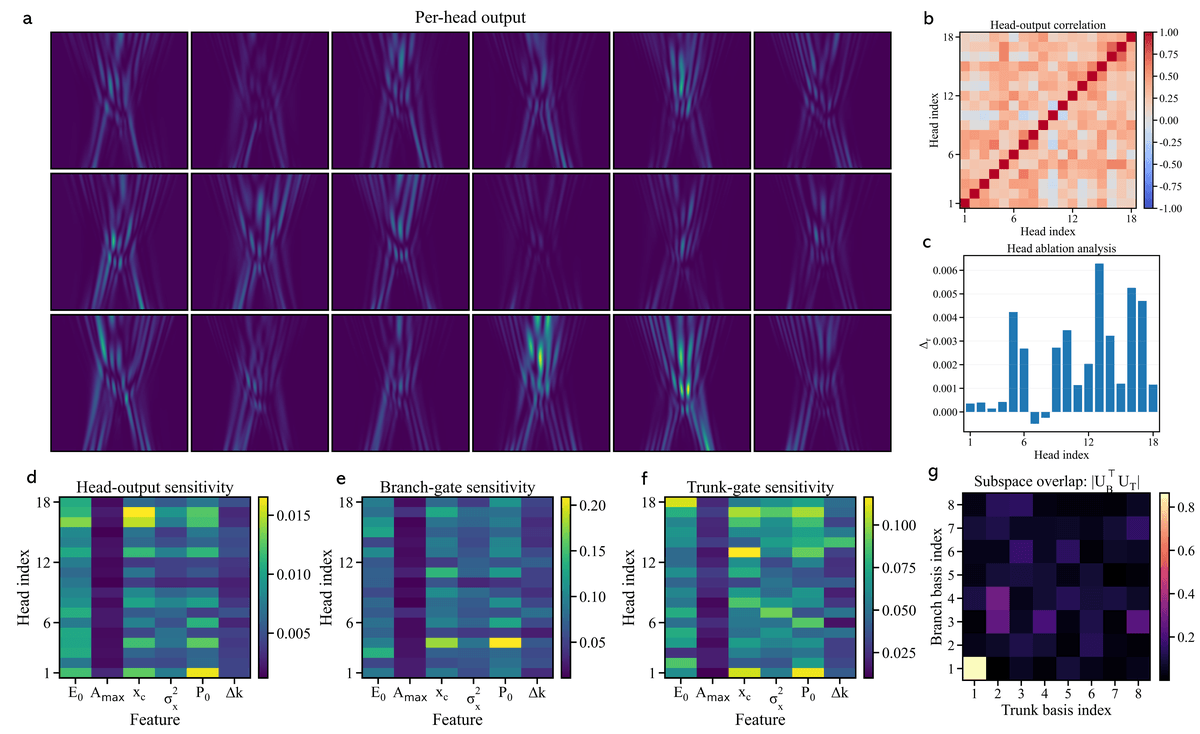
The architectural trick is loosely borrowed from the Schrodinger versus Heisenberg pictures in quantum mechanics: one describes state evolution, the other describes how observables evolve. MH-RG keeps a standard DeepONet backbone for the full wave field, then runs a parallel pathway that feeds a compact descriptor vector through three residual gates.