
MetaWorld-X Crushes Rival Robot AI by 31x Using VLM Skill Routing
MetaWorld-X uses a VLM-orchestrated mixture of expert policies trained on human motion data to give humanoid robots natural, composable whole-body control — beating TD-MPC2 by up to 31x on success rate.
 Pro
Takeaways
- What: MetaWorld-X is a hierarchical humanoid control framework that trains specialist expert policies per skill, then uses a VLM to route between them dynamically.
- The problem it solves: Single monolithic RL policies suffer from cross-skill gradient interference, producing unnatural, unstable motion on high-DoF humanoids.
- Key innovation: Human MoCap data (AMASS) trains each expert via imitation-constrained RL; GPT-4o supervises a router network that blends experts at inference time without querying the VLM again.
- Results: 9/10 success rate on locomotion tasks vs. TD-MPC2's 3/10; up to 31x higher returns on running; 2.5x faster convergence on door-opening.
- Critical finding: Removing VLM guidance causes complete task failure; removing imitation learning prevents convergence — both components are load-bearing.
- Availability: Simulation only (MuJoCo/HumanoidBench); no public code yet. Project page: syt2004.github.io/metaworldX
Getting a humanoid robot to walk across a room and open a door sounds simple. In practice, it requires the robot to simultaneously balance, navigate, reach, and apply force , skills that, when crammed into a single neural network, tend to fight each other. A new paper from researchers at Beijing University of Technology, Fudan University, the University of Hamburg, and the University of Alberta introduces MetaWorld-X, a hierarchical framework that sidesteps this conflict by splitting the problem: train specialist policies for individual skills, then let a Vision-Language Model decide how to blend them in real time.
Why monolithic policies keep failing on humanoids
Modern humanoid robots have anywhere from 19 to 61 degrees of freedom. When you train a single policy to handle walking, running, sitting, and object manipulation all at once, the gradients from each skill start interfering with each other. The network can't simultaneously learn "lean forward to run" and "stay perfectly upright to reach a shelf" without one objective undermining the other. The result is what roboticists call cross-skill gradient interference , and it shows up as jerky gaits, posture collapse, and robots that fall over the moment they try to do two things at once.
World model approaches like TD-MPC2 and DreamerV3 , which learn a compressed model of the environment and plan inside it , help with sample efficiency but don't fix the root problem. They still use a single monolithic policy, and their long-horizon rollouts accumulate prediction errors that cause value overestimation and policy mismatch. Pure reinforcement learning without any motion priors makes things worse: the robot discovers physically valid but deeply unnatural solutions, like waddling with locked knees or swinging its arms wildly for balance.
Divide, specialize, then compose
MetaWorld-X attacks this with a divide-and-conquer architecture built around three ideas working in concert:
- Specialized Expert Policies (SEP): Instead of one policy that does everything, the framework trains a library of focused experts , Stand, Walk, Run, Sit, Carry, Reach, and Crawl. Each expert only has to master one skill, eliminating cross-skill gradient conflicts by design.
- Human motion priors via imitation-constrained RL: Each expert is trained not just to complete its task, but to move like a human doing it. The team uses motion capture data from the AMASS dataset (a large archive of human MoCap recordings), retargeted to the robot's joint configuration. An energy-based reward penalizes deviations from the reference human trajectory in both joint position and velocity, producing biomechanically natural motion.
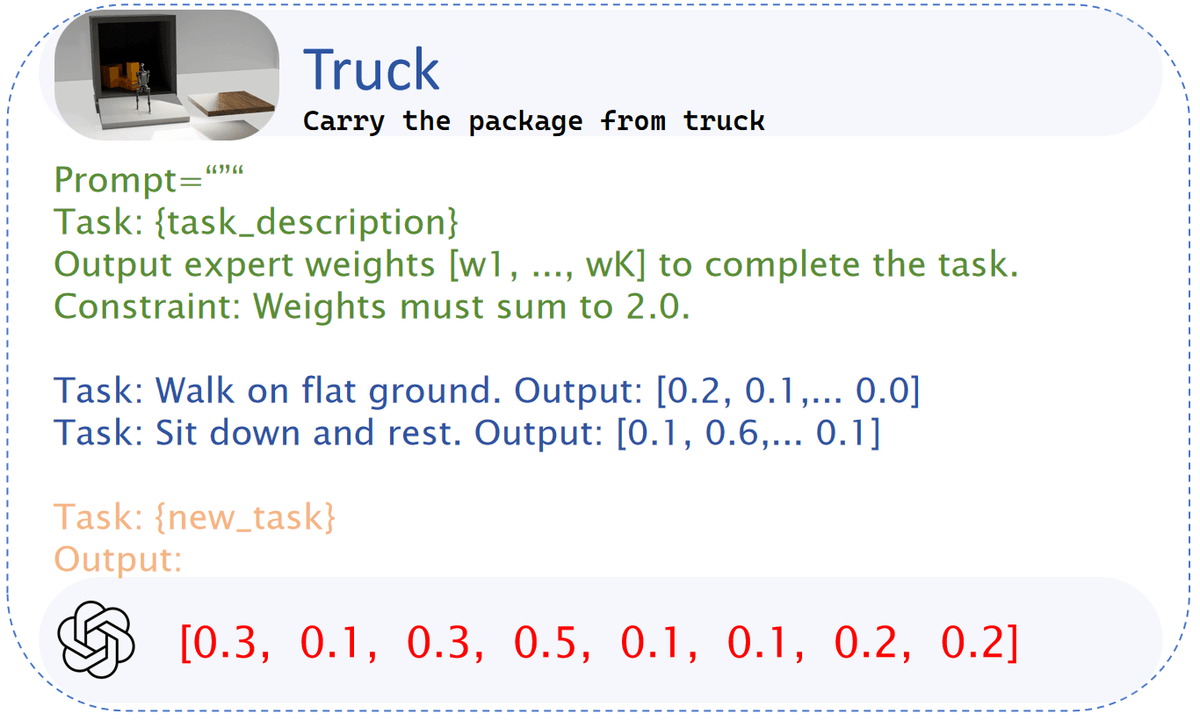
- VLM-guided Intelligent Routing Mechanism (IRM): A lightweight router network blends the expert policies at every timestep. Crucially, it's supervised by a Vision-Language Model (GPT-4o in the paper) that reads the task description and outputs relevance scores for each expert. The router learns to match those scores, then gradually transitions from VLM supervision to autonomous operation through a decaying training schedule.

How the motion prior actually works
The retargeting pipeline is worth understanding in detail. Human SMPL body model poses from AMASS are aligned to the robot's morphology via shape optimization, then inverse kinematics maps them to robot joint angles. Trajectories that are physically unstable get filtered out by a privileged simulation policy before they ever reach training. The surviving trajectories become reference targets for each expert.
During training, the expert's reward at each timestep is an exponential function of how closely the robot's joint positions and velocities match the reference. The exponential form is deliberate: it gives bounded, non-vanishing gradients whether the robot is close to or far from the target, which stabilizes learning under imperfect retargeting. A dynamic reweighting mechanism also up-weights joints that are tracking poorly, focusing the learning signal where it's most needed.

The VLM as a routing teacher
The IRM training has two phases that run simultaneously. First, a task-level prior: the VLM reads a natural language task description and outputs a probability distribution over which experts are relevant. The router minimizes KL-divergence to this distribution, giving it semantic grounding from the start. Second, a demonstration-level refinement: a few-shot set of example trajectories shows the router how expert weights should shift over time during a task (e.g., transitioning from Stand to Walk to Reach when opening a door). These two losses are combined with a time-decaying weight on the VLM term, so training starts VLM-guided and ends data-driven.
At inference time, the VLM is no longer queried. The router caches the task embedding once, then runs as a lightweight network that outputs blending weights at every control step , keeping latency low enough for real-time control.
Benchmark numbers that are hard to ignore
Experiments run on the HumanoidBench simulator (MuJoCo) across five locomotion tasks and five manipulation tasks. The success rate comparison against baselines after 500k training steps is stark:
| Method | Stand | Walk | Run | Sit | Carry |
|---|---|---|---|---|---|
| PPO | 0/10 | 0/10 | 0/10 | 0/10 | 0/10 |
| SAC | 1/10 | 1/10 | 0/10 | 2/10 | 1/10 |
| DreamerV3 | 2/10 | 2/10 | 1/10 | 3/10 | 2/10 |
| TD-MPC2 | 3/10 | 3/10 | 2/10 | 4/10 | 3/10 |
| MetaWorld-X | 9/10 | 9/10 | 9/10 | 8/10 | 9/10 |
On peak return scores, MetaWorld-X hits 2056.9 on the Run task versus TD-MPC2's 66.1 , a 31x gap. Convergence is also dramatically faster: the full model reaches stable performance on the door-opening task in 12.64 thousand steps, compared to TD-MPC2's 32.38 thousand steps. On manipulation tasks like Basketball, Door, Push, and Truck, MetaWorld-X is the top performer across the board.

What the ablation reveals
The ablation study on door-opening is particularly revealing about which components matter most:
- Remove the VLM entirely (replace with rule-based routing): complete task failure. The semantic understanding the VLM provides is not optional , it's what makes compositional generalization possible.
- Remove imitation learning: the model never converges, even if it achieves moderate returns. The motion prior isn't just for aesthetics; it provides the structured foundation the rest of the pipeline depends on.
- Remove the learned router (use VLM weights directly): performance stays high but training time increases 60% compared to the full model, confirming the router's role in efficient few-shot adaptation.
Where it falls short
The framework has real limitations worth flagging. All experiments are in simulation , there's no sim-to-real transfer demonstrated, and the gap between MuJoCo dynamics and physical hardware remains an open problem. The expert library is also manually curated: someone has to decide which skills to include, and tasks requiring skills outside that library will fail. The VLM routing adds a dependency on a large external model at training time, and while inference caches the task embedding, the quality of routing is only as good as the VLM's understanding of the task description. Finally, the paper doesn't address how the system handles skill transitions that aren't cleanly separable , tasks where locomotion and manipulation are deeply intertwined rather than sequential.
The bigger picture
Loco-manipulation names a specific engineering problem that separates useful humanoid robots from laboratory demonstrations: the combined, simultaneous execution of locomotion and manipulation. A robot that can walk or grasp is impressive; a robot that can walk to a shelf and pick up an unsorted component while maintaining balance as the load shifts its center of mass is what a warehouse or factory actually needs. MetaWorld-X doesn't solve that problem end-to-end, but it demonstrates a credible path: use human motion data to build a library of natural, stable primitives, then use language-model reasoning to compose them. The key insight , that semantic grounding via a VLM is not just helpful but necessary for compositional generalization , is the result most likely to influence future work in this space.
No code or pretrained models are publicly released with the paper, though the project page is available at syt2004.github.io/metaworldX. Given the pace of humanoid robotics research in 2026, expect follow-up work to push this toward real hardware soon.