
Meta Teaches Tiny 1B Models to Admit When They Will Fail
A new Meta and IDSIA paper teaches small models to predict how an LLM judge would score them, enabling smart routing to larger models only when needed.
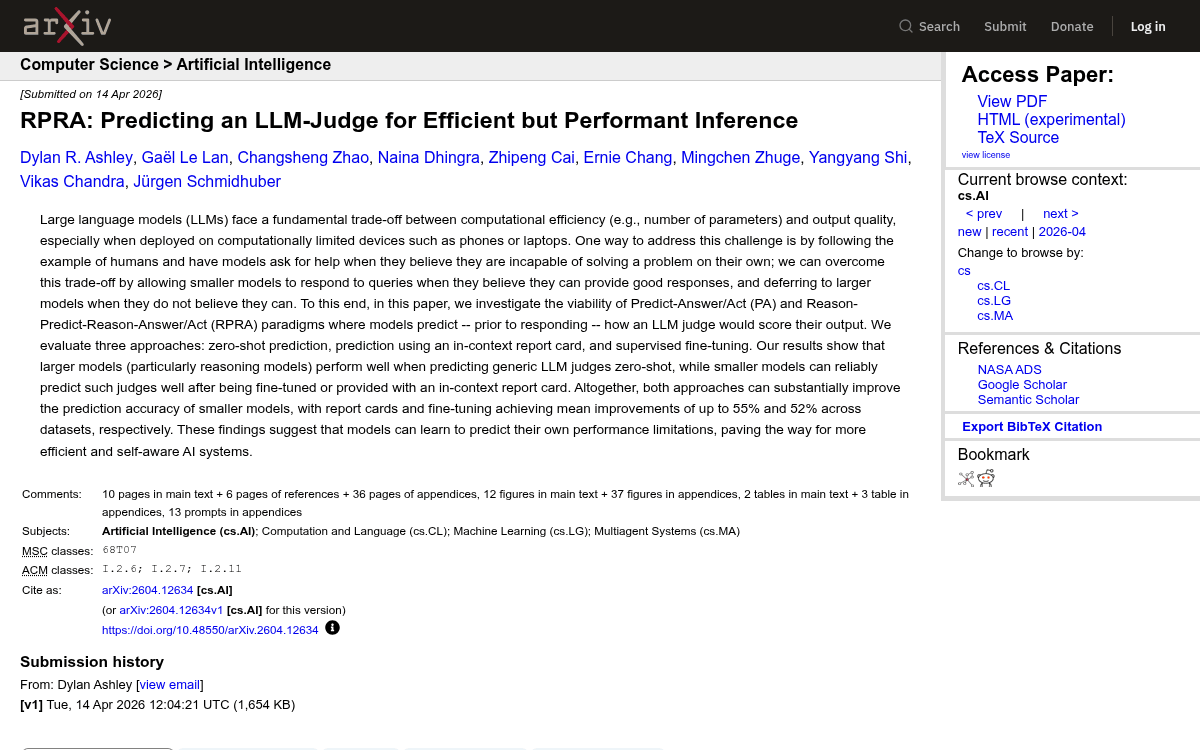
Takeaways
- New paper introduces Predict-Answer (PA) and Reason-Predict-Reason-Answer (RPRA) paradigms for efficient LLM inference.
- Small models learn to predict how an LLM judge would grade their answer before generating it, enabling smart routing.
- Report cards summarizing historical performance boost small-model prediction accuracy by up to +55% on average.
- Fine-tuning with the hindsight trick achieves comparable +52% gains without needing long context at inference.
- Tested across 11 models (MobileLLM 0.9B to Llama 4 Scout) on MedQA, LongFact, AIME 2024, SciCode, and MMLU-Pro.
- Full paper promises code release; work co-authored by Jürgen Schmidhuber and Meta researchers.
Small language models are cheap and fast, but they fail in unpredictable ways. What if a model could look at a query and honestly say I probably cannot answer this well before wasting compute on a bad response? A new paper from Meta, IDSIA, and KAUST (with Jürgen Schmidhuber among the authors) formalizes exactly that idea and shows it works surprisingly well, even for models under one billion parameters.
The work introduces two paradigms called Predict-Answer (PA) and Reason-Predict-Reason-Answer (RPRA). In both, a model predicts pre-hoc what grade an external LLM judge would give its response, and only generates a full answer if it thinks the response will be good. Otherwise, the query gets routed to a larger, more capable model.
The overconfidence problem in tiny models
The motivation is practical. MobileLLM and Llama 3.2 1B can run on phones and laptops, but their accuracy drops unevenly across tasks. That is why chatbots famously miscount the letters in strawberry. Just asking a small model are you confident? does not help either, because LLMs tend to be overconfident about their own outputs.
The authors reframe self-assessment as predicting an external grader. They use Llama 3.3 70B as an LLM judge that scores responses as great, ok, or bad according to a rubric covering accuracy, relevance, completeness, clarity, instruction following, and formatting. The prediction task is then: given only the query, output which of those three labels the judge will assign.