
Meta's MT-RL-Judge Beats Supervised AI Graders Across Six Evaluation Tasks
Meta AI trains a single multimodal judge with multi-task reinforcement learning, outperforming supervised fine-tuning and generalizing to unseen evaluation formats.
 Pro
Takeaways
- Meta AI proposes MT-RL-Judge, a single vision-language judge trained across six evaluation tasks with GRPO.
- Backbone is Qwen3-VL-30B-A3B-Instruct, trained with a format plus accuracy reward and 20 rollouts per prompt.
- Beats single-task SFT, unified SFT, and single-task RL across most in-distribution benchmarks.
- On held-out MJ-Bench pairwise tasks, unified SFT collapses to 49.4 F1 while MT-RL-Judge hits 82.2.
- Reasoning-first RL prevents the format overfitting that breaks supervised multi-task judges.
- Training uses public EasyR1 and LLaMA-Factory frameworks; no weights released.
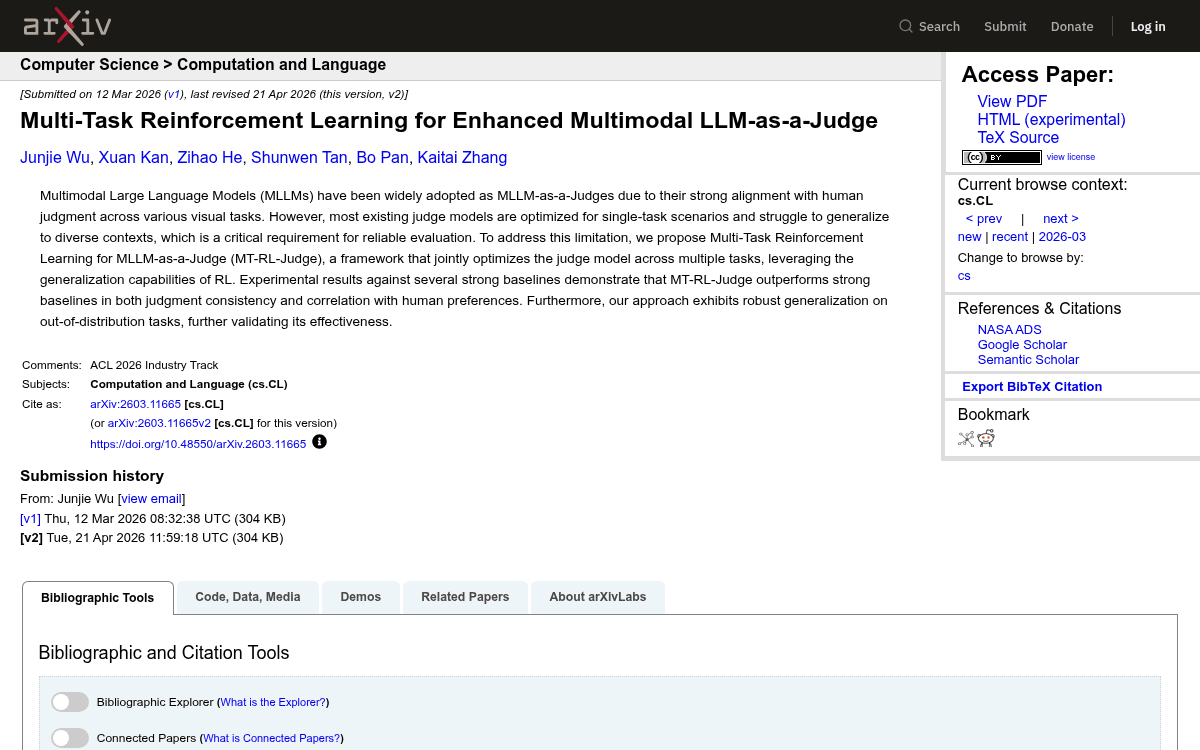
Using a large multimodal model to grade the outputs of another model has become the default shortcut when human evaluation is too slow or too expensive. The catch is that most of these judge models only work well on the exact task they were trained on, which is a poor fit for production pipelines where evaluation criteria keep shifting. A new paper from Meta AI, Multi-Task Reinforcement Learning for Enhanced Multimodal LLM-as-a-Judge, argues that the fix is not more supervised fine-tuning but multi-task reinforcement learning that forces the judge to actually reason before it decides.
Why single-task judges keep breaking
The MLLM-as-a-Judge paradigm uses a vision-language model to score things like text-image alignment, safety compliance, and image quality. Relying solely on prompt engineering with off-the-shelf MLLMs often yields suboptimal performance, necessitating task-specific training to achieve high-quality judgments, but the trained versions have their own failure mode.
The authors identify two problems that make current judges brittle:
- Narrow specialization. Existing trainable judges are typically built for one thing, like safety filtering or image quality scoring, so teams end up deploying and maintaining several models in parallel.
- Format overfitting. An SFT model trained on pointwise alignment (single image-text pair) struggles to generalize to pairwise comparisons, even when the underlying question (does this image match this caption?) is identical.
That second failure is the more interesting one. Supervised fine-tuning tends to memorize the surface pattern of the prompt template, not the evaluation logic underneath it.
The MT-RL-Judge recipe
The proposed framework, MT-RL-Judge, trains a single judge across many tasks at once using reinforcement learning instead of SFT. The backbone is Qwen3-VL-30B-A3B-Instruct, a mixture-of-experts vision-language model, and the optimizer is Group Relative Policy Optimization (GRPO), the same algorithm DeepSeek used for math reasoning.
The reward has two parts combined linearly:
- Accuracy reward: 1.0 if the final label matches the human annotation, 0.0 otherwise.
- Format reward: 1.0 if the model produces its reasoning inside
<thinking>tags and puts the final JSON verdict in a\boxed{}block, 0.0 otherwise.
For every prompt, the model generates a group of 20 rollouts, and GRPO uses the group's average reward as the baseline instead of training a separate value network. Training runs on EasyR1, an open-source multimodal RL framework, with SFT baselines built on LLaMA-Factory.
Six datasets, three capabilities
The unified training corpus covers three families of judging skills:
- Text-image alignment: SeeTRUE and ImageReward for checking whether captions actually describe an image.
- Safety: UnsafeBench, which covers violence, adult content, hate symbols, and similar categories.
- Perceptual quality: three AGIN subsets covering Naturalness (does it look like a real photo?), Rationality (does it obey physics and anatomy?), and Technical Quality (sharpness, artifacts, noise).
Each task uses a task-specific rubric prompt but the same reasoning-first output format, which is what lets one model learn all of them together.
Where the numbers land
On in-distribution tasks, MT-RL-Judge either wins or ties across the board. The more telling comparison is against three baselines built on the same backbone: an off-the-shelf zero-shot judge, single-task SFT and unified SFT, and single-task RL. RL-Single surpasses SFT-Single on 5 out of 6 benchmarks, achieving notable gains on SeeTrue (+3.0) and AGIN-Rationality (+4.63), which supports the argument that reasoning traces help most on tasks that actually need logic.
The out-of-distribution test is where the framework earns its keep. The team evaluated on MJ-Bench, a dataset strictly held out from the training corpora that requires pairwise comparison between two candidate images rather than the pointwise yes/no format used in training. The results:
| Method | Image-text Alignment (Macro-F1) | Safety Judge (Macro-F1) |
|---|---|---|
| Off-the-shelf zero-shot | 59.41 | 73.07 |
| SFT-Unified | 55.82 | 49.40 |
| MT-RL-Judge | 60.59 | 82.23 |
The unified SFT judge actually got worse than doing nothing on the safety task, dropping to 49.40%, falling substantially below that of the zero-shot Off-the-shelf baseline (73.07%). Multi-task exposure alone is not enough. The RL-trained version, on the other hand, adapted to the new pairwise format without any retraining.
What is actually new here
The headline finding is not that GRPO works on vision-language models. It is that switching from imitation to reward-driven training is what makes multi-task judges stop overfitting to input formats. An SFT-Unified model sees the same six tasks that MT-RL-Judge sees, but it collapses when the input structure changes because it never had to justify its answers. Forcing the model to write reasoning traces first, and then rewarding it only for correctness and format compliance, seems to push it toward learning the actual evaluation criteria.
Two honest caveats. First, SFT-Single still edges out MT-RL-Judge on UnsafeBench, likely because safety patterns are highly memorizable and a specialist can exploit that. Second, the paper does not release model weights or a dedicated code repository. The training stack is reproducible in principle since both EasyR1 and LLaMA-Factory are public, but anyone wanting to use MT-RL-Judge in production will need to rerun the pipeline themselves.
For teams building automated evaluation into content moderation, generative image QA, or preference-data pipelines, the practical takeaway is straightforward: if the goal is a single judge that survives changes to prompt format and task mix, unified SFT is not enough, and reasoning-first RL is worth the extra training cost.