
Meta's MBD Kills Recommendation Bias Across Two Billion-User Apps
Meta researchers built a lightweight ranking-model branch that estimates contextual distributions, converting biased engagement signals into calibrated relative scores in production.
 Pro
Takeaways
- Meta AI introduces MBD, a framework converting biased engagement signals into calibrated relative scores.
- A lightweight auxiliary branch estimates contextual mean and variance conditioned on user-defined bias feature sets.
- Computational overhead stays below 5% with detached gradients preserving the main ranking model.
- Cuts watch-time NLL by 50% versus cluster baselines and neutralizes duration bias to near zero.
- Deployed on billion-user short-video apps yielding +0.198% watch time and +0.190% breakout metrics.
- Handles sparse binary signals like shares through logit-space projection to avoid vanishing gradients.
Every large recommendation system quietly suffers from the same problem: the raw behavioral signals it ranks on lie about user preference. Watch time inflates for longer videos regardless of interest. Loop rate punishes anything longer than a few seconds. Comment probability boosts videos over photos. When a value model blends these numbers into a single ranking score, the bias gets baked into the recommendation itself.
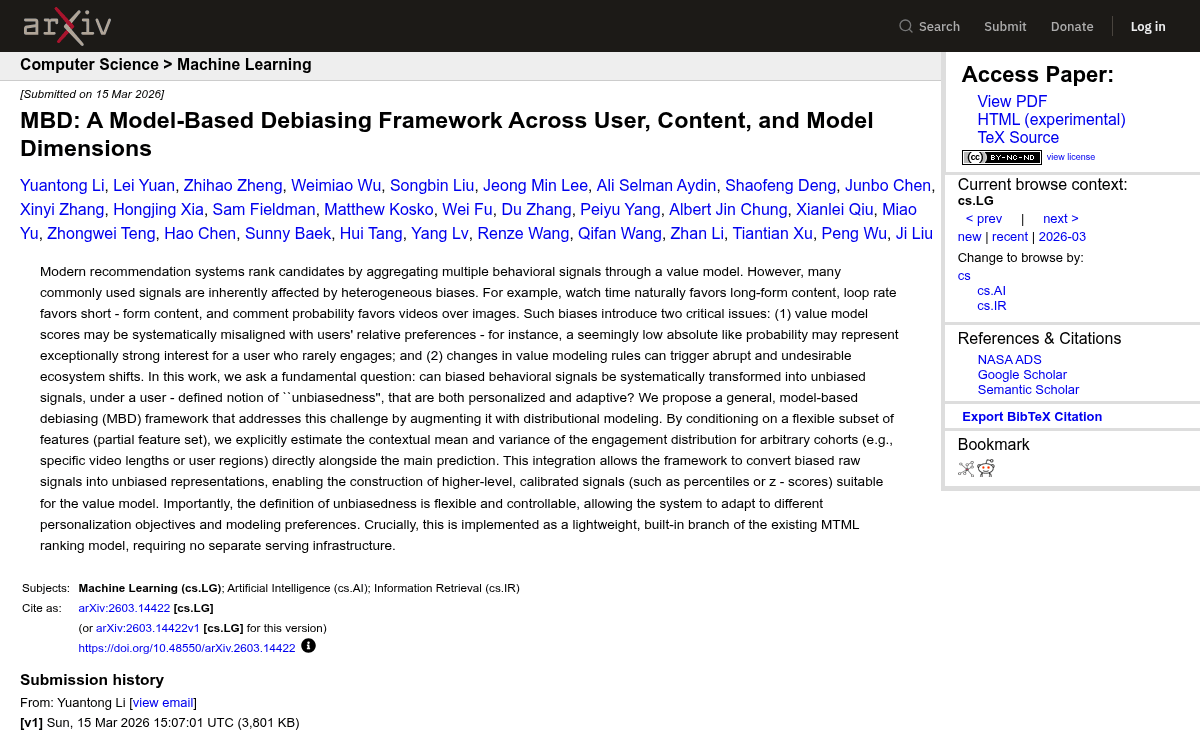
A team from Meta AI has proposed MBD (Model-Based Debiasing), a framework that reshapes those raw signals into unbiased, personalized versions by learning the statistical shape of "normal" engagement for any cohort you care about. It has already been deployed on two billion-user-level short-video applications, and the online A/B tests show measurable gains in retention and time spent.
Why point estimates are the wrong tool
Modern rankers use a multi-task multi-label (MTML) architecture that predicts a vector of engagement probabilities (like, share, watch time, loop) and then combines them with hand-tuned weights. The problem is that this linear aggregation treats raw engagement as a direct proxy for user preference intensity, when in reality those signals are confounded by content attributes rather than solely reflecting user interest.
A concrete example makes the failure obvious: 45 seconds of watch time indicates high interest for a 60-second clip but low interest for a 10-minute video. Traditional methods fail to quantify the contextual distribution of the baseline behavior. Without knowing what "normal" looks like for the specific context, you cannot separate genuine interest from bias-driven inflation.
The industry's usual fix is bucketized counting: group items by duration or category, compute a mean and variance offline, and subtract that baseline from predictions. It sort of works, but it breaks in four painful ways that Meta calls out directly:
- Discretization error: a 5.1s and a 9.9s video land in the same bucket despite very different natural watch times.
- Curse of dimensionality: conditioning on user region times video type times duration explodes into an unmanageable number of buckets.
- Data sparsity: cold-start items and rare cross-combinations have empty buckets.
- Temporal staleness: offline baselines drift as the ecosystem shifts, and real-time streaming aggregation is expensive to build.
Predicting the distribution, not just the point
MBD flips the framing. Instead of tightening the point estimate, it adds a second head to the existing ranker that predicts the contextual mean and variance of engagement, conditioned on a user-chosen subset of features called the bias feature set.
You pick what to debias against. Want to remove duration bias? Set x' = {user_profile, video_length}. Want cold-start fairness? Use {user_profile, view_count}. Want regional debiasing? Use {user_region, video_features}. The framework estimates the mean and variance of the engagement distribution for that cohort, then converts the raw prediction into a relative preference score (RPS), essentially a z-score against the cohort baseline.
Learning the mean is straightforward supervised regression against the main model's prediction. Variance is trickier because there is no direct label, so the authors use a decoupled method-of-moments trick: fit variance to the squared residual between the main prediction and the estimated mean, with stop-gradients on both sides to keep the auxiliary branch from perturbing the main ranker. The overall increased computational cost is typically below 5%, and gradients are detached so the debiasing branch has zero impact on the primary ranking model.
Once you have μ(x') and σ(x'), you can plug the RPS into the value model in different ways: additive boosting for high-confidence winners, hard filtering to suppress items far below their cohort baseline (useful against clickbait), or multiplicative reweighting for soft calibration.
What the numbers say
Offline, MBD sharply outperforms the cluster-baseline approach on distributional fit. MBD yields the lowest NLL, reducing watch time's NLL by more than 50% compared to cluster baselines (0.442 vs. 0.989). The improvement in like task (1.752 vs. 5.863) also validates the MBD's ability to model complex heteroscedasticity.
On the bias-mitigation test, the story is even cleaner. Raw watch time correlates 0.35 with video duration, and the ranking model actually amplifies that to 0.51. Heuristic baselines like VVP95 over-correct into negative territory (-0.043 and -0.228). MBD lands the RPS at 0.003 for watch time and -0.04 for loop rate, neutralizing bias in both directions without flipping to over-correction.

Deployment results at billion-user scale
Three real production case studies show the framework working in the wild:
- Media length debias: after correcting the systematic penalty against multi-media stories, impressions shifted +0.58% toward multi-media content, with +0.198% watch time and +0.173% likes.
- Content format debias: modeling the (user × format) cohort produced a +0.058% watch time lift on long-time-spent surfaces and filtered out clickbait using the
p < μ - σrule. - Cold-start debias: conditioning on (user × length × views) gave +0.190% breakout and +0.135% views by identifying high-potential new content that lacked interaction history.
The engagement efficiency analysis is the most interesting piece. Short videos (0-30s) saw both fewer views and less watch time, but views dropped harder than watch time (efficiency ratio below 100%), meaning MBD was pruning low-value loops. Longer videos (30s to several minutes) showed the inverse: a modest view increase produced a disproportionately large watch-time gain, with the 5-10 minute bucket delivering a 562% efficiency ratio.
Where it breaks and where it fits
The main pitfall the authors flag is variance modeling for sparse binary events like shares or comments, where click-through rates hover around 1%. In probability space, everything clusters near zero and gradients vanish. Their fix is a logit-space projection method that projects the prediction into the unbounded latent space by estimating the statistics of the logit, which stretches the compressed probability interval into a quasi-symmetric manifold where moments can actually distinguish signal from noise.
MBD is not open-source, and no code or model release is mentioned in the paper. It is described as a framework and architecture pattern that teams can implement on top of an existing MTML ranker. If you run a large-scale recommender with a value-model aggregation step, the recipe is straightforward: pick your bias feature set, add a dual-prediction branch with detached gradients, and swap raw predictions for RPS in the value model. The paper also mentions quantile regression as an alternative estimator, though it requires fixing the quantile level at training time.
The broader point is that this reframes debiasing from a per-signal engineering exercise into a general, feature-set-driven abstraction. Existing methods like D2Q, DVR and SWaT each solve specific bias types with bespoke machinery. MBD collapses those into one lightweight branch that any bias axis can plug into, which is why Meta is willing to run it in production across multiple surfaces at billion-user scale.