
Meta's LST Cuts Speech AI Compute by 20% While Boosting Accuracy 6.5%
Meta and Johns Hopkins researchers fix the core inefficiency in speech-text LLMs by replacing raw speech tokens with compressed latent patches, slashing compute by 20% while boosting accuracy by up to 6.5%.
 Pro
Takeaways
- Core idea: LST compresses groups of raw speech tokens into latent "patches," reducing sequence length and aligning speech with text granularity.
- Key results: Up to +6.5% absolute gain on speech HellaSwag and +5.2% on text HellaSwag under the same compute budget.
- Efficiency: 4-to-1 speech token compression cuts ~20% of transformer FLOPs; TTS inference requires 4x fewer autoregressive steps.
- ASR stability: LST achieves 6.8% WER at 1k fine-tuning steps vs. 140% for the baseline -- a dramatic stabilization.
- Scales well: Gains grow from 420M to 1.8B parameters and persist at 7B, suggesting improved compute-optimal scaling.
- Open source: Code available from Meta/Facebook Research on GitHub.
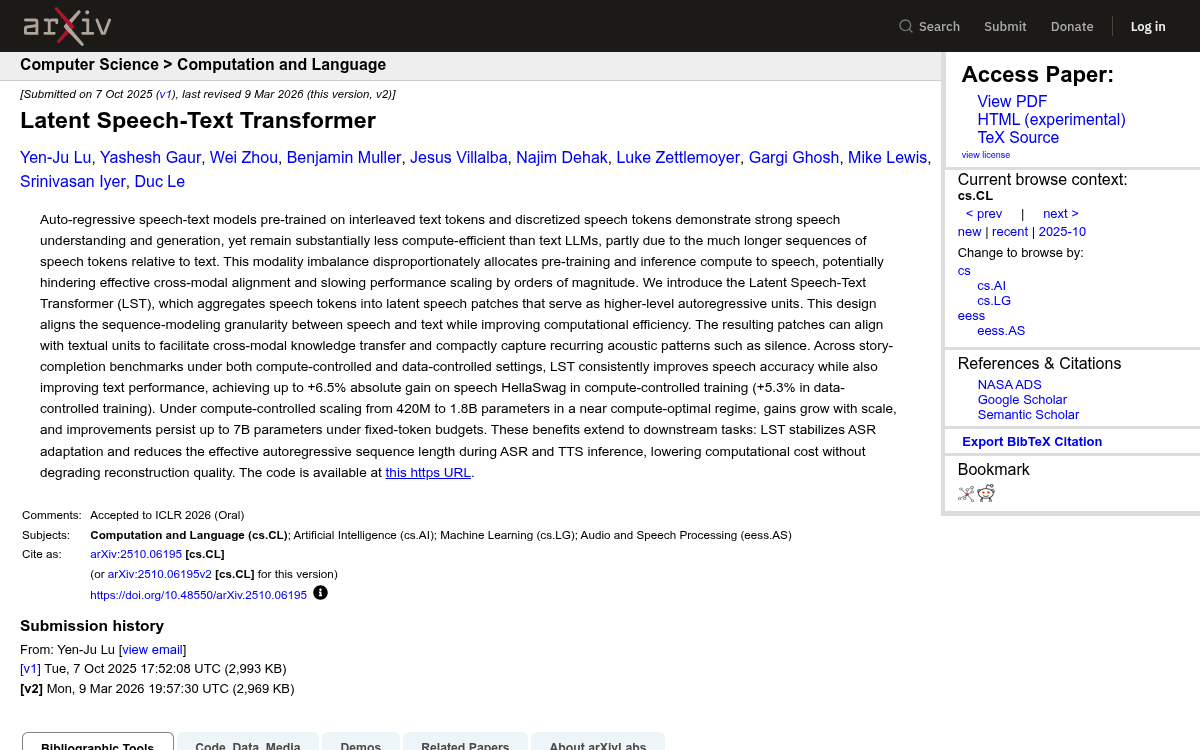
Speech-language models have a dirty secret: they are dramatically less efficient than their text-only counterparts, and the gap is not small. Auto-regressive speech-text models pre-trained on interleaved text and discretized speech tokens demonstrate strong speech understanding and generation, yet remain substantially less compute-efficient than text LLMs, partly due to the much longer sequences of speech tokens relative to text. Researchers from Meta and Johns Hopkins University have now published a fix, and it is elegant.
The paper introduces the Latent Speech-Text Transformer (LST), a new architecture that compresses groups of raw speech tokens into compact "patches" before feeding them into the main language model. The result is a system that is faster to train, cheaper to run at inference, and -- counterintuitively -- more accurate on both speech and text benchmarks. The code is open-source on GitHub.
Why speech tokens are a compute nightmare
To understand the problem, you need to know how speech is typically represented in these models. Raw audio is encoded into discrete tokens using a model like HuBERT, which produces tokens at 25Hz -- meaning 25 tokens per second of audio. The frame rate of discrete speech tokens typically ranges from 25 to 100Hz, leading to a huge discrepancy in lengths between speech representations and the underlying text modality. A single spoken sentence that maps to 10 text tokens might require 200 or more speech tokens to represent the same content.
Speech tokens are more than 11 times longer than text tokens, which means that in a joint speech-text model, the transformer spends the vast majority of its compute budget processing speech -- even though speech carries far less semantic information per token than text. This modality imbalance disproportionately allocates pre-training and inference compute to speech, potentially hindering effective cross-modal alignment and slowing performance scaling by orders of magnitude.
Prior attempts to fix this have largely failed. Systems relying on fixed-frame-rate acoustic tokenization result in speech sequences that are significantly longer than their corresponding text. Beyond computational inefficiency, this sequence length disparity often triggers hallucinations in TTS and amplifies the modality gap in spoken language modeling. Approaches like acoustic BPE -- borrowing the subword compression trick from text -- showed limited gains in practice.
Patches, not tokens
LST's core idea is borrowed from Meta's own Byte Latent Transformer (BLT), which showed that grouping raw bytes into dynamic patches before processing them with a large transformer is more efficient than operating on individual tokens. LST applies the same intuition to speech. LST aggregates speech tokens into latent speech patches that serve as higher-level autoregressive units. This design aligns the sequence-modeling granularity between speech and text while improving computational efficiency.
The architecture has three components working together:
- Patch Encoder: A lightweight transformer that reads a local window of raw speech tokens and compresses them into a single patch embedding using sliding-window self-attention and cross-attention. Only speech spans are patched -- text tokens pass through unchanged.
- Global Transformer: The main, large autoregressive model that processes the interleaved sequence of text tokens and speech patches. This is where most of the compute lives, and it now operates on much shorter sequences.
- Patch Decoder: A second lightweight transformer that takes patch representations and reconstructs the original speech tokens for generation tasks like TTS. It uses cross-attention to condition on both the latent patches and the text context.

The key insight is that the heavy global transformer -- which scales quadratically with sequence length -- now operates on compressed patches instead of raw speech tokens. The resulting patches can align with textual units to facilitate cross-modal knowledge transfer and compactly capture recurring acoustic patterns such as silence.
Three ways to decide where patches begin
One of the more interesting contributions is the set of patching strategies the team explores. Not all patches are created equal:
- Static Patching: Every 4 consecutive HuBERT tokens are merged into one patch, regardless of content. Simple and fast, but ignores linguistic structure.
- Alignment Patching: Uses a Wav2Vec2+CTC forced aligner to find word boundaries in the audio, then creates one patch per word. Silence regions between words get their own patches too. This creates semantically coherent patches but requires an external aligner at inference time.
- Curriculum Patching: Starts training with alignment-based patches (which carry rich semantic signal), then gradually transitions to static patches over the course of training. At inference, only static patching is needed -- no aligner required. This is the best-performing strategy overall.
The curriculum approach is particularly clever: it uses the aligner's supervision during the phase when the model is learning the most, then weans itself off the dependency. Curriculum patching gradually transitions from alignment-based to static patching, retaining alignment benefits during early training while enabling simple static-only inference.
The numbers are hard to argue with
The team evaluated on speech versions of standard commonsense reasoning benchmarks: HellaSwag (pick the most plausible sentence completion from 4 options), StoryCloze (2-way narrative coherence), and TopicStoryCloze (topic-consistent story completion). All speech was synthesized with the Kokoro TTS model to create spoken versions of these text benchmarks.
Under a fixed compute budget (same number of training iterations), LST with Curriculum Patching delivered:
- +6.5% absolute on speech HellaSwag (39.0 → 45.5)
- +5.2% absolute on text HellaSwag (47.0 → 52.2), showing the gains are not zero-sum
- Consistent improvements on StoryCloze and TopicStoryCloze across both modalities
Under compute-controlled scaling from 420M to 1.8B parameters in a near compute-optimal regime, gains grow with scale, and improvements persist up to 7B parameters under fixed-token budgets. This is a critical result: the benefit is not a small-model trick that disappears at scale.
The efficiency story is equally strong. LST stabilizes ASR adaptation and reduces the effective autoregressive sequence length during ASR and TTS inference, lowering computational cost without degrading reconstruction quality. Specifically, the 4-to-1 patching ratio cuts the speech portion of the sequence by 75%, reducing overall transformer FLOPs by roughly 20% due to the quadratic attention cost.

ASR fine-tuning: a dramatic stability improvement
One of the most striking downstream results is in ASR (automatic speech recognition) fine-tuning. The baseline SpeechLLM, when fine-tuned on LibriSpeech for just 1,000 steps, produces 140% / 202% word error rate -- essentially hallucinating transcripts. LST at the same checkpoint achieves 6.8% / 10.4% WER. By 2,000 steps, LST is already at its best performance, while the baseline is still struggling at 44.7% / 73.2% WER. The patching mechanism appears to stabilize the model's behavior during adaptation, likely because the compressed sequence length reduces the chance of runaway autoregressive errors.
For TTS, LST matches the baseline in character error rate after 20,000 fine-tuning steps, while generating sequences that are 4x shorter -- meaning 4x fewer autoregressive decoding steps at inference.
What it cannot do (yet)
The paper is honest about its limitations. The current work:
- Only covers half-duplex interaction (speech and text alternate in turns), not real-time full-duplex dialogue like Moshi
- Does not include instruction fine-tuning or RLHF-style alignment -- only pre-training is studied
- Has not been extended to other modalities like image or video
- Curriculum and alignment patching still require a forced aligner during pre-training, even if not at inference
The t-SNE visualizations of the learned patch embeddings are a nice sanity check: patches for the same word cluster tightly together (within-word cosine similarity ~0.87), while different words are well-separated (~0.43 between-word similarity). The model is genuinely learning word-level acoustic concepts inside its patches, not just compressing noise.
The bigger picture
LST is a meaningful step toward closing the gap between speech and text LLMs. The fundamental problem -- that speech requires orders of magnitude more tokens to represent the same semantic content as text -- has been known for years. Speech+text models are designed to jointly model both speech and text, often by interleaving token sequences from both modalities, enabling transfer and sharing of semantic knowledge from pre-trained textual LLMs, significantly improving language understanding and reducing data requirements. But the sequence length mismatch has always been a drag on how well that transfer actually works.
By operating at the granularity of words rather than acoustic frames, LST gives the global transformer a fighting chance to treat speech and text as genuinely equivalent modalities. The fact that text performance also improves -- not just speech -- suggests the model is learning better joint representations, not just getting more efficient at a fixed quality level. For anyone building voice-native AI systems, this is the kind of architectural progress that compounds.