
Meta's Fillerbuster Fills Missing 3D Scenes From a Single Phone Video
A new multi-view diffusion transformer from Meta and Berkeley jointly fills in missing 3D scene content and recovers camera poses from casual phone captures.
 Pro
Takeaways
- Fillerbuster is a 650M-parameter multi-view diffusion transformer that completes 3D scenes from casual captures. Paper
- It jointly denoises images and camera raymaps, so it can hallucinate views and recover unknown poses in one pass.
- Trained from scratch on ScanNet++ and Shutterstock data using 64 A100 GPUs for about a month.
- Beats NeRFiller on masked 3D inpainting: 29.60 vs 25.57 PSNR, 0.096 vs 0.182 LPIPS.
- Supports flexible sequence lengths via index embeddings, scaling from a handful of frames to dozens.
- Code, weights, and Nerfstudio/gsplat integration available at facebookresearch/fillerbuster.
Anyone who has tried to reconstruct a 3D scene from a phone video knows the drill: you scan a room, feed the footage into Gaussian Splatting or a NeRF, and the moment the virtual camera pans somewhere you did not actually record, the reconstruction falls apart into smears and floaters. A team from Meta Reality Labs, UC Berkeley, and the University of Toronto is proposing a fix called Fillerbuster, a multi-view diffusion transformer that hallucinates the missing parts of a scene and recovers camera poses at the same time.
The model completes unknown regions of a 3D scene with a multi-view latent diffusion transformer, targeting the reality that casual captures are often sparse and miss surrounding content behind objects or above the scene. In practice, users have hundreds of input frames and want to complete areas that none of those frames observed. The team is releasing weights and training code through facebookresearch/fillerbuster, with hooks into Nerfstudio and gsplat.
Why casual captures break existing tools
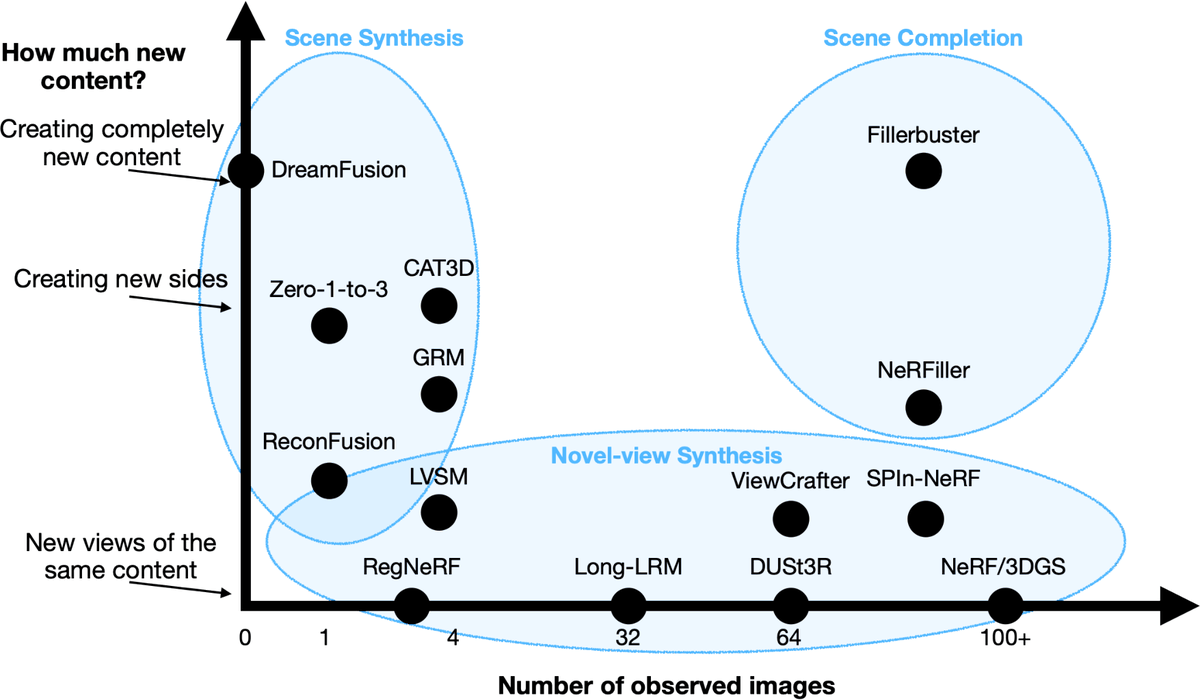
Two families of prior work touch this problem but neither really solves it. Sparse-view reconstruction methods try to make the pixels you did capture look better. Object-centric generative models like Zero-1-to-3 or CAT3D hallucinate the hidden sides of a single object from one or two photos. CAT3D uses 1 or 3 input images and generates 7 or 5 outputs, but never goes beyond a total sequence size of 8, and it remains closed-source.
Real casual captures sit awkwardly between those regimes. You have dozens or hundreds of frames, the poses may or may not be known, and the missing content is scattered around the scene in unpredictable places. 3D inpainting methods like SPIn-NeRF or NeRFiller rely on 2D inpainters inside a NeRF pipeline, and none of them condition on camera views when inpainting, which makes completion of large unknown regions impossible because some generated views end up with no context of the existing scene.
A unified image-and-pose diffusion transformer
Fillerbuster reframes scene completion as a single joint inpainting problem over both pixels and cameras. It is a latent diffusion transformer that denoises multiple input images and calibrated camera poses with masks indicating known and unknown regions. Cameras are represented as 6-channel raymaps, where each pixel stores a ray origin and unit direction in world space, rather than the more common Plücker coordinates.

The workflow at inference time is flexible. You hand the model any mix of the following, and it fills in the rest:
- Known images with known poses (standard conditioning)
- Known poses where you want new views generated
- Partial images where only some pixels are known
- Known images whose poses are unknown and need to be recovered
Under the hood, the architecture is DiT-L/2 with a latent patch size of 2 by 2 and 24 layers of multi-head self-attention, trained with a flow matching objective. Separate VAEs compress images and raymaps by 8x spatially into a 16-dimensional latent, and the full model has only 650M parameters, small enough to fit on most GPUs. Classifier-free guidance is applied separately over images and raymaps, with a higher weight in unknown regions than in known ones.
How it scales to long sequences
The most interesting design choice is how Fillerbuster handles a variable number of frames. It uses two positional embeddings: fixed sinusoidal 2D layout embeddings for patches within an image, and an unordered index descriptor added to every token coming from the same image. During training the per-image frequency is sampled randomly; at inference the frequencies are spaced uniformly across however many frames you pass in.
That decoupling lets a model trained on sequences of around 20 images generalize to inference sequences of 32, 48, or more. Completion is also non-autoregressive: the model denoises all views at once rather than generating one frame conditioned on the previous, which is how it stays consistent across a wide baseline.
Training was not cheap. The team trained from scratch on ScanNet++ plus a large corpus of Shutterstock 2D images and 3D asset renderings, using 64 A100 GPUs for approximately a month at 256 by 256 resolution for 1M iterations, then fine-tuned for 100K iterations with resolutions ranging from 64 by 64 up to 1024 by 1024.
What the numbers say
On the NeRFiller masked-region completion benchmark, Fillerbuster is comfortably ahead:
| Method | PSNR | SSIM | LPIPS |
|---|---|---|---|
| NeRFiller | 25.57 | 0.89 | 0.182 |
| Fillerbuster | 29.60 | 0.92 | 0.096 |
The reported metrics compare 32 inpainted images against the final renderings from the same 32 viewpoints, without depth supervision or iterative dataset updates. On the Nerfbusters casual-capture dataset, the authors introduce a relative rotation accuracy metric that estimates how consistent the geometry of a generated fly-through is by running LoFTR feature matching between nearby frames and computing camera rotations. Fillerbuster produces the most geometrically stable videos in that comparison.

An ablation surfaces an unexpected finding: dropping the pose-prediction task hurts image quality. When the model does not learn to predict camera pose, it performs worse at image generation, indicating that image and pose predictions are complementary tasks.
Uncalibrated scene completion
Because raymaps are just another modality the model can inpaint, Fillerbuster can bootstrap a scene from unposed photos. Given 16 unposed images, the model denoises the raymaps conditioned only on the images, then solves for pinhole camera parameters that match backprojected rays to the denoised rays, taking only 5 seconds to converge for 16 images. After that, generated poses become the conditioning for hallucinating a full fly-through of the scene, all without ever running COLMAP or an external structure-from-motion pipeline.
Inference is fast enough to be usable. For 50 denoising steps at 256 by 256, a batch of 16 images takes about 12 seconds on an A100; at 512 by 512 it climbs to under a minute. The authors note that quality holds up at roughly 24 steps, halving those times.
Where it fits and where it breaks
The natural home for this model is scene reconstruction from consumer captures: apps like Polycam, Luma flythroughs, or any Gaussian Splatting pipeline where a user waves a phone around and expects a watertight result. Fillerbuster generates a set of ~100 novel anchor views in multiple rounds, adds them to the training dataset, and then optimizes 3D Gaussians with an added normal-alignment regularizer to keep geometry from cheating on inconsistencies.
The authors are candid about limits. Choosing camera paths is challenging because cameras should not be sampled inside objects or behind walls, and generations degrade when sampled far outside the conditioning views, suggesting benefits from more diverse training data and stronger priors. They also flag that starting from a pre-trained image or video diffusion model would likely yield better fidelity than training from scratch, though they trained from scratch for legal reasons around the underlying datasets.
One denoising pass to rule them all
The real advance here is unification. Previous multi-view generative models either assumed known cameras, produced only a small fixed number of views, or handled objects rather than full scenes. Fillerbuster collapses novel-view synthesis, pose recovery, and 3D inpainting into one denoising pass over a variable-length sequence, using a 650M-parameter model that runs on a single GPU. The framework is designed to be extended: the same joint-inpainting scheme could add depth, Gaussians, or semantics as additional modalities, which the authors explicitly encourage the community to build on top of the open-source release.