
Meta's DexWM Teaches Robots Dexterous Grasping by Watching Human Hands
DexWM predicts dexterous hand-object interactions from egocentric video, then plans robot grasps hitting 83% success on a real Franka arm zero-shot.
 Pro
Takeaways
- DexWM predicts future latent states of dexterous hand-object interactions using 3D finger keypoints as the action space.
- Trained on 900+ hours of EgoDex human video and DROID robot data, unified via dummy keypoints for parallel-jaw grippers.
- An auxiliary hand consistency loss boosts fingertip prediction accuracy by up to 34% at 4-second horizons.
- Hits 83% zero-shot grasping success on a real Franka Panda arm with Allegro hand, no real-world training.
- Beats Diffusion Policy by 50+ points on average across reach, grasp, place simulation tasks.
- Code released at github.com/facebookresearch/dexwm; accepted to ECCV 2026.
Teaching robots to manipulate objects like humans do has been stuck on a data problem. There is no large-scale dataset of five-fingered robots doing chores, and even the best world models condition on coarse signals like text prompts or wrist positions that miss what fingers are actually doing. A team from Meta FAIR and NYU, including Yann LeCun, is proposing a workaround: skip the robot data, learn dexterity from human hands on video, and use the resulting model as a planner for a real robot.
Their system, DexWM, is a latent-space world model that predicts future latent states of the environment conditioned on past states and dexterous actions. Rather than predicting pixels, it predicts DINOv2 features, then uses those predictions inside a Model Predictive Control loop to grasp real objects with an Allegro hand attached to a Franka Panda arm. It works zero-shot in the real world, and the code is out.
The action-space problem in one sentence
Every world model needs a way to represent what the agent did between two frames. Prior work has modeled wrist position or used high-level text, but these representations are often too coarse for dexterous skills. Text says "pick up the duck" but does not say which finger touches where. A wrist trajectory tells you the arm moved but not whether the hand opened. For dexterous manipulation, both details matter.
DexWM's answer is to represent an action as the change in 3D hand keypoints between two moments, plus the change in camera pose. Following the MANO parameterization, each hand is represented by 21 keypoints, and the action vector stacks the delta of both hands together with camera translation and orientation deltas, producing a 44 by 3 tensor per step. Because both hands share one representation, human egocentric video and robot data can be poured into the same training pipeline.
Turning humans into training data
The team trained on roughly 900 hours of video across two sources:
- EgoDex, an egocentric video dataset for learning dexterous manipulation, recorded using Apple Vision Pro headsets, providing 829 hours at 1080p with 25 hand keypoints per hand.
- DROID, a diverse robot manipulation dataset collected using the Franka Panda robot equipped with parallel-jaw grippers, roughly 100 hours.
DROID is the interesting bit. Parallel-jaw grippers have two prongs, not five fingers, so how do you feed them to a five-fingered action space? Parallel-jaw grippers are approximated as dexterous hands using dummy keypoints placed on concentric circles at the end-effector, with radii varying by the gripper's open/close state, mimicking finger spread. An open gripper becomes a splayed hand; a closed gripper becomes a fist. This trick lets the same model absorb human videos, parallel-jaw robot videos, and later, a real Allegro hand.
How the model is put together
The architecture is deliberately lightweight for a world model in the video generation era:
- Frames are encoded with a frozen DINOv2 image encoder, producing patch-level latent states.
- A Conditional Diffusion Transformer (CDiT) predictor takes a history of past latents plus the current action and outputs the next latent state.
- Unlike diffusion-based CDiT methods, we directly regress future latent states using DINOv2 features for faster inference without iterative denoising.
- A small transformer keypoint head reads the predicted latent and outputs heatmaps for fingertips and wrists.
That last piece is the second key idea. The team noticed that if you only train the model to match future DINOv2 features, the hand region, which is tiny compared to the full image, gets ignored. So they added a hand consistency loss that forces the predicted latent to also decode into correct fingertip and wrist heatmaps. Adding hand consistency loss yields up to a 34% increase in PCK@20 at 4 seconds prediction. PCK@20 measures the percentage of predicted keypoints landing within 20 pixels of the ground truth, a standard hand-pose metric.
From world model to robot planner
A world model that only rolls out video is a curiosity. DexWM becomes useful because it plugs into an MPC controller. Given a start image and a goal image, the system searches over robot joint-angle trajectories using the Cross-Entropy Method. Forward kinematics converts each candidate joint sequence into a hand-keypoint action, DexWM rolls out the resulting latent trajectory, and the cost function scores how close the final latent (and predicted keypoints) come to the goal.
Because everything happens in latent space, planning is fast enough to be practical. DexWM rollouts during simulation planning are parallelized across 8 H100 GPUs, with total planning time per episode ranging from 38 to 168 seconds depending on how many CEM samples and iterations you spend. To bridge the human-to-robot embodiment gap, the model is fine-tuned on about four hours of random exploratory motions collected in the RoboCasa simulator, with no task-specific demonstrations.
The numbers
The most striking result is real-world grasping. Deployed on a real Franka arm with an Allegro hand and no real-world training data at all, DexWM achieves 10 successes out of 12 trials, approximately 83% success rate. In simulation across reach, place, and grasp tasks, the comparisons look like this:
| Model | Reach | Place | Grasp (sim) | Grasp (real) |
|---|---|---|---|---|
| Diffusion Policy | 16% | 8% | 0% | 0% |
| DexWM without pretraining | 18% | 8% | 14% | 0% |
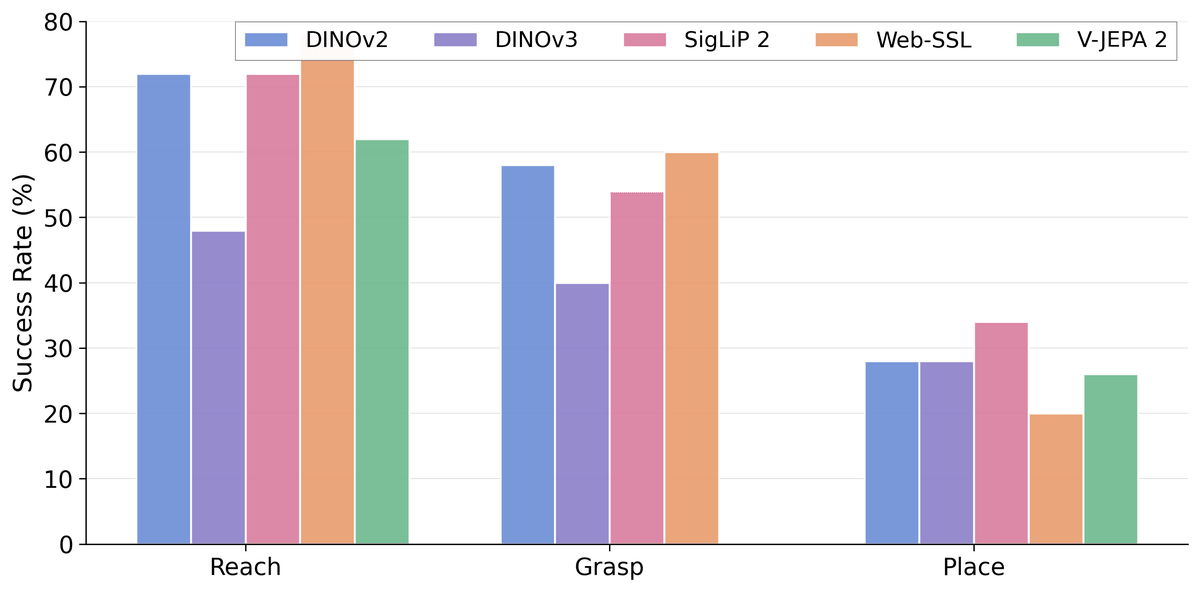
| DexWM | 72% | 28% | 58% | 83% |
The DexWM-without-pretraining row is important: it isolates the value of human video pretraining, not just the architecture. The team also ran a control experiment where they pretrained Diffusion Policy on the same human data. DP achieves only 4% average simulation success, far below DexWM's 53%, indicating that the improvement stems from modeling dexterous dynamics rather than pretraining alone.
On open-loop video prediction, DexWM beats a text-conditioned Cosmos-Predict2, a navigation-conditioned NWM variant, and a body-pose-conditioned PEVA variant. Interestingly, PEVA gets slightly lower perceptual loss on DINOv2 embeddings, but DexWM wins on PCK@20 by five points. The authors argue this exposes a weakness in how world models are usually evaluated: a lower feature-space L2 does not necessarily mean the hands are in the right place.
What it is good at, and where it breaks
DexWM works best on manipulation tasks that can be posed as goal-image reaching in a mostly static scene with a single agent. It handles reach and grasp well; place is harder because the robot has no force feedback and must maintain grip through an entire transport motion. A failure analysis in the paper attributes 70% of place failures to dropping the object before reaching the target.
Other limitations to know about:
- Goals are specified as images, not language, though the framework could be extended.
- The system still needs about four hours of exploratory robot data in simulation to close the embodiment gap.
- Our current setup assumes static scenes without external agents, so dynamic environments with other actors would require adding stochasticity.
- Scaling behavior is monotonic from 30M to 450M parameters, but the paper does not push beyond that.
Availability
The paper has been accepted to ECCV 2026 and the team released code on GitHub under the facebookresearch org. The project page links to unofficial weights on Google Drive. Backbones are swappable: the ablations show DexWM also runs with DINOv3, Web-SSL, V-JEPA 2, and SigLIP 2, with DINOv2 as the default.
The broader point worth taking away: for tasks where getting robot data is prohibitively expensive, a world model trained on humans and used as a planner is starting to look like a serious alternative to imitation learning. Behavior cloning collapses when the training set lacks successful demonstrations of the target task, but planning inside a learned dynamics model does not need them, only enough exploratory data to ground the embodiment.