
Meta FAIR's Neural MFG Beats Classic Pandemic Models by 4,500x
A new arxiv paper from Radboud University and Meta FAIR fuses mean-field game theory with neural SDEs, cutting COVID modeling error by orders of magnitude.
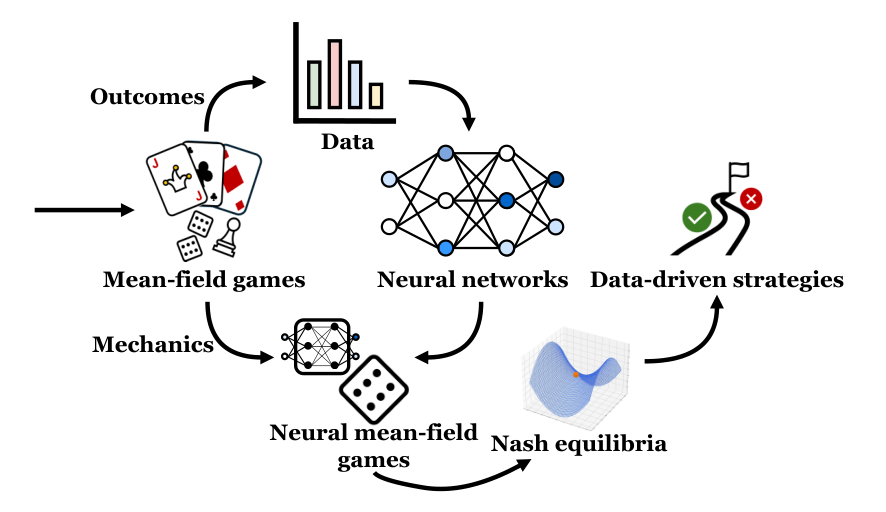
Takeaways
- Radboud University and Meta FAIR propose Neural Mean-Field Games, combining MFG theory with neural SDEs.
- The network augments classical HJB and Fokker-Planck dynamics, making equilibria data-driven while preserving existence proofs.
- On COVID-19 SIR modeling in Japan, MSE drops to 2.407e-7, beating Latent SDE, ContiFormer and deep-RL baselines.
- Extended out-of-sample test shows 9.076e-6 MSE versus 0.318 for Latent SDE across the Omicron wave.
- Small MLPs of 3 to 8 layers run on an Apple M1 Pro laptop using JAX, Diffrax and Equinox.
- Code is open-source; limits include shared weights across agents and opaque decisions.
A new research paper introduces Neural Mean-Field Games, a framework that grafts a neural stochastic differential equation onto the classical mean-field game (MFG) formulation so the resulting model can learn strategic dynamics from data rather than being fully specified by hand. The work, authored by Anna C.M. Thöni and Tal Kachman at Radboud University with Yoram Bachrach at Meta FAIR, is a methodological contribution and ships with open-source code in JAX.
Why mean-field games are painful to solve
Mean-field game theory models strategic interactions when the number of players is so large that tracking them individually becomes intractable. Instead of simulating every agent, MFGs replace the crowd with a distribution and describe the equilibrium through a coupled pair of PDEs: a Hamilton-Jacobi-Bellman equation for the representative agent's optimal strategy, and a Fokker-Planck equation for how the population evolves over time.
That elegance comes with real headaches. The PDE approach requires full knowledge of the game dynamics, suffers from the curse of dimensionality, and the finite-difference discretizations used to solve it can destroy the existence or uniqueness of solutions. Reinforcement-learning approaches based on Fictitious Play are model-free but give up the numerical exactness of the differential-equation route.
Splitting the difference with a neural SDE
The authors sit between those two camps by treating the agent-level dynamics as a neural SDE, the stochastic extension of neural ODEs from Chen et al. In a plain neural SDE, both the drift and diffusion terms of a stochastic process are parameterized by small neural networks and unrolled by a differentiable solver. Applied to an MFG, the network output is added on top of the classical drift, so the model keeps the known physics of the game and lets a network fill in what the equations miss.