
Meta and CMU's BTPO Fixes the Broken Math Behind AI Preference Training
BTPO fixes a fundamental math flaw in how reasoning models are trained on human preference data, beating GRPO-based approaches by up to 9% on key benchmarks
 Pro
Takeaways
- BTPO is a new training algorithm for reward models that reason via chain-of-thought before scoring responses, fixing a fundamental math flaw in prior approaches.
- Existing methods (GRPO, RM-R1, J1) treat preference learning as a verifiable generation task -- BTPO shows this ignores the true Bradley-Terry likelihood structure.
- The key insight: CoT reasoning is a latent variable in the preference likelihood, creating a ratio-of-expectations that standard RL objectives cannot optimize correctly.
- BTPO uses a Monte Carlo gradient estimator with an instance-level misalignment weight that automatically focuses training on examples the model currently gets wrong.
- BTPO outperforms all baselines by up to 9.1% on math reasoning and beats RM-R1 by over 30 points on math, across four model sizes with no SFT pre-training.
- No public code or model release; paper from Meta Superintelligence Labs and CMU is available on arXiv.
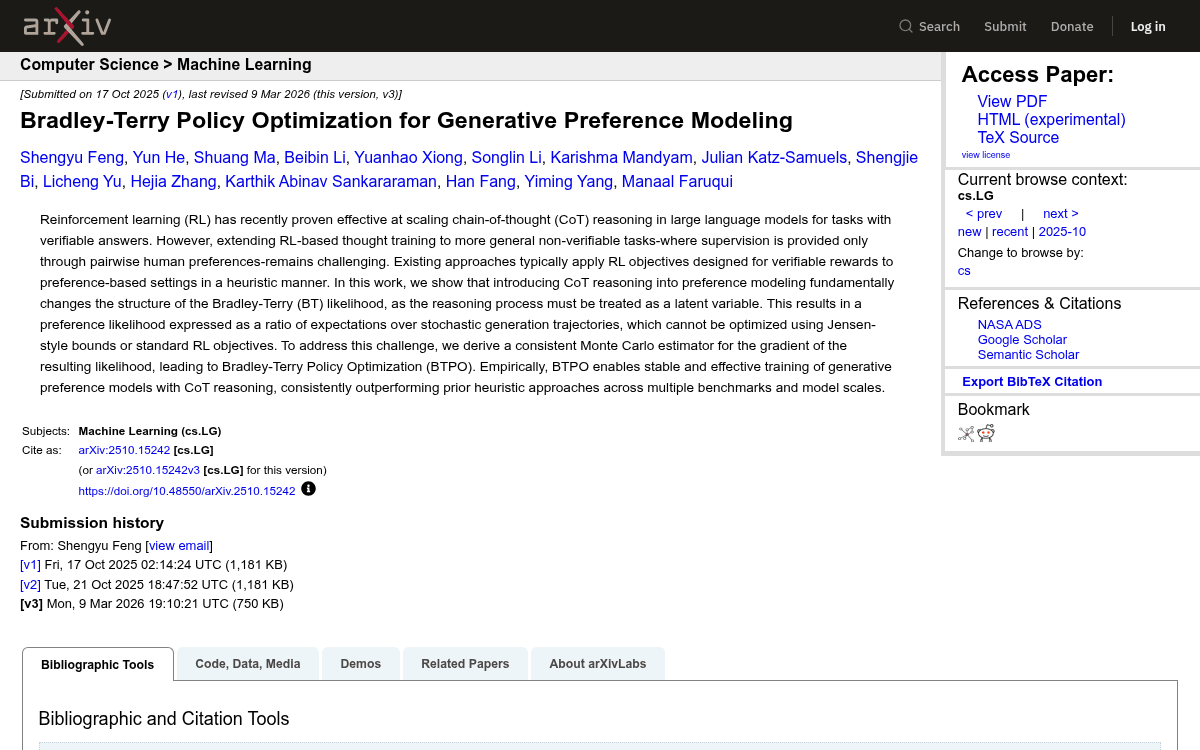
Reinforcement learning has unlocked a new tier of reasoning in large language models. Give a model a math problem with a checkable answer, and you can train it to think step-by-step using RL -- this is the core insight behind DeepSeek-R1 and OpenAI's o-series. But what happens when there is no checkable answer? When the only signal you have is a human saying "I prefer response A over response B"? That is the much harder problem, and a new paper from researchers at Meta Superintelligence Labs and Carnegie Mellon University argues that every current approach to solving it is mathematically broken -- and proposes a principled fix called Bradley-Terry Policy Optimization (BTPO).
The reward model problem nobody talks about
To understand why this matters, you need to know what a reward model actually does. In the standard RLHF pipeline, a reward model is trained to assign scalar scores to prompt-response pairs, indicating how well a response aligns with human preferences. The Bradley-Terry model of preferences defines the probability that, in a pairwise comparison between two items, a judge prefers one over the other, assuming each item has a latent strength and that observed preferences are a noisy reflection of these underlying strengths. In practice, this means a separate LLM reads a response and outputs a single number -- a score -- and that score is used to train the main model.
The limitation is obvious in hindsight: a single scalar score throws away everything the LLM knows. It cannot explain its reasoning. It cannot hedge. It cannot catch a subtle logical error in a long response. This is why the field has been moving toward generative preference models (GPMs) -- reward models that first think about a response, generating a chain-of-thought (CoT) reasoning trace, and then produce a preference judgment conditioned on that reasoning. The problem is that nobody had a principled way to train them.
Why the math breaks when you add reasoning
Here is where the paper's core insight lives. In a classical Bradley-Terry reward model, the preference probability is a clean, differentiable function of two scalar scores. You can compute a loss, take a gradient, and update your model. Simple.
The moment you insert a CoT reasoning step, everything changes. The model now generates a sequence of tokens before producing its judgment, and that token sequence is never observed in your training data -- you only have the human preference label. In statistics, an unobserved variable that influences your outcome is called a latent variable. The paper shows that treating CoT as a latent variable transforms the Bradley-Terry likelihood from a simple sigmoid loss into something far more complex: a ratio of expectations over all possible reasoning trajectories the model could have taken.
This ratio-of-expectations structure is the crux of the problem. You cannot apply Jensen's inequality to get a tractable lower bound (a standard trick for dealing with expectations inside logarithms). You cannot directly apply GRPO or PPO objectives designed for verifiable rewards. Existing GPMs -- including RM-R1, J1, and RRM -- sidestep this by reframing preference learning as a generation task with a binary reward (did the model pick the right response?). The BTPO paper argues this is a heuristic that ignores the statistical structure of preference modeling entirely.

The fix: a Monte Carlo gradient estimator
Rather than approximating or sidestepping the true likelihood, BTPO directly estimates its gradient using a Monte Carlo estimator -- a technique that approximates an intractable expectation by sampling from it. The key idea is to sample multiple reasoning traces for each response, then use those samples to estimate both the preference probability and the gradient of the log-likelihood.
The resulting gradient estimator decomposes into two clean components:
- Preference scoring update: Adjusts how the model scores a response after seeing the reasoning, weighted by an "misalignment factor" -- a term that is large when the model currently assigns low probability to the correct preference. This automatically focuses training on the hard cases the model is getting wrong.
- Thought generation update: Adjusts the reasoning traces themselves, using a self-normalized weight that rewards reasoning trajectories that contribute more strongly to correct preference judgments. In practice, this part uses a GRPO-style update with the normalized preference score as the reward signal.
The misalignment weight is the key piece missing from all prior methods. Standard GRPO-based GPMs treat every training example with equal weight, which means the model keeps over-optimizing examples it already handles well while ignoring the ones it gets wrong. BTPO's instance-level weighting corrects this automatically.
The training setup is straightforward: for each response in a preference pair, sample n=4 reasoning traces, run a forward pass to get the "Yes" probability (the score), compute the Monte Carlo gradient estimate, and update. No second generation pass is needed -- the thought probability and the answer probability can both be extracted from a single forward pass through the sequence.
Beating heuristic RL across the board
The paper evaluates BTPO against four baselines -- the standard BT model (no reasoning), GRAM (pairwise model, no reasoning), GRPO (pair), and GRPO (point) -- across three benchmarks and four model sizes (Qwen2.5-3B, Qwen2.5-7B, Llama3.2-3B, Llama3.1-8B).

The results are striking. BTPO consistently outperforms all baselines, with improvements of up to:
- 4.8% on helpfulness and harmlessness
- 2.7% on instruction following
- 9.1% on math reasoning
Perhaps more telling is the comparison against RM-R1, the official checkpoint from the "Reward Modeling as Reasoning" paper, which uses both supervised fine-tuning and RL. Even with that head start, RM-R1 achieves only 62.7% on helpfulness/harmlessness, 52.2% on instruction following, and 55.0% on math reasoning when evaluated on the same benchmarks. BTPO running from Qwen2.5-7B-Instruct with no SFT pre-training hits 70.4%, 61.4%, and 85.4% respectively -- a massive gap that further fine-tuning RM-R1 on the target datasets does not close.
The ablation studies reinforce the story. Removing the misalignment weight from BTPO causes large accuracy drops on helpfulness/harmlessness and math reasoning, confirming it is not just a cosmetic addition. And while pre-generating thoughts offline and training a standard BT model on them gives marginal gains (~1%), BTPO's end-to-end training produces substantially better reasoning traces.

Where this fits and what it cannot do
BTPO is most useful when you want a reward model that can reason -- for use in RLHF pipelines, best-of-N selection, or as an LLM judge. It is particularly well-suited for tasks requiring step-by-step evaluation: math correctness, complex instruction following, multi-turn conversations. The paper notes that pairwise models (which see both responses at once) tend to underperform on these tasks, likely because jointly evaluating two long responses is a distribution shift from pretraining. BTPO's pointwise formulation avoids this.
The main limitation is inference cost. Generative preference models are inherently more expensive than scalar reward models -- they generate a reasoning trace before scoring. The paper evaluates with greedy decoding and no majority voting to reflect realistic inference budgets, but even so, GPMs cost more per call than a standard BT reward head. There is also no public code or model release mentioned in the paper, which limits immediate reproducibility.
The broader implication is significant: the same principle -- treating generated reasoning as a latent variable and optimizing the true likelihood -- could extend beyond pairwise preferences to structured prediction, decision-making, and agentic tasks where a model reasons before acting but that reasoning is never directly supervised. BTPO is a concrete proof that principled probabilistic formulations beat heuristic RL objectives, even when the math is harder to derive.