
Meta AI's LfCD-GRIP Makes Robots 10x Faster Than Their Human Teachers
A new imitation learning method lets robots discover faster trajectories than their human teachers, cutting real-world pick times from 100 seconds to 12.
 Pro
Takeaways
- USC-led paper introduces LfCD-GRIP, letting robots learn better policies than their constrained human demonstrators show.
- Method uses state-only goal-proximity rewards instead of imitating actions limited by joystick or teleop interfaces.
- Monte Carlo Dropout identifies confident states; linear interpolation fills in reward values between anchors on agent trajectories.
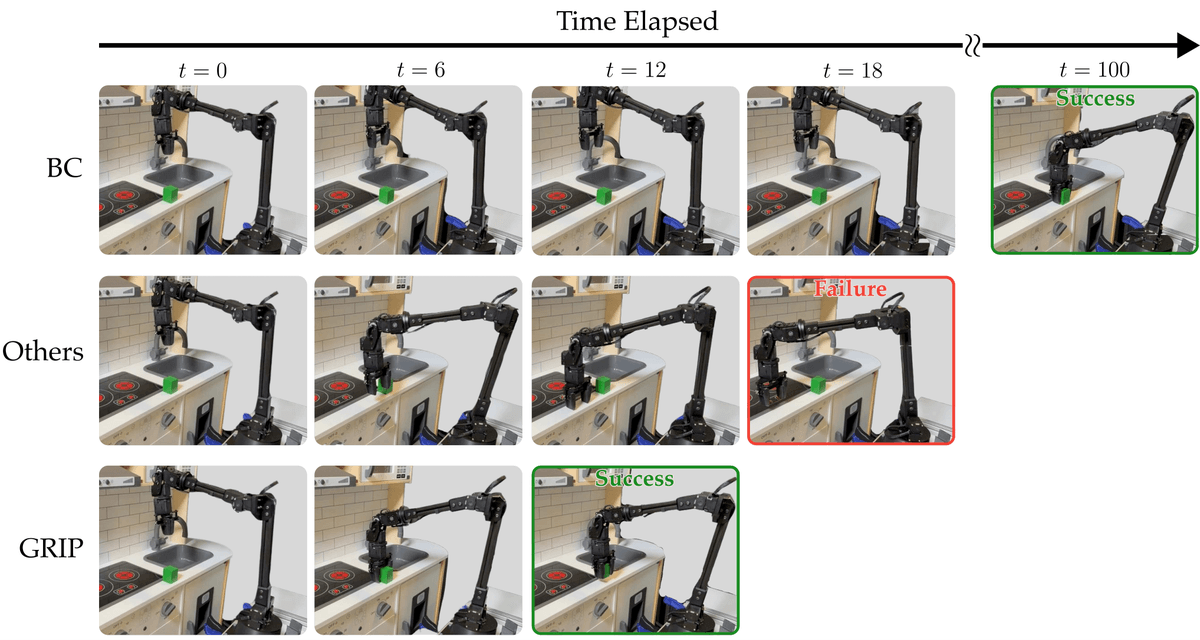
- Real WidowX 250s arm completes pick-and-place in 12 seconds versus 100 seconds for behavioral cloning, a 10x speedup.
- Consistently beats BC, GAIL, GAIfO, SSRR, and proximity-based IRL across MiniGrid, Maze2D, Fetch, and WidowX tasks.
- Videos and code at the project site; paper on arXiv.
When you teach a robot arm through a joystick, you can only nudge it along one axis at a time. When you teach it kinesthetically, your grip and reach limit its motion. Human demonstrations end up slower and more awkward than what the robot itself is physically capable of. So why should the robot mimic those limits?
A team from USC, UC San Diego, and Meta AI argues it shouldn't. Their new paper, When a Robot is More Capable than a Human, introduces a framework called LfCD-GRIP that lets a robot use human demos as a rough guide toward the goal, then discover shorter, smoother trajectories on its own. On a real WidowX 250s arm, it finishes a pick-and-place task in 12 seconds, ten times faster than behavioral cloning trained on the same data.

The interface is the bottleneck
Most imitation learning research assumes the expert is optimal. In practice, they rarely are, though the reason usually isn't skill. A 6-DoF arm teleoperated with a joystick requires mode-switching to control different axes, which prevents smooth, simultaneous, multi-axis motion and produces slow, segmented trajectories. The demonstrator knows what they want the robot to do; they just can't express it fluently through the interface.
This creates a specific problem the authors call Learning from Constrained Demonstrations (LfCD), which differs from learning from suboptimal or noisy demos:
- Behavioral cloning mimics the suboptimal actions directly
- Inverse RL infers reward functions that reflect the same constraints