
Mercedes-Benz's BevAD Hits 72.7% Driving Success by Throwing Away Resolution
Mercedes-Benz researchers strip down end-to-end driving stacks, find that shrinking perception features and adding diffusion planning unlocks state-of-the-art closed-loop performance.
 Pro
Takeaways
- BevAD hits 72.7% success rate on Bench2Drive, beating UniAD and VAD by more than 55 SR points.
- High-resolution BEV features cause causal confusion in planners; a masking and patchify tokenizer fixes it.
- Diffusion planning plus disentangled path+speed representation gives complementary gains in closed-loop driving.
- Diffusion planners keep scaling linearly with data while point estimators plateau around 8,000 scenes.
- Real-world NAVSIM results: 86.6 PDMS with 10x less compute than ParaDrive.
- Code and models are open-sourced at github.com/dmholtz/bevad.
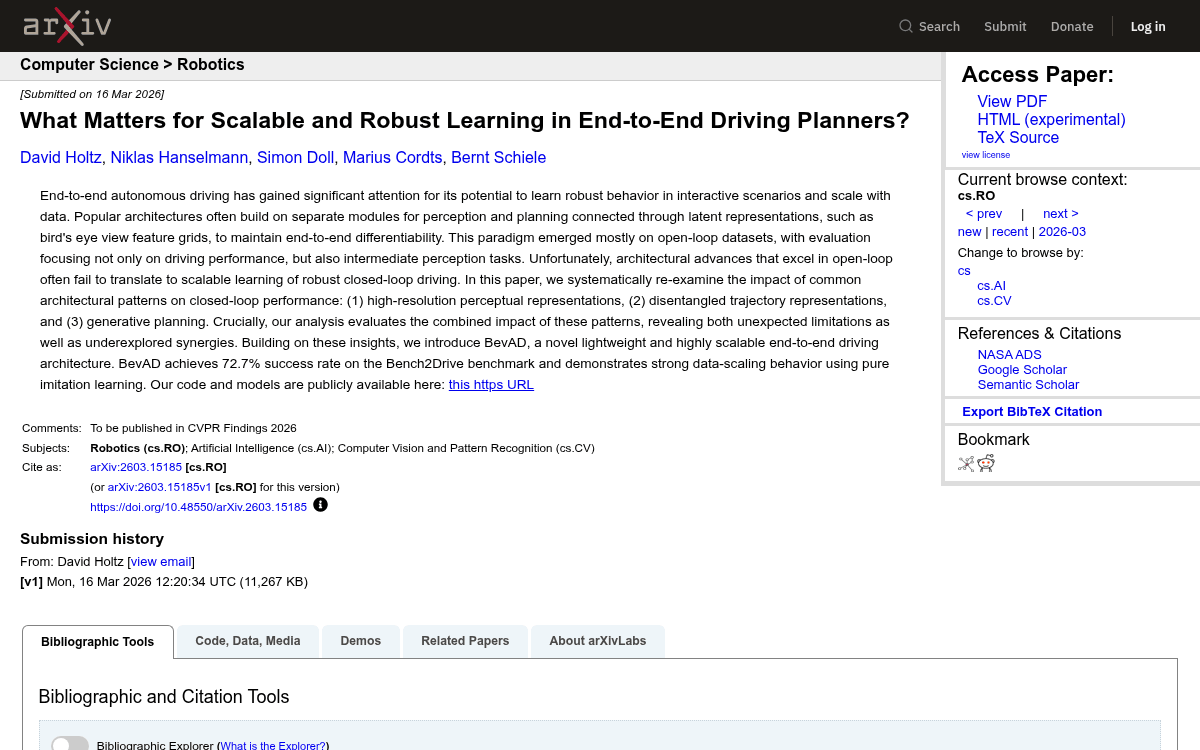
A team from Mercedes-Benz AG and the Max-Planck Institute for Informatics has released BevAD, a camera-only end-to-end driving architecture that reaches 72.7% success rate on the Bench2Drive benchmark using pure imitation learning. The interesting part is not the number itself, but how they got there: by deliberately throwing away resolution in the perception stage and combining two ideas that the field had been studying separately.
The paper, What Matters for Scalable and Robust Learning in End-to-End Driving Planners?, is a systematic study of three architectural choices that dominate current end-to-end autonomous driving (E2E-AD) research. The authors find that the conventional wisdom from open-loop benchmarks actively hurts you when you close the loop in a simulator.
The open-loop trap
End-to-end autonomous driving has gained significant attention for its potential to learn robust behavior in interactive scenarios and scale with data. Most modern stacks are modular but fully differentiable transformers that pass information through a bird's-eye-view (BEV) feature grid, a top-down latent representation of the scene around the car.
The problem: this paradigm emerged mostly on open-loop datasets, with evaluation focusing not only on driving performance, but also intermediate perception tasks, and architectural advances that excel in open-loop often fail to translate to scalable learning of robust closed-loop driving. Open-loop means you replay a recorded dataset and check whether the model's predicted trajectory matches the human's. Closed-loop means the model actually drives in a simulator, so its own mistakes compound.
The authors examine three patterns that keep showing up in the literature:
- High-resolution BEV features feeding the planner, favored by open-loop leaders.
- Disentangled trajectory representations that separate the spatial path from the speed profile, favored by closed-loop leaders in CARLA.
- Generative planners based on diffusion, which sample from a distribution of possible futures instead of regressing one point estimate.
High resolution is a trap
The first counterintuitive finding: bigger BEV grids make planning worse. The team builds a scene tokenizer that masks out irrelevant BEV cells and patchifies the rest with pixel-unshuffle, projecting the result to a lower channel dimension to force a bottleneck. As the patch size grows from 1 to 4, the driving score climbs from 66.86 to 82.62 and the success rate jumps from 36.36 to 57.43, while the open-loop L1 trajectory error barely moves.
Their explanation is causal confusion. With a full 100x100 BEV grid, the planner attends to distant, sometimes occluded cells and picks up spurious correlations. Attention maps show numerous punctual, high activation patterns in distant, often occluded or irrelevant BEV regions, strongly indicating causal confusion. The planner is essentially memorizing visual landmarks as shortcuts to actions, which averages out in L1 metrics but produces catastrophic failures at test time such as running red lights right after fixating on them.
This directly contradicts prior work claiming higher BEV resolution helps everything. The authors argue detection heads use local reference points, so more resolution helps localization. Planning needs global cross-attention, so more resolution just means a longer distracting context.
Diffusion and disentanglement, together
The second finding is a synergy. Disentangling steering (a path in space) from acceleration (a speed profile in time) helps with static infractions like lane departures. Diffusion planning, which iteratively denoises a trajectory sample rather than regressing a single point, helps with dynamic infractions like collisions and red-light violations. Combining both gives the highest overall success rate in their controlled study.
The scaling behavior is where diffusion really pays off. When they scaled training data across five splits that each roughly double in size, point-estimator planners plateau after about 8,000 training scenes, matching earlier closed-loop scaling law results. Diffusion planners keep improving linearly across the entire range they tested, with no sign of saturation. Difficult skills like Give Way and Merging only emerge at the larger dataset sizes.
What BevAD actually looks like
Combining these insights produces BevAD. The pipeline works like this:
- Six surround cameras feed a RADIO image backbone with a low-rank adapter and a BEVFormer-style encoder that produces a 100x100 BEV feature grid.
- A DETR-style deformable-attention object detector supervises the BEV features. Auxiliary tasks like online mapping and occupancy prediction are pruned.
- The scene tokenizer masks the outer 20% of left and right BEV cells and patchifies with p=4, collapsing the grid to 25x15 scene tokens.
- A transformer planning head with adaLN-Zero conditioning (borrowed from diffusion transformers) attends to the scene tokens, conditioned on the driving command, current velocity, and diffusion timestep.
- Planning queries are interpreted as path tokens plus velocity tokens (disentangled) and denoised over 2 to 10 DDIM steps.
- Two PID controllers turn the path and speed profile into steering and acceleration.
The team also introduces a BEV-space camera augmentation that applies a random yaw and lateral offset to all camera extrinsics simultaneously, so a multi-camera rig can be augmented without novel view synthesis.
Numbers on Bench2Drive
On the 220 test routes of Bench2Drive, BevAD trained on Simlingo's routes (BevAD-S) hits 80.63 driving score and 55.30 success rate. When scaled with an extra 8,000 uniformly sampled scenario routes from a new route generator (BevAD-M), it reaches 88.11 driving score and 72.73 success rate, beating prior modular baselines UniAD (16.36 SR) and VAD (15.00 SR) by very large margins.
On the real-world NAVSIM benchmark, BevAD scores 86.6 PDMS versus 83.4 for UniAD and 84.0 for ParaDrive, while using a 570 GPU-hour (A100-80GB) training compute budget, 10x less than ParaDrive. Ablations confirm both masking and patchifying contribute to the real-world gains.
Training efficiency is a big deal in this paper. Streaming BEV feature caching and LoRA finetuning on RADIO let BevAD process 35x more training samples per second with a frozen BEV backbone, and achieves a 22x speed-up in end-to-end training compared to UniAD-tiny, and fits end-to-end training on a single A100-80GB at batch size 16.
Where it breaks
BevAD is not solved driving. The authors are candid about the failure modes:
- Red-light infractions in about 19% of unsuccessful runs, especially after pedestrians finish crossing at signalized intersections.
- Route deviations when the model ignores lane-change navigation commands.
- Miscellaneous collisions in high-interaction merging scenarios.
- Long-range perception is a structural weakness. The spatial bottleneck that helps in urban driving may not extend to highway speeds where the car needs to see far ahead.
- On the fine-grained multi-ability evaluation, BevAD trails prior work on Overtaking, Emergency Brake, and Traffic Sign skills even though it dominates the mean.
Why this matters if you build driving stacks
The practical takeaways are unusually concrete for an architecture paper:
- If you are shipping an E2E driving planner, benchmark it closed-loop. Open-loop L1 error can be flat while the model is quietly learning shortcuts that blow up in simulation.
- Consider aggressively compressing your BEV before the planner. A 16x reduction in token count via patchifying gave the biggest single jump in Bench2Drive success rate.
- If you are betting on data scaling, diffusion-based planners appear to scale further than regression heads without saturating, which changes the ROI calculus on data collection.
- Disentangling path from speed pays off independently of the modeling choice, and it makes PID controller tuning cleaner.
Code and models are available at the official GitHub repository, and the project page includes an interactive 3D viewer showing closed-loop rollouts across scenarios like emergency vehicle yielding, cyclist overtaking, and construction bypass. The work will appear at CVPR Findings 2026.