
Melbourne Researchers' UniCast Gives Frozen AI Forecasters Eyes and Language
UniCast adds vision and text context to frozen time-series foundation models, dynamically routing which modality matters most for each prediction instance
 Pro
Takeaways
- UniCast is a parameter-efficient framework that adds vision and text context to any frozen Time Series Foundation Model.
- Two core mechanisms: Conditional Prompting generates per-instance soft prompts from multimodal inputs; Modality Routing uses cross-attention to decide how much each modality matters.
- Only ~5-6% of total parameters are trainable; all pretrained backbones (TSFM, vision encoder, text encoder) stay frozen.
- Outperforms fully fine-tuned Chronos, Timer, and TimesFM on 10 diverse benchmarks, achieving avg MSE of 0.7034 vs. 0.7379 for fine-tuned Chronos.
- Works across backbones (Chronos, Timer, TimesFM) and encoder combinations (CLIP/BLIP + Qwen/LLaMA), confirming the design is backbone-agnostic.
- No public code release yet; inference requires generating a plot and LLM text description per input window, adding overhead.
Time-series foundation models (TSFMs) have become the go-to starting point for forecasting across finance, healthcare, and energy. Most forecasting work still involves building custom models for each dataset, but foundation models flip this around -- they are pretrained on massive amounts of time-series data and can forecast new patterns without additional training. The catch? Despite their success, existing TSFMs operate almost exclusively in a unimodal regime, treating time series as isolated numerical signals. A new paper from the University of Melbourne argues this is a fundamental design flaw -- and proposes a fix.
The paper introduces UniCast, a parameter-efficient wrapper that plugs vision and text context into any frozen TSFM. The core insight is deceptively simple: the same numerical pattern can mean very different things depending on context. A spike in ATM withdrawals looks different before a public holiday than after a bank run. UniCast gives the model a way to know the difference.
The problem with static fusion
In real-world settings, forecasting problems are rarely unimodal. Temporal observations are often accompanied by rich auxiliary context, such as visual information and textual descriptions, which frequently provide complementary signals that disambiguate temporal patterns. Prior work has tried to address this by injecting text or images into forecasting pipelines, but the approach has a critical flaw.
Most existing approaches rely on static prompts or fixed fusion schemes, implicitly assuming that auxiliary modalities are uniformly informative across all instances. This assumption is problematic in practice: the relevance of vision or text varies substantially depending on the temporal state, noise level, and data regime, and indiscriminate fusion can introduce spurious correlations or amplify irrelevant signals.
The authors frame this as a missing capability, not just a missing feature. Existing TSFMs lack architectural mechanisms to represent external contextual signals and to regulate their influence in an input-dependent manner. As a result, identical temporal patterns observed under different contextual conditions are treated as equivalent, leading to brittle behavior and degraded performance in challenging scenarios.
Two mechanisms, one frozen backbone
UniCast's design philosophy is clean: keep every pretrained model frozen, and learn only how to route information into it. UniCast is designed around two complementary components: Conditional Prompting, which infers instance-conditioned contextual representations from time series, vision, and text inputs using a lightweight Transformer-based context distiller; and Modality Routing, which dynamically regulates how auxiliary modalities influence prediction.

Conditional Prompting (CP) works in two stages. First, a Transformer-based context distiller processes token-level embeddings from frozen vision and text encoders alongside patch-level embeddings from the time-series input, producing modality-aware contextual representations. These are then combined with pooled time-series embeddings and fed through a Transformer encoder to generate an instance-specific soft prompt -- a learned vector that nudges the frozen TSFM without modifying its weights. Think of it as a per-input sticky note attached to each forecast request.
Modality Routing (MR) is where UniCast gets its adaptivity. Using cross-attention conditioned on the evolving temporal representation, UniCast selectively amplifies informative modalities while suppressing noise, enabling fine-grained and interpretable control over multimodal contributions. Concretely, the time-series patch embeddings act as queries, while vision and text embeddings serve as keys and values. The resulting attention weights are literally a per-instance score of how much each modality should matter. This routing is applied iteratively at each layer of the TSFM, so modality relevance is re-evaluated as temporal representations deepen.
Here is a simplified view of the core routing step:
# Q: time-series patch embeddings at position t
# K, V: stacked vision + text contextual embeddings
alpha = softmax(Q @ K.T / sqrt(d))  # modality relevance scores
routed_context = alpha @ V          # weighted multimodal injection
ts_repr = ts_repr + routed_context  # inject into time-series stream
All pretrained encoders remain frozen during training, with learnable parameters restricted to the conditional prompt generators, modality routing layers, and lightweight projection modules. Across all main configurations, UniCast operates in a strongly parameter-efficient regime -- despite incorporating large pretrained vision and text encoders, only approximately 5-6% of the total parameters are trainable.
What goes in, and what comes out
UniCast takes three inputs per forecast instance:
- Time series: raw numerical observations, patched and embedded
- Vision: a matplotlib plot of the time series, encoded by CLIP or BLIP
- Text: a natural-language description of the series' trend and seasonality, generated by Qwen3-VL and encoded by Qwen2 or LLaMA
The text descriptions are auto-generated per window using a fixed prompt that asks a VLM to describe trend direction and seasonality in JSON format. This means UniCast can be applied to any dataset without manual annotation -- the text context is synthesized on the fly.
Benchmarks and results
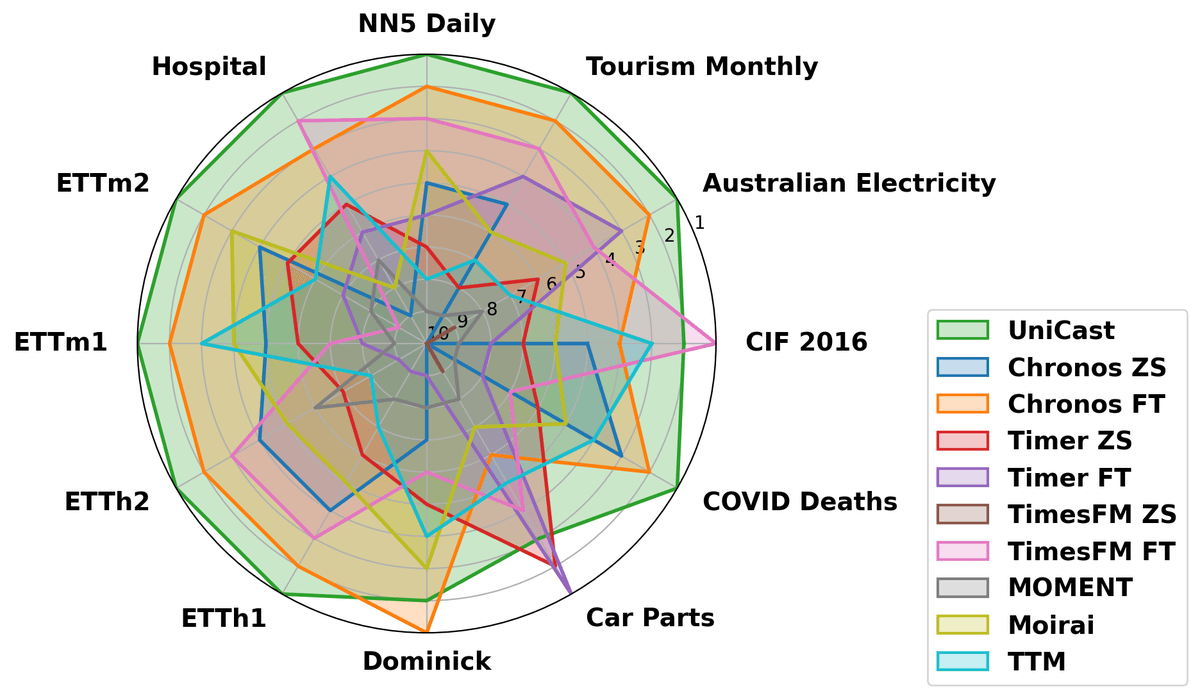
UniCast is evaluated on a representative subset of Benchmark II datasets spanning diverse domains, frequencies, and data regimes, covering varying levels of temporal signal strength and contextual availability. The 10 datasets include NN5 Daily (ATM withdrawals), Australian Electricity, Tourism Monthly, COVID-19 Deaths, Car Parts sales, CIF 2016 banking, Dominick retail, Hospital patient counts, and ETTh/ETTm energy transformer readings.

UniCast consistently outperforms the zero-shot performance of all baselines and, notably, surpasses the fully fine-tuned variants of Chronos, Timer, and TimesFM on the majority of datasets. The best configuration (Chronos + BLIP + LLaMA) achieves an average MSE of 0.7034 across the benchmark, compared to 0.7379 for fine-tuned Chronos alone -- a meaningful gain achieved while keeping the Chronos backbone entirely frozen.
The ablation results are particularly telling:
- Zero-shot Chronos: avg MSE 1.9765
- Fine-tuned Chronos: avg MSE 0.7379
- UniCast (CP only): avg MSE 0.7263
- UniCast (MR only): avg MSE 0.7322
- UniCast (CP + MR): avg MSE 0.7034 -- best overall
The fact that UniCast outperforms fully fine-tuned backbones indicates that its gains cannot be attributed to increased model capacity or additional training, but instead arise from effective instance-conditioned multimodal control.
UniCast also works across backbones. Swapping Chronos for Timer or TimesFM as the frozen TSFM produces consistent gains over both zero-shot and fine-tuned variants of those models, confirming the approach is backbone-agnostic.
Where it shines -- and where to be cautious
The qualitative results reveal something important about when UniCast helps most. UniCast produces forecasts that more closely align with ground-truth trajectories, particularly around turning points, abrupt trend changes, and amplitude variations. This is exactly the regime where pure numerical models struggle: distribution shifts between the input window and the forecast horizon.
That said, there are real-world constraints to keep in mind:
- UniCast requires generating a matplotlib plot and an LLM-written text description for every input window at inference time -- adding latency and compute overhead
- The evaluation uses Chronos's zero-shot benchmark protocol, which may not reflect all production forecasting scenarios
- The text descriptions are auto-generated and may carry noise for time series with weak or ambiguous trends
- The paper does not yet include a public code release
The real shift here
The broader significance of UniCast is architectural, not just empirical. Time-series foundation models have recently become strong zero-shot forecasters for numerical time series, with models like TimesFM, Moirai, Chronos-2, and Sundial trained on large collections of temporal data. But they are all fundamentally unimodal. UniCast demonstrates that you do not need to retrain these models from scratch to give them multimodal awareness -- you can bolt on a lightweight routing layer that teaches them when to listen to images and text, and when to ignore them.
Beyond accuracy improvements, UniCast exhibits enhanced robustness under non-stationary conditions and provides interpretable signals of modality relevance through its routing mechanism. The attention heatmaps show the model learning to focus on trend-related tokens in text descriptions and on peak regions in visual plots -- behaviors that emerge from training, not from hand-engineering. For teams building forecasting systems where contextual metadata already exists -- event logs, sensor images, analyst notes -- UniCast offers a practical path to exploiting that context without touching the underlying foundation model.