
Melbourne Researchers Build a 3-Agent Loop to Fake Crisis Tweets
Researchers built a three-agent loop that iteratively generates, checks, and refines synthetic crisis tweets, replacing costly real Twitter data for AI evaluation.
 Pro
Takeaways
- New agentic workflow generates synthetic crisis tweets with controllable location and damage labels, published on arXiv.
- Three agents loop: generator drafts a tweet, evaluator runs heuristic checks, augmenter feeds structured errors back into the prompt.
- Compliance checks cover location substring match, kNN damage classification via MPNet embeddings, and self-BLEU textual diversity.
- Case study covers six earthquakes; 20-50 percent of tweets pass all checks after three feedback rounds.
- Synthetic datasets reproduce real tweet length and hashtag distributions and yield similar AI benchmark scores.
- Datasets and code available on GitHub; small LLMs like Gemma, Qwen, Llama all work as generators.
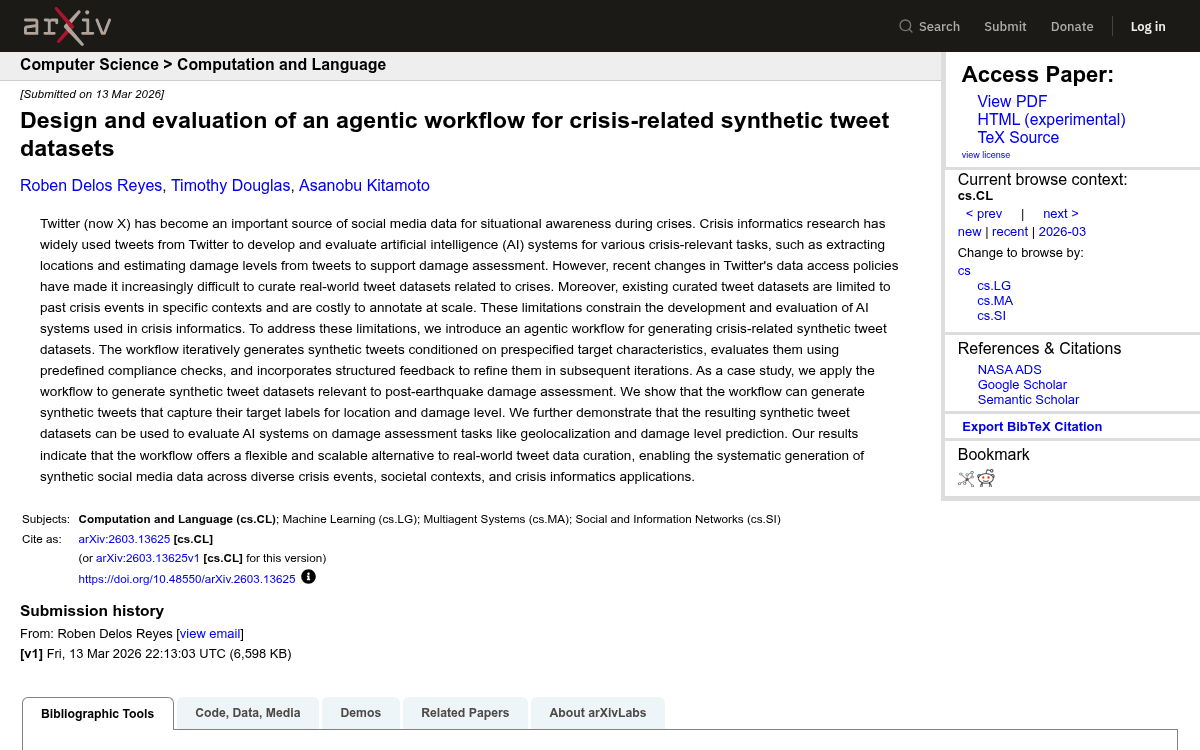
Crisis informatics has a data problem. Researchers who build AI systems to extract locations, estimate damage, and monitor emergencies from social media have long relied on tweets, but Twitter's shift to X has locked most of that pipeline behind expensive access tiers. A new paper from researchers at the University of Melbourne, University College London, and Japan's National Institute of Informatics proposes a workaround: an agentic workflow that generates synthetic crisis tweets on demand, with controllable labels for location and damage severity.
The idea is straightforward. Instead of scraping real posts about earthquakes, floods, or hurricanes, you specify what you want a tweet to describe, let a small language model draft it, then run it through automated compliance checks. Failed drafts get sent back with structured feedback until they pass. The output is a labeled dataset you can use to benchmark downstream AI systems.
Why real tweets became a bottleneck
Recent changes to Twitter's data access policies have made tweet collection increasingly restricted and costly, and existing curated datasets are tied to specific historical crisis events and societal contexts whose characteristics may not apply to future crises. Annotating them at scale is also expensive. The result: crisis AI research often depends on small labeled datasets from a handful of past events, which limits both training and evaluation.
Straight LLM generation is tempting but risky. LLMs are susceptible to errors and biases and require careful validation of their outputs, and there's no guarantee that a raw generation actually reflects the situational context of a real crisis. That gap is what the agentic wrapper is designed to close.
Three agents in a feedback loop
The workflow has three components that talk to each other:
- Generator: an LLM that produces a synthetic tweet conditioned on a target label vector containing a location and a damage level (0 to 3, mapped to Modified Mercalli Intensity ranges).
- Evaluator: runs three heuristic compliance checks on the draft.
- Augmenter: converts failed check results into a structured feedback message, appends it to the prompt, and asks the generator to try again.
Only tweets that pass all checks are accepted by the compliance evaluator and added to the synthetic tweet dataset. Rejected tweets accumulate in the prompt as negative examples, which the authors frame as a form of in-context learning.

The three checks are deliberately lightweight so the loop runs fast:
- Location correctness: case-insensitive substring match between the target location and the tweet text.
- Damage level correctness: k-nearest neighbors classification using
all-mpnet-base-v2sentence embeddings against a reference set of labeled real tweets, with k=5. - Textual diversity: self-BLEU score against 100 randomly sampled accepted tweets, rejected if 4-gram overlap exceeds a threshold of 40.
The earthquake case study
The authors tested the workflow on six real earthquake events spanning very different geographies and severities: the 2014 Napa California, 2014 Iquique Chile, 2015 Nepal, 2019 Ridgecrest California, 2021 Fukushima Japan, and 2021 Haiti earthquakes. Target label vectors were extracted from real tweets collected in an earlier study, with locations pulled by spaCy's en_core_web_trf and damage levels annotated by gemma-3-27b-it.
For the generator itself, they picked a small model to keep iteration cheap. They found that a lighter 1B-parameter Gemma 3 instruction-tuned model was sufficient for tweet generation compared to heavier Gemma 3 variants while requiring less computation and enabling faster generation. They also tested Qwen-3-0.6B and Llama-3.2-1B-Instruct as drop-in alternatives, which worked comparably. That interchangeability is a key point: the loop is model-agnostic.
Results and dataset characteristics
On the first shot, without any feedback, roughly 30 to 80 percent of synthetic tweets passed each individual compliance check across all six earthquake events. Damage level was the harder condition to satisfy than location. After three feedback rounds, about 20 to 50 percent of synthetic tweets passed all three checks and were added to the datasets.

Temperature turned out to be an important knob. Higher temperatures had only a small effect on location and damage level correctness, but a large effect on textual diversity, generating tweets more likely to pass the diversity check. Running at temperature 1.4 with three feedback rounds produced the largest accepted datasets, ranging from about 2,500 tweets for the 2021 Fukushima event to over 58,000 for the 2019 Ridgecrest event.
Structural characteristics of the synthetic tweets also matched reality without being explicitly requested. Tweet length distributions were comparable between real and synthetic datasets across all six events, and hashtag patterns like #earthquake were reproduced implicitly by the generator.
Do the synthetic datasets actually work as a proxy?
The more important question: can you use these datasets to evaluate real AI systems? The authors tested pretrained models on geolocalization (using spaCy's en_core_web_sm) and damage level prediction (using gemma-3-4b-it) across both real and synthetic corpora. Results were roughly in the same ballpark on both, though not identical:
- Geolocalization coverage on real tweets: 91-99 percent; on synthetic: 73-96 percent.
- Geolocalization accuracy on real tweets: 33-76 percent; on synthetic: 74-88 percent (actually higher on the synthetic side).
- Damage prediction accuracy on real tweets: 32-65 percent; on synthetic: 29-57 percent.
The synthetic-to-real gap is real but modest. Enough, the authors argue, to use these datasets as a proxy for ranking or stress-testing systems when real data is unavailable.
Limitations worth flagging
This is not a drop-in replacement for real corpora. A few honest caveats from the paper:
- The workflow needs target labels as input, which assumes some prior knowledge of the crisis. The authors suggest deriving them from past events or crisis simulators like HAZUS.
- The damage level check depends on reference embeddings from a labeled real dataset, so you cannot fully bootstrap from nothing.
- The emphasis on speed may have reduced output quality, resulting in noisier datasets, and using a stronger generator or an LLM-based evaluator would improve quality at higher computational cost.
- The case study only covers earthquakes. Adapting to floods, hurricanes, or misinformation detection requires rewriting the prompts, target labels, and compliance checks, though the overall architecture stays the same.
Code and datasets
The synthetic tweet datasets produced in the study are released on GitHub. If you work on crisis informatics, disaster NLP, or just need controllable synthetic short-text data with structured labels, the repo is a reasonable starting point, and the three-agent template is generic enough to lift into other domains where real user-generated content is hard to obtain.