
MBZUAI's MAGIC3 Catches Fake TikTok Videos 27x Faster Than VLMs
A new detector spots misinformation in short videos by measuring how text, visuals, and audio disagree, matching VLM accuracy at 27x the speed.
 Pro
Takeaways
- MAGIC3 detects fake short videos by exposing cross-modal consistency between text, visuals, and audio at multiple granularities. See the paper.
- Real videos show high text-visual but moderate text-audio consistency; fake videos flip this pattern on both FakeSV and FakeTT.
- The detector combines pairwise consistency scores, token-level attention heatmaps, temporal audio-visual alignment, and LLM style rewrites.
- MAGIC3 reaches 86.71% on FakeSV and 84.95% on FakeTT, beating the strongest non-VLM baselines by 2 to 3 points.
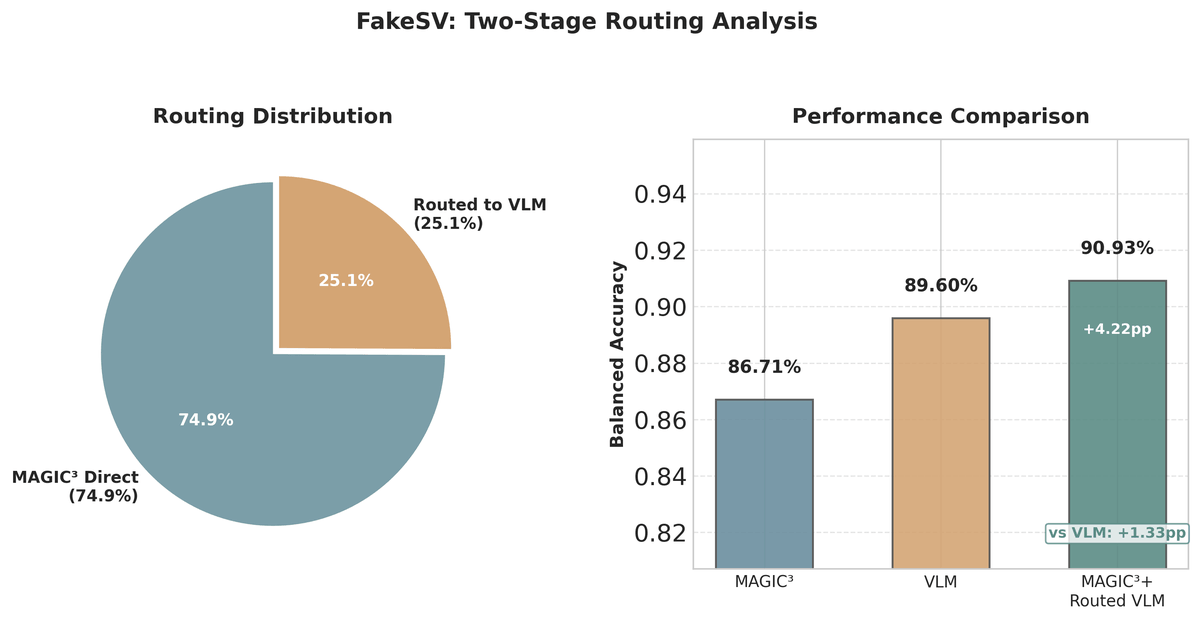
- A two-stage pipeline routes 25% of hard cases to FakeSV-VLM, hitting 90.93% accuracy at 18-27x higher throughput.
- The approach is blind to misinformation where all modalities agree but the underlying facts are wrong.
Fake news on TikTok, Douyin, and YouTube Shorts rarely comes with obvious tells. The clip looks real, the voiceover sounds plausible, the caption reads like a news headline. What breaks is the relationship between them: a sensational subtitle stapled onto unrelated stock footage, or an emotional voiceover paired with visuals that show something entirely different. A team from MBZUAI and the Chinese Academy of Sciences has built MAGIC3, a detector that turns this cross-modal disagreement into an explicit, measurable signal, and uses it to route only the hardest cases to expensive vision-language models.
The tell that fake videos can't hide
The paper starts with a surprisingly clean finding. On two benchmark datasets, FakeSV (Chinese) and FakeTT (English), real videos exhibit high text-visual but moderate text-audio consistency, while fake videos show the opposite pattern. The authors argue this asymmetry follows directly from how cheapfakes are made: producers grab visually coherent stock or stolen footage, then dub it with fabricated subtitles and voiceovers engineered to sound emotionally aligned with the narration. The audio and text end up tightly coupled to each other but drift away from what the visuals actually show.

A second finding is that a single scalar global consistency score behaves like an interpretable difficulty axis. Prediction errors cluster in the middle band, and the correlation between global consistency and predicted fake probability is strong and negative (Spearman rho around -0.91 on FakeSV and -0.96 on FakeTT). That gives moderators a tangible reason a video was flagged, and gives the system a natural knob for deciding when to escalate.
Inside MAGIC3
MAGIC3 is a lightweight head that sits on top of frozen encoders: BERT for text, Swin Transformer for keyframes, and ExHuBERT for audio emotion embeddings. The interesting parts are the consistency modules bolted on top:
- Cross-Modal Consistency Gate (CMCG): pools each modality into a vector and computes scalar agreement scores for text-visual, text-audio, and visual-audio pairs, plus a global score.
- Consistency Field Estimator (CFE): converts cross-modal attention matrices into per-token and per-frame heatmaps that show exactly which words or frames find support in another modality.
- Temporal Cross-Modal Inconsistency (TCMI): aligns audio and visuals along time and measures per-timestep distance to catch dubbing and reused footage.
- Adversarial-Aware Rewrite Fusion (AARF): asks DeepSeek-V3.2 to rewrite each caption in neutral, formal, and sensational styles, then fuses the views with gated weights to make text embeddings robust to writing style.
- Hierarchical Multimodal Transformer: does intra-modal refinement, consistency-weighted cross-attention, and a global pooling stage.
Training uses a Contrastive-Adversarial Joint Learning objective that combines cross-entropy, InfoNCE contrastive losses, small adversarial perturbations regularized with KL divergence, and a term that ties the global consistency score to the aggregated attention fields.
The routing trick
The classifier produces a fake probability, a confidence score, and an entropy-based uncertainty estimate. At inference time these feed a two-stage pipeline. Easy samples get handled by MAGIC3 directly. The roughly 25% flagged as uncertain, inconsistent, or low-confidence get routed to FakeSV-VLM, a specialized fine-tuned vision-language model.

What the numbers say
On FakeSV, MAGIC3 alone hits 86.71% accuracy, beating the previous best non-VLM baseline (KDSGAT-FNVD) by about 2 points. On FakeTT it reaches 84.95%, roughly 3 points above the same baseline. Zero-shot VLMs like GPT-4o-mini and Qwen2.5-VL lag by 16 to 20 accuracy points, which the authors read as evidence that explicit consistency modeling matters more than raw model size.
The bigger story is efficiency. The two-stage system reaches state-of-the-art accuracy on FakeSV and FakeTT while offering 18-27x higher throughput, offering substantially better cost-performance tradeoff. Concretely, MAGIC3 processes about 680 samples per second on a single RTX 5090 with 1.67 GB peak memory on cached features, versus 7 samples per second and 22.76 GB for the VLM-only pipeline. Adding the VLM back in for the hard 25% pushes accuracy to 90.93% on FakeSV and 89.52% on FakeTT, actually surpassing the standalone VLM.
Where it falls short
The authors are upfront about the trade-offs. MAGIC3 runs on pre-extracted features, so end-to-end latency is dominated by decoding and feature extraction unless you cache them. The TCMI module only captures coarse audio-visual mismatch, not fine-grained causal or temporal logic. And the deepest limitation is fundamental to the approach: consistency-based detectors are blind to misinformation where every modality is internally coherent but factually wrong. Catching that requires external knowledge and fact retrieval, which the authors flag as their next direction.