
MBZUAI's LoFT Beats LoRA by 40% Without Adding Inference Overhead
LoFT fixes LoRA's hidden optimizer misalignment to match full fine-tuning accuracy at a fraction of the compute cost
 Pro
Takeaways
- LoFT is a new LoRA-style fine-tuning method that fixes optimizer state misalignment (momentum and variance) in addition to gradient misalignment, provably recovering full AdamW dynamics.
- On LLaMA-7B commonsense reasoning, LoFT (r=16) scores 76.08% average accuracy vs. LoRA's 73.57% and DoRA's 71.11%, with no inference overhead.
- At rank 4, LoFT outperforms DoRA by +40% and LoRA by +25% on LLaMA-7B, making it especially powerful under extreme parameter budgets.
- LoFT (simple) variant skips second-moment calibration for under 6% memory overhead vs. LoRA and only ~0.1% accuracy loss, at 1.27x LoRA latency.
- LoFT eliminates the need to tune LoRA's scaling hyperparameter alpha, reducing a common source of instability and failed runs.
- Code is open-source at github.com/tnurbek/loft; paper accepted at ICML 2025 TTODLer-FM workshop.
Fine-tuning a 7-billion-parameter model on every single weight is expensive -- so expensive that most teams default to LoRA, which freezes the original weights and injects small trainable matrices to approximate the update. It works remarkably well, but a stubborn gap with full fine-tuning has persisted for years. A new paper from MBZUAI and Amazon Science argues that the community has been diagnosing only half the problem.
The problem everyone missed
The standard explanation for LoRA's accuracy gap is gradient misalignment: the low-rank matrices can only express a limited slice of the true gradient, so some useful update directions get dropped. Recent methods like DoRA and LoRA-Pro have tried to fix this. But the LoFT authors show that optimizer state misalignment is an equally important culprit that has been largely ignored.
The performance gap stems not only from gradient misalignment but also from the misalignment of optimizer states, particularly the first and second moments used by AdamW. In plain terms: AdamW keeps a running average of past gradients (momentum) and a running average of their squared values (variance) to adaptively scale each update. When you constrain updates to a low-rank subspace but keep accumulating those statistics as if you were doing full fine-tuning, the numbers go out of sync. The optimizer is steering based on a map that no longer matches the terrain.
There is also a third, more practical annoyance: LoFT eliminates the need for tuning extra hyperparameters, e.g., the LoRA scaling factor alpha. That scaling factor -- often set to 2*r by convention -- has no principled derivation and can cause divergence if set wrong. LoFT removes the need to tune it entirely.
Six building blocks, one coherent fix
LoFT addresses these issues through six core building blocks. Each one targets a specific source of divergence between low-rank and full-rank optimization dynamics:
- Alternating updates -- Instead of updating both low-rank matrices U and V simultaneously (which introduces a spurious quadratic gradient term), LoFT updates only one at a time. This eliminates a second-order cross-term that silently distorts the update direction.
- Gradient scaling -- The gradient is rescaled by the inverse of the subspace's Gram matrix, making updates invariant to how U and V are scaled relative to each other.
- Momentum recalibration -- As the low-rank subspace rotates across training steps, the accumulated momentum from previous steps is projected forward using a calibration matrix, keeping the running average consistent with the current subspace.
- Second-moment alignment -- The variance estimate (AdamW's denominator) is similarly recalibrated using cross-term accumulators, so the adaptive step sizes reflect the actual curvature in the current subspace.
- Projected full update reconstruction -- Rather than computing a low-rank update directly, LoFT reconstructs what the full fine-tuning update would have been and then projects it onto the low-rank subspace -- getting the closest possible approximation.
- Gradient clipping -- The effective gradient norm used for clipping is computed as if the layer were being fully fine-tuned, matching the clipping behavior of full AdamW.

The result is provably correct: LoFT-AdamW recovers full fine-tuning when the rank equals the maximum of the matrix dimensions and U, V are full-rank. LoFT is the first low-rank adaptation method that provably recovers full fine-tuning.
The memory trade-off
The second-moment calibration requires storing cross-term accumulators that scale as O((m+n)*r^2) rather than the O((m+n)*r) of standard LoRA. In practice on LLaMA-7B at rank 16, this translates to a 25.65% memory increase over LoRA -- comparable to DoRA (simple) at 25.23%, and far less than full DoRA which balloons memory by over 341%.
For teams where even that overhead is too much, the authors provide LoFT (simple), which skips second-moment calibration. The accuracy cost is only about 0.1% on LLaMA-7B, and memory overhead drops to under 6% relative to LoRA. Training latency for LoFT (simple) is roughly 1.27x LoRA at rank 4, compared to 2.54x for DoRA (simple).
Benchmarks: closing the gap across modalities
The paper tests across language and vision tasks. On commonsense reasoning with LLaMA-7B across eight benchmarks (BoolQ, PIQA, HellaSwag, Winogrande, ARC, and others):
- LoFT at rank 16 achieves the highest average accuracy of 76.08%, outperforming both LoRA (73.57%) and DoRA (71.11%) by notable margins.
- For LLaMA2-7B, LoFT at rank 16 reaches an average accuracy of 80.46%, surpassing LoRA by 11.7% and slightly edging out DoRA.
- On LLaMA3-8B, LoFT hits 85.63% average accuracy at rank 16, the best of all methods tested.
The low-rank story is where LoFT really separates itself. At rank 4, LoFT surpasses DoRA by an impressive +40% and LoRA by +25%, highlighting LoFT's extreme efficiency in constrained settings. Meanwhile, LoRA and DoRA both suffer steep accuracy drops at lower ranks, while LoFT exhibits a much flatter accuracy curve.
On vision tasks, LoFT was evaluated on ViT-Base across four challenging image classification datasets including two medical imaging benchmarks (ISIC2019 and HAM10000) and DomainNet. LoFT at rank 16 achieves the highest average accuracy of 76.12%, outperforming both LoRA (75.46%) and DoRA (74.74%), and even slightly surpassing full fine-tuning (75.86%). The authors attribute LoFT beating full fine-tuning to implicit regularization from the low-rank structure preventing overfitting -- a pattern that also shows up on GPT-2 Large, where LoFT achieves lower evaluation perplexity than full fine-tuning despite higher training perplexity.
What this unlocks in practice
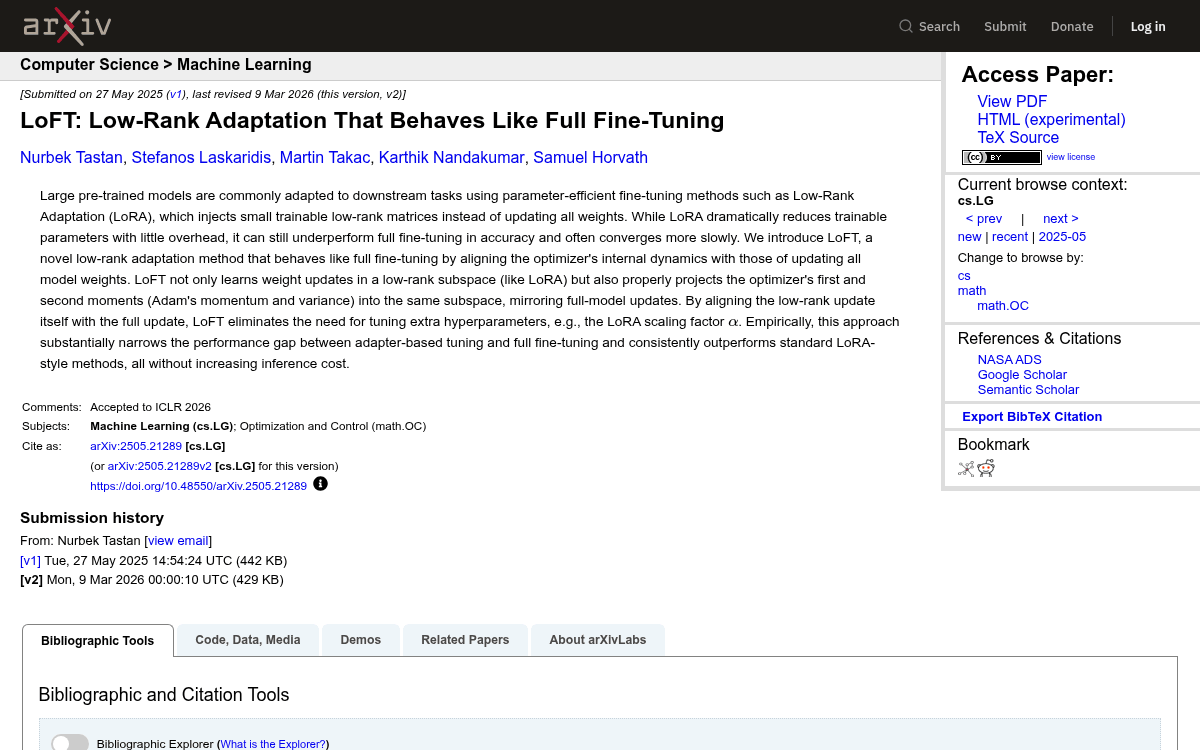
The most immediate use case is anyone already using LoRA who wants better accuracy without changing their inference setup. LoFT is a novel low-rank adaptation method that behaves like full fine-tuning by aligning the optimizer's internal dynamics with those of updating all model weights -- and since the low-rank structure is preserved, there is zero inference overhead. The adapter merges into the base weights exactly like LoRA does.
LoFT is particularly compelling in three scenarios:
- Extreme rank compression -- Teams running on constrained hardware (edge devices, federated learning) who need to push rank as low as 1 or 2. LoFT at rank 1 on LLaMA2-7B still outperforms LoRA at rank 16.
- Medical and domain-specific imaging -- The paper shows LoFT handles long-tailed, skewed datasets better than LoRA and DoRA, which both show instability on HAM10000 and DomainNet.
- Eliminating alpha tuning -- Any workflow where the LoRA scaling hyperparameter has been a source of instability or requires grid search can simply set it to 1 (or equivalently,
alpha=rin HuggingFace PEFT).
A quantized variant, QLoFT, is also demonstrated. On Orca-Math math reasoning with LLaMA3, QLoFT at rank 16 achieves 0.324 accuracy versus QLoRA's 0.292 -- and QLoFT at rank 4 (75% fewer parameters) still beats QLoRA at rank 16.
Limitations to know
The main constraint is memory. The full LoFT-AdamW variant requires O((m+n)*r^2) for second-moment cross-terms, which grows quadratically with rank. The authors recommend keeping rank at or below the square root of the smaller matrix dimension. The current implementation is also pure PyTorch with no custom CUDA kernels, so the latency numbers (3.23x LoRA at rank 16) have room to improve. The authors flag dedicated kernel implementations as future work.
The code is available at https://github.com/tnurbek/loft. The paper was accepted at the ICML 2025 TTODLer-FM workshop. For anyone doing serious fine-tuning work, the core insight -- that optimizer state alignment matters just as much as gradient alignment -- is likely to influence how the next generation of PEFT methods are designed.