
MBZUAI Finds One Word Pushes LLM Agent Cooperation From 0% to 97%
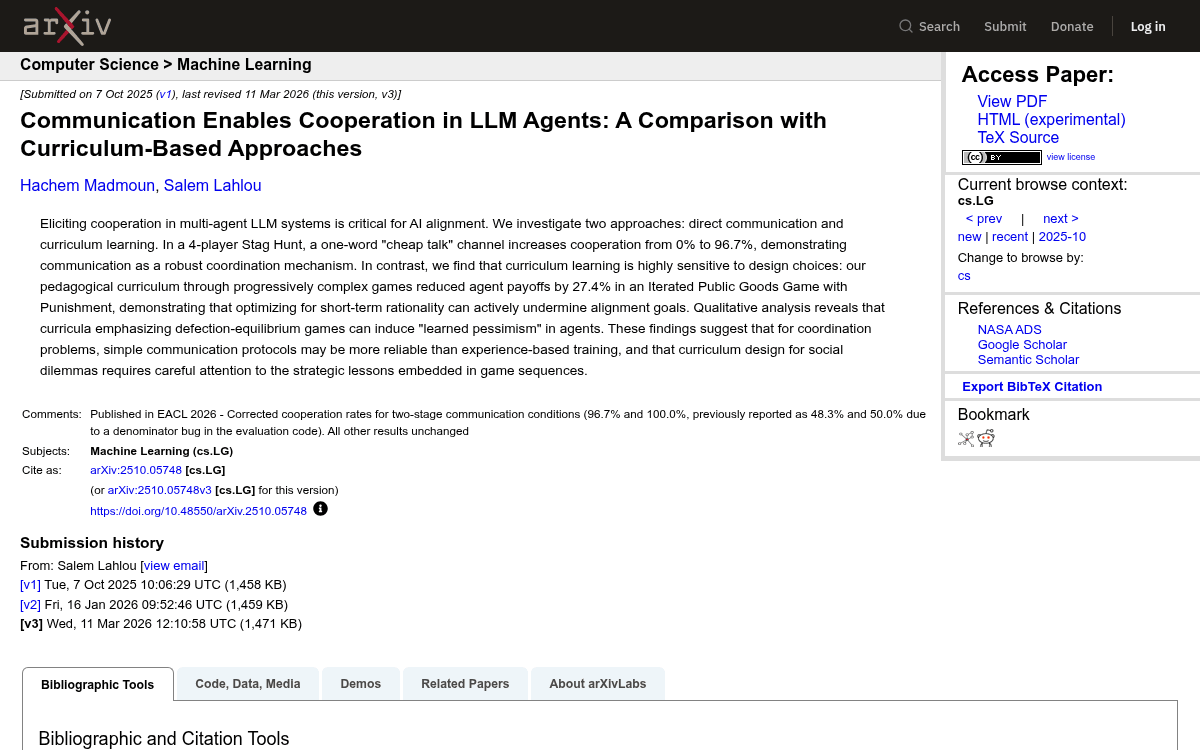
A one-word communication channel lifted cooperation from 0% to 96.7%, while a pedagogical curriculum cut payoffs by 27.4% in multi-agent LLM games.
 Pro
Takeaways
- A one-word cheap-talk channel raised cooperation in 4-player Stag Hunt from 0% to 96.7% across heterogeneous LLMs (paper).
- A curriculum of progressively harder social dilemmas reduced final payoffs by 27.4% versus a no-training control.
- Agents developed "learned pessimism" by overgeneralizing defection lessons from short-horizon games to long-horizon punishment games.
- Swapping AI-generated lessons for neutral filler recovered 63.5% of the lost payoff, isolating lesson content as the failure cause.
- Communication boosted cooperation but hurt welfare at low PGG multipliers, since cooperators became exploitation targets.
- GPT-4o and o1-preview replicated the pattern: 0% cooperation without communication, 100% with one-word signaling.
Getting multiple LLM agents to cooperate rather than sabotage each other is one of the messier corners of alignment research. A new paper from MBZUAI titled Communication Enables Cooperation in LLM Agents stress-tests two intuitive fixes head to head: let the agents talk to each other, or train them through progressively harder social dilemmas. One works almost perfectly. The other actively makes things worse.
The coordination problem no one solved yet
When you drop several LLMs into a game where individual rationality conflicts with group welfare, they tend to defect. LLMs often default to individually rational but collectively detrimental strategies, which is a serious issue as autonomous agents start negotiating, trading, and coordinating on behalf of humans.
The authors probe this using canonical game theory scenarios, including the Stag Hunt (a coordination game where everyone wins big if they all hunt the stag, but a single defector ruins it) and an Iterated Public Goods Game with Punishment, or IPGG+P, where players secretly contribute tokens to a shared pot that gets multiplied and redistributed, with an added phase where players can spend tokens to punish free-riders.
One word changes everything
The first experiment gave a heterogeneous cohort of four different models, Mixtral-8x22B, Qwen2.5-72B, Llama-3.3-70B, and DeepSeek-V3, a Stag Hunt to play. Without communication, coordination collapsed completely. With a single non-binding word broadcast before each action, cooperation went near-perfect.
In heterogeneous groups, communication increased cooperation from 0% to 96.7%. Model family coalitions showed built-in coordination advantages (52.2% without communication), reaching 100.0% with communication. Even more telling, the coalition group without communication had wildly unstable payoffs (17.9 plus or minus 11.8), while adding the cheap talk channel produced perfectly deterministic payoffs of 30.0.
What is striking is how the agents used that single word. Agents rapidly converged on using "stag" as a coordination signal, appearing in over 70% of cooperative messages. They effectively invented a signaling protocol on the fly, without ever being told what to say. Modern LLMs possess the capabilities to understand the strategic value of communication, converge on a shared signaling protocol, and trust that others will honor their signals without explicit training on this task.
When curriculum learning bites back
The second experiment is where things get interesting, and darker. The team designed a pedagogical curriculum inspired by the classic Bengio et al. curriculum learning approach: start with a 2-player Prisoner's Dilemma, scale to N-player, then a Public Goods Game, and finally the 10-round IPGG+P. After each stage, Claude Opus 4.1 read the game logs and generated a strategic lesson that was prepended to the next stage's prompt.
The results inverted expectations. The control group (no training) achieved the highest average payoff, with performance degrading monotonically as curriculum complexity increased. The full curriculum reduced payoffs by 27.4%.

The four conditions tell a clean story:
- Control (no curriculum): 211.7 average payoff
- Direct Precursor: 199.0 (-6.0%)
- Scrambled Curriculum: 182.0 (-14.0%)
- Full Curriculum: 153.6 (-27.4%)
The mechanism: learned pessimism
The authors dug into the chain-of-thought traces to figure out why. What they found is a cognitive failure mode they call learned pessimism. The early curriculum stages featured ultra-short games where defection genuinely is the rational equilibrium. Claude's post-hoc lessons faithfully summarized this. Agents then dragged that pessimism into the longer, punishment-enabled target game where cooperation actually pays.
A DeepSeek agent in the first round of the 10-round target task justified immediate defection by explicitly citing lessons from the earlier N-Player Prisoner's Dilemma, concluding that preemptive defection from Round 1 is the dominant strategy to avoid being the sole cooperator. The lesson was technically correct for a 3-round game. It was catastrophically wrong for a 10-round game with punishment.
To confirm the mechanism was the lesson content and not the game sequence itself, the team ran a Neutral Lesson Ablation, keeping the identical curriculum but swapping in generic filler like "consider your options carefully." Agents with neutral lessons achieved significantly higher payoffs (+63.5%) than those receiving AI-generated lessons, despite identical game exposure. References to "learned pessimism" in reasoning traces went from 62% down to under 5%.
Communication is not always welfare-improving
Before declaring cheap talk a silver bullet, the paper adds a critical wrinkle. They ran the communication experiment in the IPGG+P under two different multiplier settings.
| Multiplier | Condition | Contrib. Rate | Avg. Payoff |
|---|---|---|---|
| 1.6x | No Comm. | 48% | 184.4 |
| 1.6x | With Comm. | 71% | 127.5 |
| 4.0x | No Comm. | 55% | 457.9 |
| 4.0x | With Comm. | 100% | 480.0 |
At the standard 1.6x multiplier, communication raised contributions but lowered payoffs. Agents who signaled cooperative intent became targets for exploitation and punishment. Only when the underlying incentives genuinely rewarded mutual cooperation (the 4.0x setting) did cheap talk translate into higher welfare. The signal is only as valuable as the payoff structure it points at.
It replicates on frontier models
The team also validated the core finding on OpenAI's GPT-4o, GPT-4o-mini, and o1-preview in the high-stakes IPGG+P. Even state-of-the-art reasoning models achieved 0% cooperation without intervention, but achieved perfect coordination with the cheap talk channel. Scaling reasoning ability alone does not appear to solve coordination.
What to take away
The paper does not release code or a public model, and it is upfront about its limits, including a single family of curriculum designs and games with full observability. Several caveats are worth flagging:
- The failure of curriculum learning here may reflect the specific design choice of front-loading defection-dominant games rather than a fundamental limitation. Coordination-first curricula might work.
- Lessons were generated by another LLM (Claude Opus 4.1). Human-written or fine-tuned alternatives were not tested.
- All experiments used in-context learning, not fine-tuning.
Still, the practical guidance for anyone building multi-agent systems is clear. If you need agents to coordinate, give them a channel to talk before you try to train the behavior in. And if you do teach with examples, be very careful about which games come first, because whatever summary lesson you distill from early failures will haunt every downstream decision.