
Mayo Clinic's AI Aligns Proton Therapy Scans With 96.82% Accuracy
A Mayo Clinic team built a registration model that fuses CT contours, dose maps, and treatment notes to align scans 1,222 pairs across seven anatomical regions.
Takeaways
- Mayo Clinic team proposes a coarse-to-fine CT registration framework for adaptive proton therapy.
- Fuses CT scans with CTV contours, OAR masks, dose maps, and planning text.
- Uses anatomy/risk-guided attention, CLIP-based text FiLM modulation, and foreground-masked NCC loss.
- Trained on 1,222 CT pairs from 553 patients across seven anatomical regions.
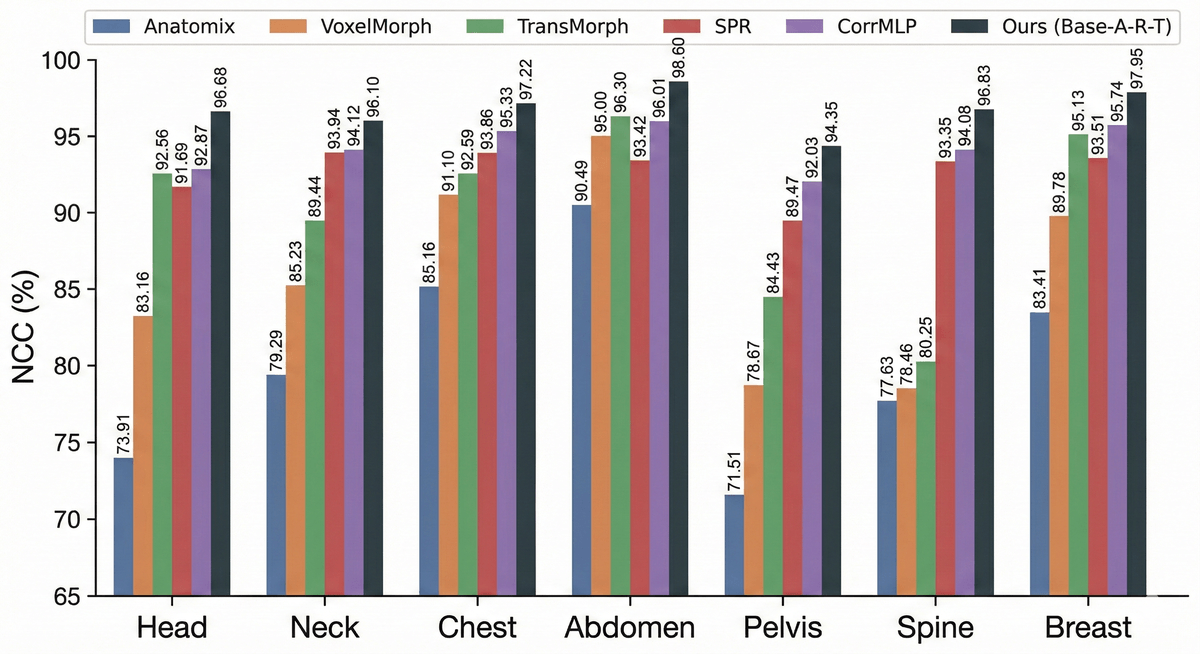
- Hits 96.82% NCC and 89.13% SSIM, beating TransMorph, VoxelMorph, SPR, and CorrMLP.
- Cuts target propagation error from 5.41% to 4.19% relative volume difference.
Proton therapy can hit tumors with millimeter precision, but that precision cuts both ways: small shifts in a patient's anatomy between sessions can push the beam onto healthy tissue. A team from Mayo Clinic and ShanghaiTech has released a deformable registration framework that aligns planning CTs with follow-up scans by fusing the pixel data with the contours, dose maps, and treatment notes that already live in every radiotherapy workflow.
Why generic registration models keep failing in the clinic
Deformable image registration (DIR) is the task of warping one 3D scan so that every voxel lines up with the corresponding voxel in another scan. In adaptive proton therapy, clinicians need this to compare a patient's baseline planning CT against repeat CTs taken during treatment, then adjust the plan when the tumor shrinks or organs shift.
Conventional DIR methods are often too slow for emerging online adaptive workflows, while existing deep learning approaches are designed for generic benchmarks and underutilize clinically relevant information beyond images. Models like VoxelMorph and TransMorph optimize on CT intensities alone, which biases them toward homogeneous regions and lets alignment drift inside the small, high-stakes structures that actually matter for a dose plan.
Feeding the model everything the clinician sees
The authors treat registration as a multimodal problem. Alongside the paired CTs, the network ingests four extra signals that treatment planning already produces:
- Clinical target volume (CTV) contours