
Max Planck's BioTUCH Fixes AI Body Tracking With a $20 Wearable
A new framework pairs off-the-shelf pose estimators with a wrist-worn bioimpedance sensor to fix hand-to-face self-contact failures, cutting reconstruction error by 11.7%.
 Pro
Takeaways
- BioTUCH combines wrist bioimpedance sensing with visual pose estimators to fix self-contact reconstruction failures.
- Delivers an average 11.7% PA-V2V improvement and 31.6 point jump in contact detection across three baselines.
- Wrist joint error drops by roughly 8.85 mm; ablation shows the contact loss does nearly all the work.
- Contact detection hits 0.858 sensitivity and 0.992 specificity; no adversarial non-contact gestures were misclassified.
- New dataset offers 19,183 dynamic contact frames with synced RGB, mocap, and bioimpedance annotations.
- Miniature 20 USD wearable sensor replaces a 15,000 USD lab analyzer; code and data at biotuch.is.tue.mpg.de.
Video-based 3D pose estimators have gotten remarkably good, but they still trip over one of the most common human behaviors: touching yourself. When a hand rests on a cheek or fingers interlock, monocular models tend to leave the hand floating in front of the face rather than actually making contact. A team at the Max Planck Institute for Intelligent Systems has proposed a fix that skips the usual purely-visual approach and instead measures skin-to-skin contact directly through the body's electrical resistance.
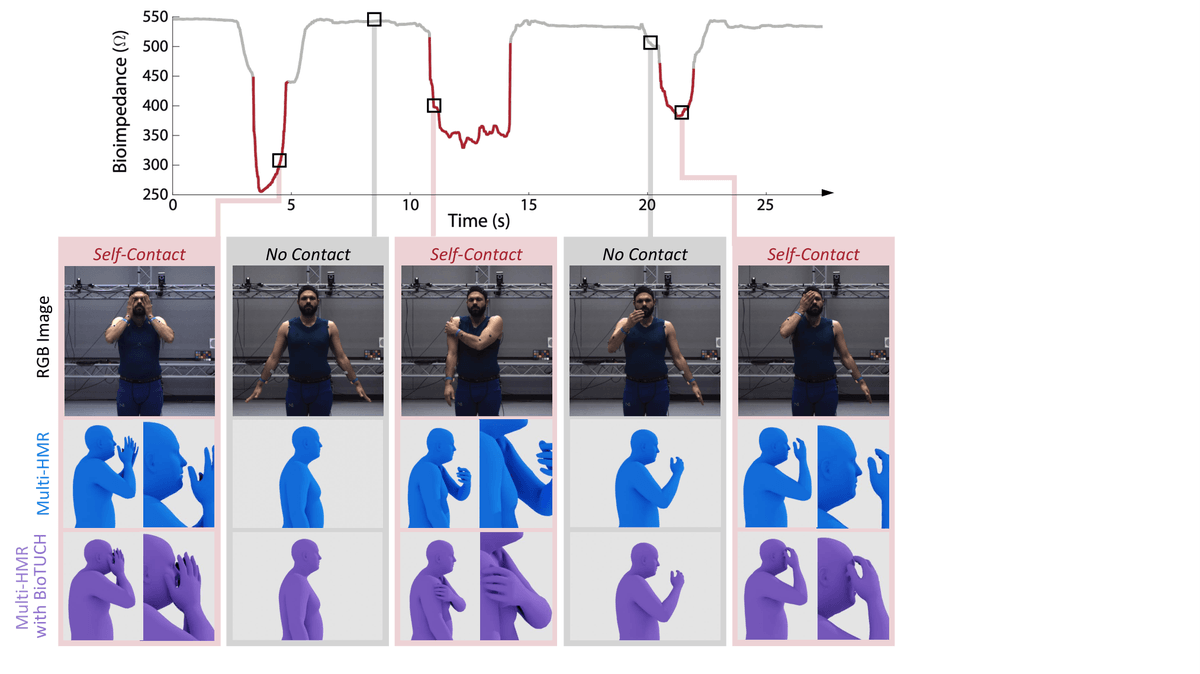
Their method, called BioTUCH, pairs any off-the-shelf pose estimator with a wrist-worn bioimpedance sensor that reliably detects when the hands (or any two body parts wired into the circuit) touch. Testing with three input pose estimators, the authors demonstrate an average of 11.7% improvement in reconstruction accuracy.
Why floating hands are hard to fix
Self-touch is not a niche behavior. It shows up constantly in everyday video: resting your chin on a fist, rubbing your eyes, clasping your hands. But the depth ambiguity of a single RGB camera makes it nearly impossible to tell whether a hand is grazing the face or hovering a centimeter away. Even for humans, distinguishing hovering from actual contact in a single RGB image remains challenging. The failure of visual estimators here can largely be attributed to a lack of specialized training data, since occlusions and depth ambiguities hinder the generation of reliable pseudo-ground truth.
Prior work like TUCH and SCP tried to enforce contact through optimization or learned priors, but they still ultimately rely on visual cues. Multi-view rigs solve the problem but are expensive and impractical for in-the-wild capture. That data bottleneck is what BioTUCH targets.
Using your body as a circuit
The physical trick is elegant. Bioimpedance measures the electrical resistance of a person's body to a small alternating electric current, the same principle some scales use to estimate body fat through the feet. When two body parts touch, they create a parallel electrical pathway through which the current can flow, decreasing the total wrist-to-wrist bioimpedance.
That drop is sharp and easy to detect. The team built a signal-processing pipeline that resamples the raw signal, applies a 100 ms median filter, differentiates it, and uses adaptive thresholding (borrowed from audio onset detection) to mark the start of a contact. The end is defined as the moment the signal returns to 98% of its pre-contact value. The approach prioritizes specificity over sensitivity, allowing more missed contacts than incorrect detections in order to avoid optimizing non-contact poses. In evaluation on 57 gestures, the algorithm hit 0.858 sensitivity and 0.992 specificity, with none of the adversarial non-contact gestures misclassified as contact.
How the optimization actually works
BioTUCH is a per-frame refinement layered on top of an existing estimator like Multi-HMR, AiOS, or TUCH. When the sensor flags a contact frame, the system runs a targeted optimization on the arm joints only, leaving the rest of the body untouched.
The pipeline works like this:
- Run an off-the-shelf method to produce an initial SMPL-X mesh for the sequence, then average and freeze the body shape parameters.
- For contact frames, find the closest hand-vertex-to-body-vertex pairs, excluding the hand's own arm.
- Apply masked gradient updates so only shoulder, elbow, and wrist parameters change.
- Minimize a loss that combines 2D keypoint reprojection, a consistency term, a mesh interpenetration barrier, and a proximity term that pulls the closest vertices together.
- Stop when the distance drops below 5 mm in all axes or the iteration limit hits.
A key detail: because depth is where visual estimators fail hardest, the proximity loss weights the camera z-axis four times more heavily than the image plane. This weighting is based on quantitative analysis showing errors along the camera's viewing direction are typically 3 to 4 times larger than errors in the viewing plane.

The dataset nobody had
To validate the method, the authors collected what they describe as the first directly-sensed contact-aware dataset. It comprises 82 dynamic self-touch gestures derived from observational studies, neuropsychological research, and poses from the MTP dataset. Categories include hand-to-face, hand-to-hand, hand-to-neck, hand-to-chest, behind-the-back, and multi-region contacts, plus nine adversarial non-contact gestures that look like self-touch from a frontal camera.
Three participants performed the gestures while a Vicon motion capture system, a frontal RGB camera at 30 fps, and a lab-grade impedance analyzer recorded synchronized data. Ground-truth SMPL-X meshes were fitted using MoSh++. The result is 19,183 contact frames of dynamic motion with automatic bioimpedance-based annotation, a significant jump over the largely static datasets that dominated the field before.
What the numbers say
The headline 11.7% PA-V2V improvement averages across three baselines, but the joint-level breakdown is more interesting. Shoulder and elbow errors barely move (they even degrade by a fraction of a millimeter), while wrist errors drop by roughly 8.85 mm. Contact detection rates jump by an average of 31.6 percentage points across methods.
| Method | PA-V2V (mm) | Wrist error (mm) | Detection rate (%) |
|---|---|---|---|
| Multi-HMR | 57.46 | 65.37 | 41.28 |
| Multi-HMR + BioTUCH | 50.21 | 56.29 | 78.34 |
| AiOS | 72.24 | 77.29 | 45.87 |
| AiOS + BioTUCH | 62.79 | 65.61 | 78.48 |
| TUCH | 70.55 | 58.71 | 59.46 |
| TUCH + BioTUCH | 63.99 | 52.91 | 84.60 |
An ablation showed the contact loss does almost all the work, while the 2D reprojection loss alone actually hurts performance. This confirms that bioimpedance provides unique information that cannot be derived from 2D keypoints alone.
From lab equipment to a 20 dollar wearable
The lab validation used a Zurich Instruments MFIA analyzer that is roughly 29 by 23 by 10 centimeters, weighs about 4 kg, and costs around 15,000 USD, making it impractical for large-scale data collection. The team therefore built a compact, wearable version measuring 2 by 1.8 by 1.1 cm, weighing 20 grams, and costing about 20 USD. The core is an Adafruit QT Py ESP32-C3 microcontroller wired to two electrode wristbands, running for over three hours on a small battery.

Two in-the-wild sequences with the miniature sensor worn under clothing showed the approach still works with a single side or frontal camera, correcting depth errors that Multi-HMR could not resolve on its own.
Where it breaks and where it goes next
BioTUCH is not a universal fix. It is most useful when the contact happens along the camera's optical axis and depth ambiguity is doing the damage. When contact is already clearly visible in the image plane, the baseline usually reconstructs it and BioTUCH does nothing. When contacts are entirely occluded, like hands clasped behind the back, the underlying arm-pose errors are too large for the vertex-proximity optimization to recover.
Other limitations worth noting:
- The method relies on the input mesh to identify which body regions should be in contact, so a badly estimated initialization can send the optimization to the wrong target.
- Simultaneous multi-region contacts (a hand touching both the face and the other hand) can confuse the closest-vertex logic.
- Bad finger articulation from the base estimator can cause early stopping, since the 5 mm convergence check triggers on whichever vertex pair meets it first.
- Detection is currently binary; the sensor could in principle also estimate contact location and size, which the authors flag as future work.
The bigger opportunity is data generation. A cheap wearable that produces reliable contact annotations means you can build the kind of large-scale, in-the-wild training set that would let a regressor learn contact-aware pose estimation directly, the way TUCH originally learned from geometry-based pseudo-ground truth. Code and dataset are available at the project page, and the full paper includes the qualitative video results and the miniature sensor design details for anyone who wants to build one.