
Math Proves AI Writing Its Own Prompts Beats Human-Written ones
A new arXiv paper uses category theory to prove why prompts that generate prompts consistently beat hand-written ones on creative tasks.
 Pro
Takeaways
- Paper On Meta-Prompting proposes a category-theory framework for describing LLM prompting behavior.
- Formalizes meta-prompting, the practice of using prompts to generate other prompts, as morphisms between objects.
- Proves formal results on task agnosticity and equivalence between different meta-prompting approaches.
- Human evaluations show meta-generated prompts beat hardcoded ones on creativity tasks with p < 0.01.
- Framework accounts for LLM stochasticity, aimed at agentic pipelines with chatbot and specialist components.
- Code and category theory primer available at adewynter/metaprompting on GitHub.
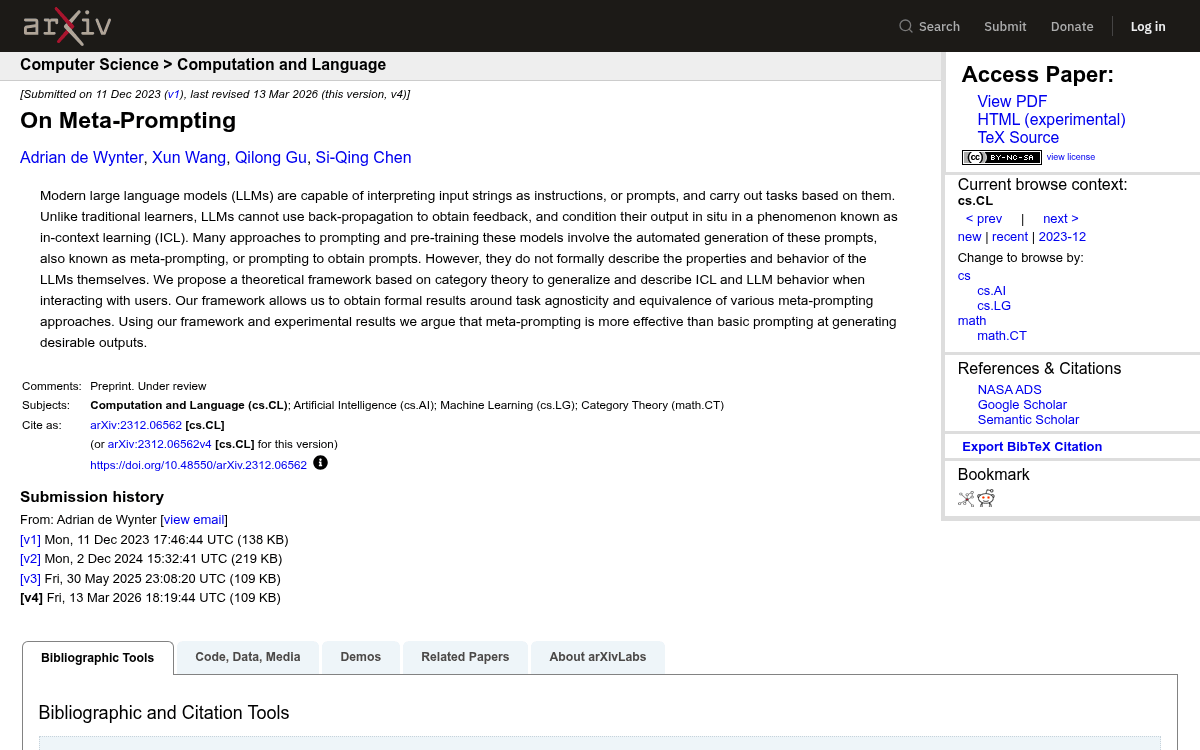
A theory paper making the rounds on arXiv takes a surprisingly formal swing at one of the messiest parts of working with language models: prompt engineering. Authored by Adrian de Wynter and colleagues, On Meta-Prompting proposes a mathematical framework, built on category theory, that models what happens when a model writes its own prompts, and proves that this approach should beat hand-written prompts in a wide class of tasks.
The pitch is unusual for a prompting paper. Instead of another benchmark of clever templates, the authors argue that we lack a formal language for describing what LLMs actually do in-context, and that without one, comparing prompting techniques is closer to folklore than science. Having a theoretical background to understand LLMs is valuable because we don't know how these things work. In fact, we don't even have probability bounds on their correctness for any algorithm.
The problem with prompting research
Prompting is weird from a learning-theory perspective. Unlike traditional learners, LLMs cannot use back-propagation to obtain feedback, and condition their output in situ in a phenomenon known as in-context learning (ICL). That means every result in a prompting paper depends on the specific string you typed, the specific model checkpoint, and the specific sampling temperature. Two users trying to do the same job will almost certainly write different prompts and get different outputs.
The authors point out this is why theoretical work here is hard: it would be unrealistic to assume that a set of users desiring to do the same thing (e.g., paraphrasing their own document) will use the same prompt when interacting with the LLM. Nonetheless, all users will expect analogous experiences and performances. You need a formalism that treats prompts as objects and transformations between them, not as fixed strings.
Category theory as the modeling tool
That framing is exactly what category theory is built for. Categories describe objects and the structure-preserving maps (morphisms) between them, which is a natural fit if you want to say things like "any prompt that accomplishes task X can be transformed into any other prompt that accomplishes task X." The paper introduces a formal meta-prompting framework using category theory to model and generalize prompting techniques in large language models. It employs meta-prompt morphisms to autonomously generate task-specific prompts, enhancing adaptability and task-agnostic performance.
Meta-prompting itself is the practice the authors want to formalize. Many approaches to prompting and pre-training these models involve the automated generation of these prompts. We call these approaches meta-prompting, or prompting to obtain prompts. Think of an outer prompt whose job is to produce the actual instruction the model will follow, rather than you writing that instruction yourself.
Crucially, the framework doesn't pretend LLMs are deterministic. This framework is flexible enough to account for stochasticity, and allows us to obtain formal results around task agnosticity and equivalence of various meta-prompting approaches. Task agnosticity is the property that matters here: the same meta-prompt should work regardless of the downstream job.
What they actually prove and measure
The paper is theoretical first, empirical second. The framework yields formal results showing that under reasonable assumptions, meta-generated prompts should outperform static ones. The authors then test this on two domains where "correct" is subjective and human judgment matters most.
- Experiments are run in two active areas of model research: creativity and ideation.
- User evaluations with GPT-4 show a significant preference (p < 0.01) for meta-generated prompts over static, hardcoded prompts in creative applications.
- The theoretical result is stronger than the experiment: the authors argue meta-prompting will always outperform traditional prompting under their assumptions.
Why the abstraction is the real contribution
The headline number is nice, but the more interesting move is proving equivalence between meta-prompting techniques. If two different meta-prompts are morphisms into the same object in the category, they should produce interchangeable results, which is a real answer to the "why does this template work and that one doesn't" question that dominates prompt engineering threads.
The authors also flag where this matters most in practice: the implications are of particular interest in agentic scenarios, that is, horizontal components (e.g., a chatbot) that interact with vertical components (e.g., specialists, such as a summarization component). In other words, if you are building a system where one LLM call sets up prompts for another, you now have a formal reason to expect that setup to be more robust than a static template.
Getting your hands on it
Code and documentation live in the adewynter/metaprompting repository, which also includes what the authors describe as a gentle introduction to category theory aimed at ML readers. The repository accompanies the paper "On Meta-Prompting" by De Wynter et al. It introduces a formal mathematical framework to understand prompting in LLMs, along with its user interaction. A brief introduction to category theory and LLMs is provided.
A few honest limitations worth noting before you rewrite your prompt library:
- The experimental evidence is on creativity and ideation, both subjective domains judged by user preference rather than task accuracy.
- The formal guarantees hold under the framework's assumptions, which abstract away real-world messiness like tokenizer quirks, context-length limits, and system-prompt hijacking.
- Category theory has a learning curve. The authors acknowledge as much: Category theory may seem daunting (our AAAI reviewers thought so) with all them crazy arrows and diagrams.
If you already lean on meta-prompting patterns like automatic prompt optimization or agent-of-agents setups, this paper gives you a vocabulary to reason about them and a first-principles argument that the pattern is not just cargo-culted best practice. If you write static system prompts and never touch them again, it is a nudge that you are probably leaving quality on the table.