
Maryland's TraceR1 Teaches AI Agents to Plan Ahead, Beating Rivals by 40 Points
A new research paper introduces TraceR1, a two-stage reinforcement learning recipe that forces multimodal agents to plan multi-step trajectories before touching the mouse.
 Pro
Takeaways
- New paper introduces TraceR1, a two-stage RL framework that forecasts action trajectories before executing them.
- Stage one uses trajectory-level rewards; stage two grounds plans with execution feedback from frozen tool agents.
- Hits 75.3% on AndroidControl-High, more than 40 points above prior RL-trained GUI agents.
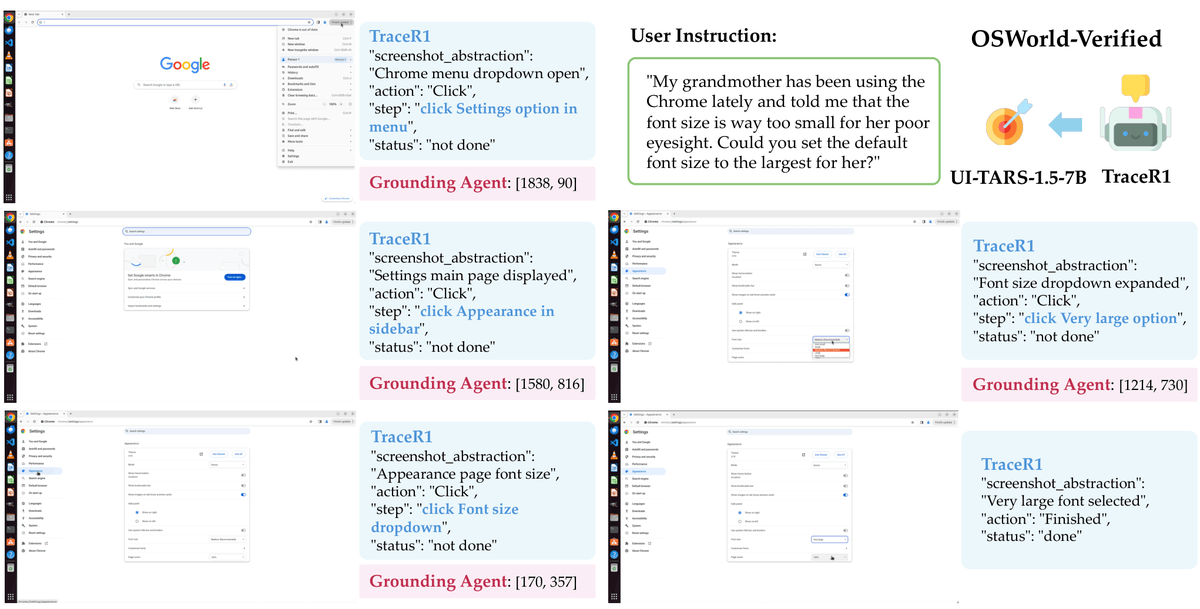
- Improves OSWorld-Verified by 15.7% relative over the Qwen3-VL baseline and gains 8.7 points on GAIA.
- Evaluated across seven benchmarks covering online, offline computer-use, and multimodal tool reasoning.
- Authored by University of Maryland researchers with Adobe Research collaborators; no public code release yet.
A team of researchers led by the University of Maryland with collaborators at Adobe Research have published a paper introducing TraceR1, a training framework that tackles one of the more embarrassing habits of today's computer-use agents: they act first and think later. Most existing systems remain reactive, optimizing actions in isolation without reasoning about future states or long-term goals, which limits planning coherence and prevents agents from reliably solving high-level, multi-step tasks.
The fix the authors propose is conceptually simple: teach the model to forecast the whole sequence of actions it expects to take before executing any of them, and reward it for keeping that forecast globally consistent. Results across seven agent benchmarks suggest the approach closes a real gap that step-by-step training has been leaving open.
Why reactive agents keep tripping over themselves
Modern GUI and tool-use agents are usually trained with reinforcement learning on single-step decisions. The model looks at a screenshot, picks the next click, gets a reward, repeats. That works fine for short tasks but breaks on anything where an early choice constrains later options and mistakes don't surface until several steps downstream.
Two existing alternatives try to address this. ReAct interleaves reasoning traces with actions in a step-by-step loop, where the agent sees an observation, produces a thought, produces an action, and receives the next observation. That still leaves the agent without a forward plan. Monte Carlo Tree Search explores a branching tree of future states at inference time, which gets expensive fast. TraceR1 bakes trajectory reasoning into the model weights through RL training, paying the compute cost once during training rather than on every rollout.