
MARVAL Makes Image AI 33x Faster and Finally Unlocks Human Preference Training
A new distillation method collapses masked auto-regressive diffusion into a single step, delivering 30x speedups and making RL fine-tuning finally practical.
 Pro
Takeaways
- MARVAL distills the inner diffusion chain of MAR models into a single AR step, keeping flexible token ordering intact.
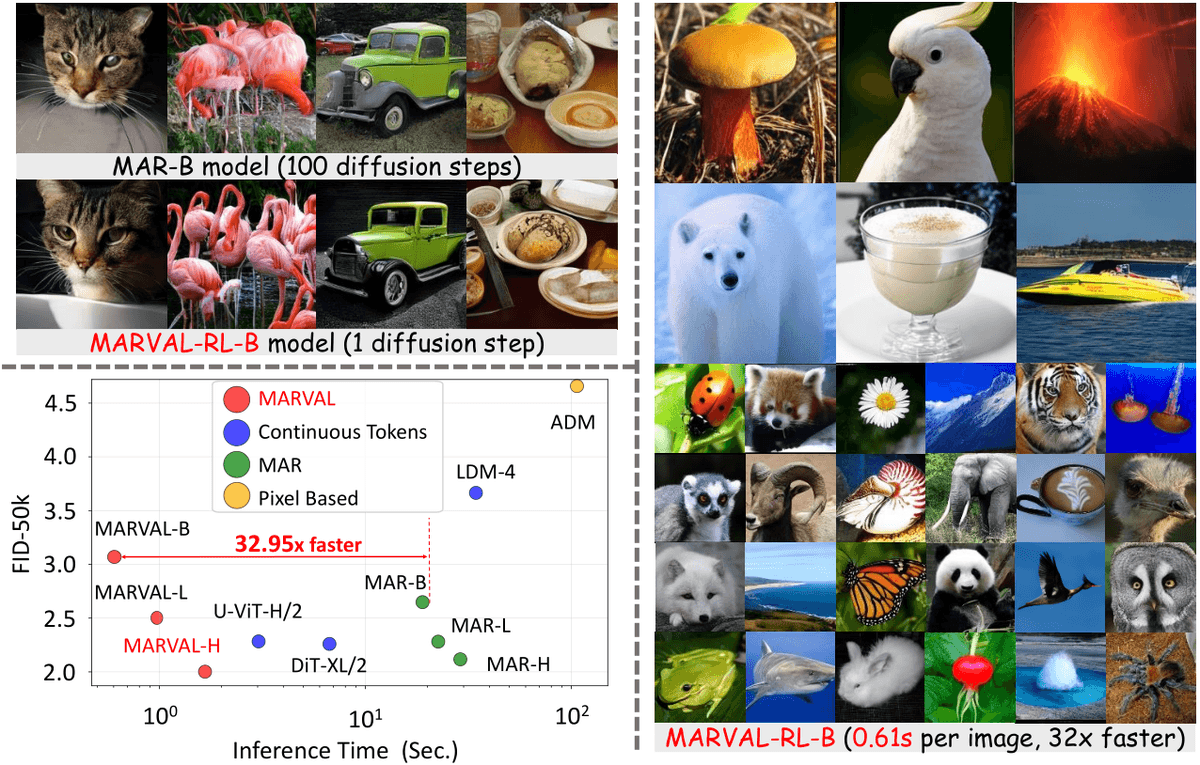
- MARVAL-Huge hits FID 2.00 on ImageNet 256x256 while running 20x faster than MAR-H.
- MARVAL-B generates images in 0.61s, a 32.95x speedup over MAR-B's 20.10s per image.
- Guided Score Implicit Matching (GSIM) uses KL-as-Fisher-divergence with a Pseudo-Huber loss for stable one-step distillation.
- MARVAL-RL adds PickScore-based reward fine-tuning as a post-hoc stage, boosting CLIP and ImageReward across all model scales.
- Code and CVPR 2026 project page available at github.com/Godlikegu/MARVAL-RL.
Masked auto-regressive image generators like MAR combine the best of two worlds: the flexible token ordering of auto-regressive models and the sample quality of diffusion. The catch is that they run a full diffusion denoising chain inside every auto-regressive step, turning inference into a slow nested loop and making reinforcement learning post-training essentially impossible on any reasonable hardware budget. A new CVPR 2026 paper called MARVAL proposes a fix that squeezes that inner diffusion chain into a single step, delivers over 30x speedups, and unlocks RL alignment for this class of models for the first time.
The nested loop that broke MAR
Masked auto-regressive diffusion models (MAR) benefit from the expressive modeling ability of diffusion models and the flexibility of masked auto-regressive ordering. The problem is architectural: MAR runs an outer loop that gradually unmasks image tokens in random order, and inside each of those iterations it fires off a full diffusion denoising chain to actually predict the token values. Multiply hundreds of AR iterations by dozens of diffusion steps and you get inference times measured in tens of seconds per image.
That latency is not just an inference annoyance. It effectively locks MAR out of reinforcement learning post-training with human preference rewards, which has become the standard recipe for aligning generative models. Running RL on a model that takes 20+ seconds per sample, and needs to backpropagate through that entire trajectory, is a non-starter.
Collapsing the diffusion chain
MARVAL's core contribution is Guided Score Implicit Matching (GSIM), a score-based distillation objective that trains a single-step student generator to reproduce what the teacher's multi-step CFG-guided diffusion chain would have produced. The student g_theta(z, c) takes Gaussian noise and the auto-regressive context (class embedding, unmasked tokens, mask positions) and directly predicts the denoised tokens in one shot.
Under the hood, GSIM minimizes the KL divergence between the student's one-step distribution and the teacher's multi-step distribution. Because that KL is intractable, the authors rewrite it as an integral of a Fisher divergence over the diffusion time, which becomes a squared distance between the student score and the teacher score. An auxiliary network learns to approximate the student's score, and a gradient-equivalence theorem lets you actually optimize the objective. Two practical details matter:
- The teacher score is CFG-guided, so the student learns from the same distribution the teacher would actually sample from at inference.
- The theoretically-correct L2 distance causes training instability, so the authors swap in a Pseudo-Huber distance for robustness, following the SIM literature.
Why RL had to be a second stage
The subtler design choice is that reinforcement learning cannot be folded into GSIM. During distillation, the model only performs a single AR iteration on a partially masked sequence, which produces low-fidelity intermediate outputs. If you fed those to a reward model, you'd get gradients that reward something the user never sees. MARVAL-RL therefore runs as a separate post-hoc phase where the distilled generator performs full multi-step AR generation (64 iterations during training, up to 128 at inference), and PickScore evaluates the final image against a prompt like "a high-quality and harmonious picture of {class name}". The reward gradient then flows back to fine-tune the generator.
The numbers
On ImageNet 256x256 class-conditional generation, MARVAL basically matches or beats the MAR teacher across three model scales while being an order of magnitude faster:
| Model | FID | IS | Inference time (bs=1, A100) |
|---|---|---|---|
| MAR-B (100 diffusion steps) | 2.60 | 222.7 | 20.10 s |
| MAR-H | 2.06 | 247.7 | 30.98 s |
| MARVAL-B | 3.06 | 220.2 | 0.61 s |
| MARVAL-L | 2.51 | 247.1 | 0.97 s |
| MARVAL-H | 2.00 | 256.3 | 1.67 s |
MARVAL-H achieves a FID of 2.00, and MARVAL-B is 32.95x faster than MAR-B, generating images in about 0.61 seconds. The diffusion sampling itself is accelerated roughly 100x; the overall speedup is capped by the outer AR loop that MARVAL deliberately preserves.
The RL stage produces smaller but consistent gains on preference-oriented metrics. Across Base, Large, and Huge models, CLIP scores improve modestly and ImageReward jumps meaningfully (for example, MARVAL-Huge moves from -0.107 to -0.064). Qualitatively, the paper shows RL sharpening fur textures, feather edges, and object contours that the distilled-only model tends to blur.
Beyond ImageNet
To show the framework isn't tied to class-conditional generation, the authors apply it to the text-to-image DC-AR model. Compressing DC-AR's 20-step DDIM sampling into a single step, the 1-step+RL variant lifts the ImageReward score from 0.5876 to 0.6903 on 50,000 JourneyDB prompts, without visible quality loss on fine-grained details like faces and textures.
Where the CFG scale matters
One useful ablation for anyone reproducing this: the classifier-free guidance scale used during distillation is not the same as the one you'd use at inference for the teacher. MAR-B's optimal setting is w=2.9, but MARVAL-B distills best at w=1.2. Push it higher and IS climbs while FID collapses (at w=4, IS hits 316.8 but FID balloons to 13.84). The authors settle on w=1.2 as the best trade-off between realism and distribution coverage.
Trade-offs to keep in mind
MARVAL is fast and RL-ready, but there are a few caveats worth flagging before you swap it into a pipeline:
- The outer AR loop is still there. MARVAL only kills the inner diffusion chain. Latency scales with the number of AR iterations, which is why the Huge model still takes 1.67 seconds.
- Distilled-only outputs look smoother but less detailed. The paper's own qualitative comparisons show blurred animal faces and lost textures without the RL stage. Plan on running both phases.
- Training is not cheap. Distillation takes about 3 days on 8x A100s per model scale, plus another 2 days for RL refinement.
- RL can slightly hurt FID. The gains are on perceptual and preference metrics, not distribution matching, which is the expected direction for reward-based fine-tuning.
Availability
The paper is on arXiv, and code is released at github.com/Godlikegu/MARVAL-RL. The most practical takeaway is that AR+diffusion hybrid architectures no longer have to choose between generation quality and RL-based alignment. If you were writing off masked auto-regressive models because you couldn't afford to fine-tune them on human feedback, that constraint just got a lot weaker.