
MAFL Detects AI Fakes With 80% Accuracy on Just 320 Images
A new adversarial training setup strips content and generator-specific cues from CLIP features, boosting cross-model fake image detection by roughly 10 percent.
Takeaways
- MAFL introduces adversarial training that strips generator-specific and content-specific bias from CLIP-based fake image detectors.
- Beats prior state of the art by 10.89% accuracy and 8.57% average precision on cross-generator benchmarks.
- Reaches over 80% detection accuracy with only 320 training images, a major data-efficiency gain.
- Tested against FLUX, Janus, Stable Diffusion 3.5, Show-o, PixArt-XL, LlamaGen, VAR and Infinity.
- Works across CLIP backbones (ResNet50, ViT-B/16, ViT-B/32, ViT-L/14), with ViT-L/14 giving best results.
- Requires generator and content labels during training, and no public code has been released yet.
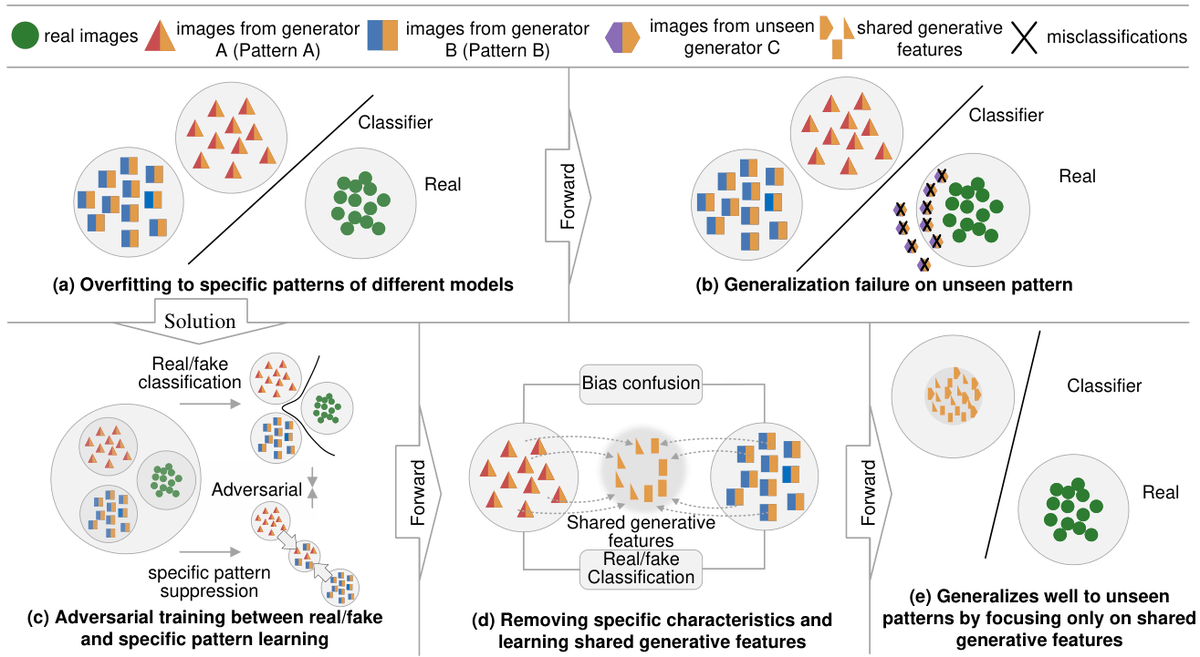
Fake image detectors keep failing the same way. Train one on outputs from a popular diffusion model, and it will happily flag samples from that generator but stumble when shown images from a different one or a different subject matter. A new framework called Multi-dimensional Adversarial Feature Learning (MAFL) targets this generalization gap and reports over 80% detection accuracy after training on just 320 images.
The bias hiding inside detectors
The authors argue that most existing detectors do not really learn what makes an image synthetic. Instead, they latch onto two shortcuts. The first is generation-pattern bias: fingerprints unique to one generator, like the frequency-domain artifacts left by ProGAN or the noise signature of a specific diffusion sampler. The second is content bias: training sets often pair certain subjects (faces, landscapes) with certain generators, so the model ends up classifying by topic rather than authenticity.

The team shows this concretely with CLIP embeddings. CLIP features are highly sensitive to semantic content, and during real/fake classification training they tend to capture model-specific generative patterns, which degrades generalization. The very backbone everyone reaches for brings its own baked-in bias.