
MACRO Framework Turns Robot Pushing Into Simple Vehicle Control
A new framework abstracts messy pushing and sliding physics into simple wheeled-vehicle models, replacing costly optimization with closed-form force allocation.
 Pro
Takeaways
- MACRO framework abstracts planar contact mechanics into five wheeled-vehicle reduced-order models for single and bimanual manipulation.
- A body-fixed virtual axle unifies unicycle, car, and forklift control for top press-and-slide motion without switching logic.
- Closed-form O(1) algebraic force allocator replaces the constrained optimization typically used in hybrid MPC controllers.
- Drake simulation reached 1.5 cm and 2 degrees accuracy on single-arm pushing; press-and-slide hit under 0.5 cm and 1 degree.
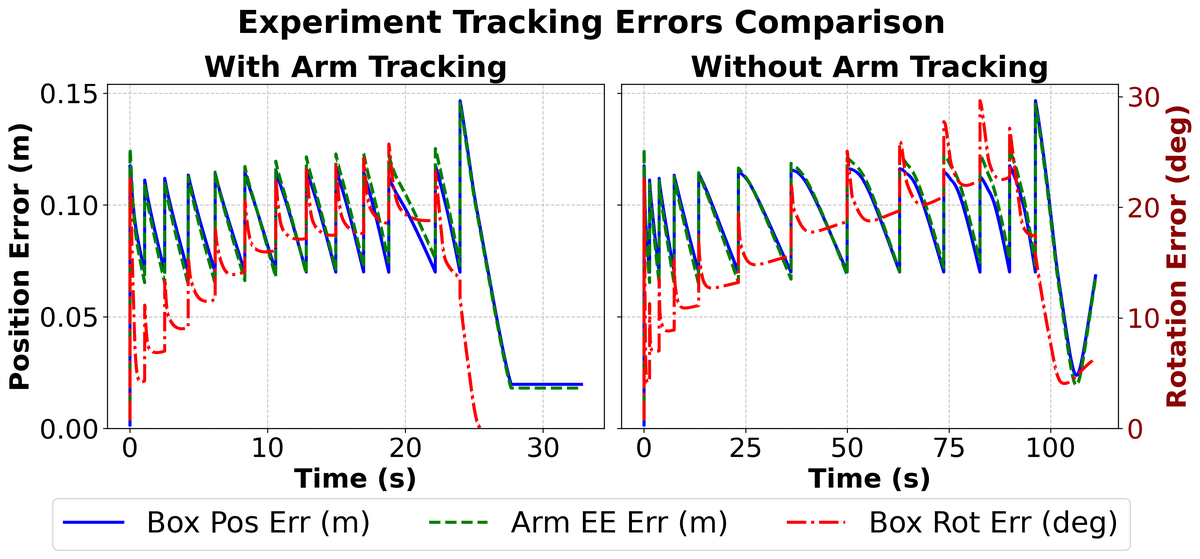
- Adding a joint-tracking term cut single-arm pushing time from over 100 seconds down to about 30 seconds.
- No hardware experiments or open-source code released yet; supplementary videos at the project site.
Pushing a box across a table sounds trivial, but it is one of the hardest problems in robotic manipulation. Contact can stick or slip, friction is asymmetric, and the object is underactuated because the robot cannot fully control its motion through a single point of contact. A new paper titled Push, Press, Slide proposes a way to sidestep the expensive optimization loops that this problem normally requires, by mapping planar contact tasks onto a small library of textbook wheeled-vehicle models.
The trouble with pushing
Non-prehensile planar manipulation, including pushing and press-and-slide, is critical for diverse robotic tasks, but notoriously challenging due to hybrid contact mechanics, under-actuation, and asymmetric friction limits that traditionally necessitate computationally expensive iterative control. The standard toolset for this problem centers on the limit surface, an ellipsoidal model of the frictional wrenches a contact patch can sustain, combined with hybrid model predictive controllers that reason over sticking versus sliding modes online.
That approach works, but it is heavy. Mixed integer programming inside an MPC can select interaction modes like sticking and sliding, but due to the non-convex nature of integer variables, the computation can be time-consuming and not feasible for high-frequency feedback control. When you add a second arm, the combinatorial explosion of contact configurations makes real-time control even harder.
Reducing physics to vehicles
The authors from Middle East Technical University and Bilkent University take a different route. Their MACRO framework (Mode-Aware Contact manipulation with Reduced-Order models) catalogs five common contact topologies and shows each one collapses to a familiar non-holonomic vehicle:
- Single-arm rear pushing: behaves like a rear-wheel-steering car, controlled with a Stanley steering law borrowed from autonomous driving.
- Single-arm top press-and-slide: reduces to a unicycle around a body-fixed virtual axle.
- Parallel bimanual pushing: becomes either a bicycle (synchronized forces) or a differential-drive robot (differential normal forces).
- Orthogonal bimanual pushing: a quasi-holonomic system controlled directly at the center of mass.
- Bimanual press-and-slide: fully quasi-holonomic, with the center of pressure steered by shifting normal load between arms.
The central technical contribution is a body-fixed tracking point for press-and-slide motion. In the paper's derivation, the lateral force component cancels entirely from the equation defining the zero-slip point, meaning the virtual axle is a pure geometric constant that stays valid whether the arm is pushing, pulling, or pivoting. This single invariant point lets the same (v, ω) controller cover the whole steering regime without switching logic.

Optimization-free force allocation
Once a trajectory is planned in the reduced-order model, the framework needs to convert a desired object wrench into commanded end-effector forces. This is normally a constrained optimization problem, because forces must stay inside friction cones and normal forces must remain positive. MACRO instead uses a closed-form algebraic allocator that runs in constant time.
For long-horizon motions where the arm might hit a joint limit or singularity, the authors incorporate Kinematic Trajectory Optimization over the manipulator's joint states, keeping the end-effector fixed in the object's body frame. Execution uses a hybrid force-impedance controller where a PI loop regulates measured normal force and an impedance term stabilizes posture.
Simulation results
Experiments were run in Drake using its hydroelastic contact model. On single-arm pushing of a 15 cm cubic box, the controller converged the box to within 1.5 cm and 2 degrees of the target pose. Adding a low-gain joint-tracking term on top of the pushing force cut completion time from over 100 seconds to about 30 seconds, and dropped RMS position error from 0.095 m to 0.085 m.

For press-and-slide on a 60x20x10 cm box, the unicycle abstraction drove the object to steady-state errors below 0.5 cm and 1 degree. The empirical virtual axle sat closer to the object than theory predicted, which the authors attribute to the heavy localized arm force shrinking the effective contact patch and dropping the pressure distribution constant from a nominal 0.6 to about 0.43. Two bimanual demonstrations, a pivot-and-move with KUKA iiwa7 arms and a wall press-fit, showed the same framework generalizing to dual-arm coordination.
Where it fits, and where it does not
MACRO is most useful when you need real-time planning for pushing, sliding, or bimanual pressing tasks and cannot afford a hybrid MPC in the loop. The optimization-free allocator makes it a candidate for high-frequency control on bimanual and humanoid platforms where compute is already saturated by other subsystems.
The limitations are worth flagging. Everything reported here is in simulation. Real hardware will introduce sensor noise, estimation delays, and unmodeled friction, and the authors list hardware validation as future work along with incorporating the Winkler elastic foundation model to handle pressure-distribution changes under heavy or compliant objects. The five topologies are illustrative rather than exhaustive, so tasks outside this library still need custom modeling. No code release is announced in the paper, though supplementary videos are hosted at the project website.