
Maastricht Researchers Train Cheap Translation Scorer Using GPT-4o Synthetic Labels
Researchers use GPT-4o to generate MQM-style error annotations and train cheaper COMET quality estimation models that rival human-labeled baselines.
 Pro
Takeaways
- New paper proposes using GPT-4o as an annotator to generate synthetic MQM error labels for training COMET quality estimation models.
- PPbMQM prompt uses persona, reflection, and output-automater patterns plus a simplified MQM error typology with six categories.
- COMET models trained on synthetic labels match human-annotated baselines on Chinese-English and English-German segment-level QE.
- Key trick: prompt for a 1-5 severity scale and discard low scores, since LLMs over-flag errors compared to humans.
- Synthetic-trained models outperform human-trained ones on low-quality segments, useful for automated post-editing pipelines.
- Built on the open-source Unbabel COMET framework; prompt published in the paper's appendix.
Running GPT-4o on every translation you want to score is a fine way to burn cash. But small learned metrics like COMET need thousands of expensive human-labeled error annotations to train. A new paper from researchers at Maastricht University, Vrije Universiteit Amsterdam, and TAUS proposes a middle path: use a big LLM once to generate synthetic error annotations, then train a cheap quality estimation model on that data.
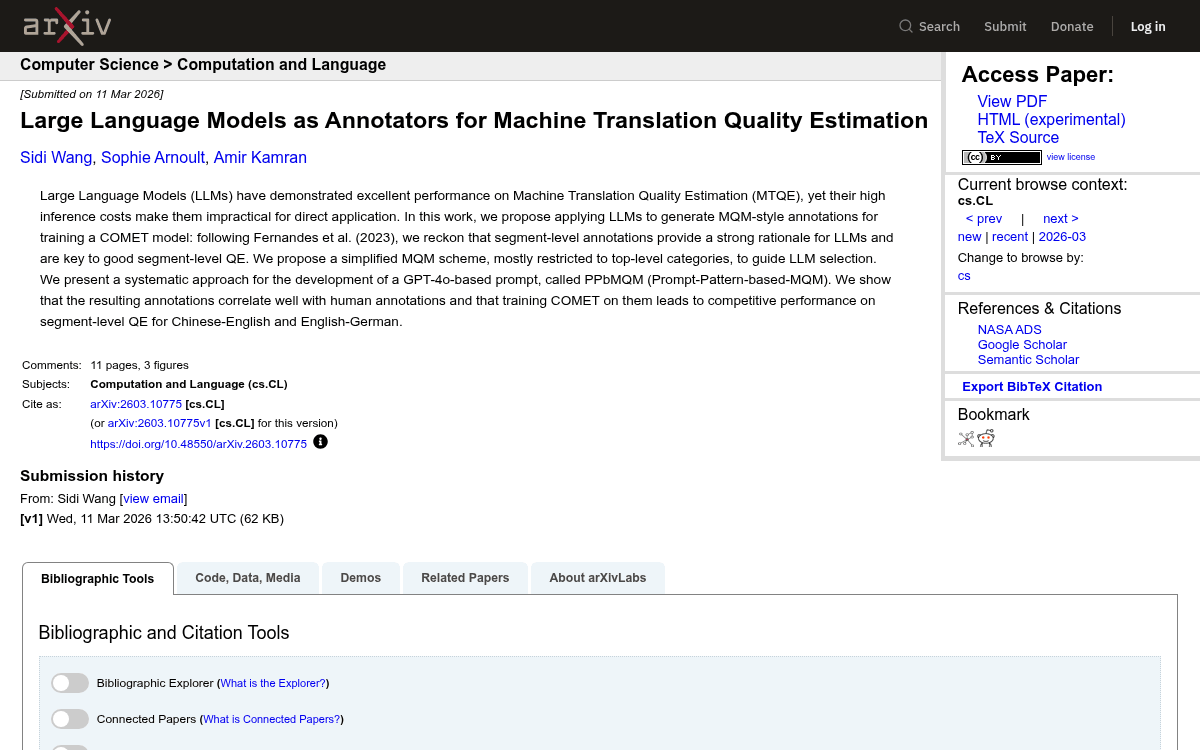
The work, Large Language Models as Annotators for Machine Translation Quality Estimation, introduces a prompting recipe called PPbMQM (Prompt-Pattern-based-MQM) that turns GPT-4o into a stand-in for the human experts who normally label translation errors. The resulting COMET models hit competitive performance on Chinese-English and English-German segment-level quality estimation.
The expensive-annotator problem
Machine translation quality estimation (QE) predicts how good a translation is without needing a reference translation. The current state of the art is a family of models called COMET and CometKIWI, which are fine-tuned on human judgment data and, according to the paper, now perform on-par with reference-based metrics.
The gold-standard labels come from MQM (Multidimensional Quality Metric) annotations, where human experts mark error spans in a translation with an error type and a severity level. Prompting for MQM provides interpretable results and also triggers reasoning in LLMs, which is why groups like Google have shown GPT-4 and PaLM-2 can produce state-of-the-art QE scores by prompting alone. The catch: Inference with LLMs is slow and costly, so you can't realistically call GPT-4o for every segment in a production pipeline.
The authors' idea is straightforward. Use the LLM once, offline, to label a training set. Then distill that knowledge into a much smaller COMET model that runs cheaply at inference time.

Simplifying MQM so LLMs can handle it
Full MQM has a deep hierarchical error typology, which turns out to be too fiddly for LLMs to apply consistently. The authors trim it down to five top-level categories, Accuracy, Fluency, Terminology, Style, and Locale Convention, plus the Omission subcategory, and two severity levels (Major and Minor). They then built the prompt step by step:
- Quiz four candidate LLMs (GPT-3.5, GPT-4 Turbo, GPT-4o, LLaMA 3 70B) on their knowledge of QE and MQM. GPT-3.5 was dropped after scoring 14/25 while the others hit 19-20.
- Design a zero-shot prompt using three prompt patterns from White et al: persona ("You are a professional translator"), reflection (ask for an explanation), and output automater (force JSON output).
- Diagnose failures. Only 70% of GPT-4 Turbo's outputs were parsable JSON, versus roughly 90% for GPT-4o and LLaMA 3. Index inconsistencies were fixed by switching to NLTK tokenization.
- Add few-shot examples for error types the model missed, especially Omission and comma-splice Fluency errors.
The severity-scale trick
The most interesting finding is that All LLMs are in fact stricter than human annotators. GPT-4o flagged roughly 3.3 errors per segment versus 1.6 for humans, and often the extra errors were technically correct catches of subtle issues that humans overlooked.
To keep the models from drowning training data in nitpicks, the authors ditched the binary Major/Minor prompt and instead asked GPT-4o to rate severity on a 1-5 scale. They then discarded anything scored 1 or 2 and mapped only score 3 to Minor and 4-5 to Major. This gave the best correlation with human judgments (Pearson 0.504 on segment-level scores).
Does the distilled COMET actually work?
The team used PPbMQM to annotate 20,703 Chinese-English and 10,121 English-German segments, then trained reference-free COMET-QE models on the synthetic labels. They compared against baselines trained on human MQM annotations from the WMT 2022 and 2023 shared tasks.
Headline numbers on Chinese-English (all 4,806 test segments): the PPbMQM-trained model reached Pearson 0.513 versus 0.470 for the human-trained baseline, though it lagged slightly on Spearman and Kendall's tau. The more striking result showed up in the low-quality bucket (segments with quality scores below 0.8), where the synthetic-trained model beat the human-trained one across all three correlation metrics on both language pairs.
The authors' hypothesis: human MQM annotations have surprisingly low inter-annotator agreement. Their appendix reports Pearson correlations between individual human raters ranging from -0.4 to 0.29 on the same segments. GPT-4o is just more consistent, and consistency is what a learned metric needs.
What it's good for, and what it isn't
- Best fit: teams that want a cheap deployable QE model for a language pair without existing MQM training data. Run GPT-4o once on a corpus, distill into COMET, ship the small model.
- Automated post-editing: the synthetic-trained model is particularly strong on lower-quality segments, which is exactly the regime where post-editing prioritization matters.
- Weak spots: the authors only tested two high-resource language pairs on news, e-commerce, conversation, and social media text. Lower-resource pairs remain untested. Style and Fluency error types are still misclassified more often than Accuracy.
- Data leakage caveat: the WMT evaluation sets may be in GPT-4o's training data, which could inflate the correlation numbers.
The COMET framework used for training is open source on GitHub. The paper does not release the PPbMQM-annotated datasets or the trained checkpoints directly, but the few-shot prompt is fully published in the appendix, so replicating the pipeline for a new language pair is mostly an API-billing exercise.