
M4Diffuser Lets a Kitchen Robot Pick and Place With 82% Success
M4Diffuser combines a multi-view diffusion transformer with a smarter QP controller to give mobile robots 82% task success in messy real-world kitchens
 Pro
Takeaways
- M4Diffuser is a hybrid robot control framework combining a multi-view diffusion transformer policy with a new QP controller for mobile manipulation.
- It achieves 82.4% average task success and only 6.8% collision rate across 5 real-world tasks, beating all baselines including HoMeR.
- Three cameras (wrist, front, rear-rotating) give the policy both close-range grasp detail and global scene context simultaneously.
- The ReM-QP controller eliminates slack variables for 28% faster execution and uses an ICN-based singularity-avoidance term for 35% less jerk.
- Trained on banana manipulation, the system generalized to croissants and eggplants with 80% success in 50 trials, showing strong object-level transfer.
- No fiducial markers required; the system is fully marker-free and tested in real kitchen environments. Project page | Paper
Getting a robot arm mounted on a wheeled base to reliably pick up a banana, navigate around a cluttered kitchen, and place it somewhere new is a deceptively hard problem. The arm and the base have to move together, the robot needs to see both the object it is grabbing and the wider room at the same time, and the math driving the joints has to stay stable even when the robot is in an awkward pose. A new paper from researchers at the University of Hamburg, TU Munich, and Agile Robots SE introduces M4Diffuser, a hybrid framework that tackles all three problems at once and achieves an average 82% task success rate with only 6.8% collision rate across five real-world tasks.
Why mobile manipulation is still unsolved
Mobile manipulation requires the coordinated control of a mobile base and a robotic arm while simultaneously perceiving both global scene context and fine-grained object details. That sounds straightforward, but it creates two competing demands on the perception system: a close-up wrist camera gives you the precision to grasp a specific object, while a wide-angle view tells you where the table is and how to navigate to it. Existing single-view approaches often fail in unstructured environments due to limited fields of view, exploration, and generalization abilities.
On the control side, the math is equally thorny. Classical whole-body controllers solve a quadratic program (QP) at every timestep to figure out how to move the base and arm joints together. Classical controllers, although stable, struggle with efficiency and manipulability near singularities -- the configurations where the robot's arm is fully extended or folded in a way that makes certain directions of motion impossible. Traditional fixes involve adding "slack variables" to the optimization to let the solver relax constraints, but this bloats the problem size and produces jerky, slow motions.
Two innovations, one framework
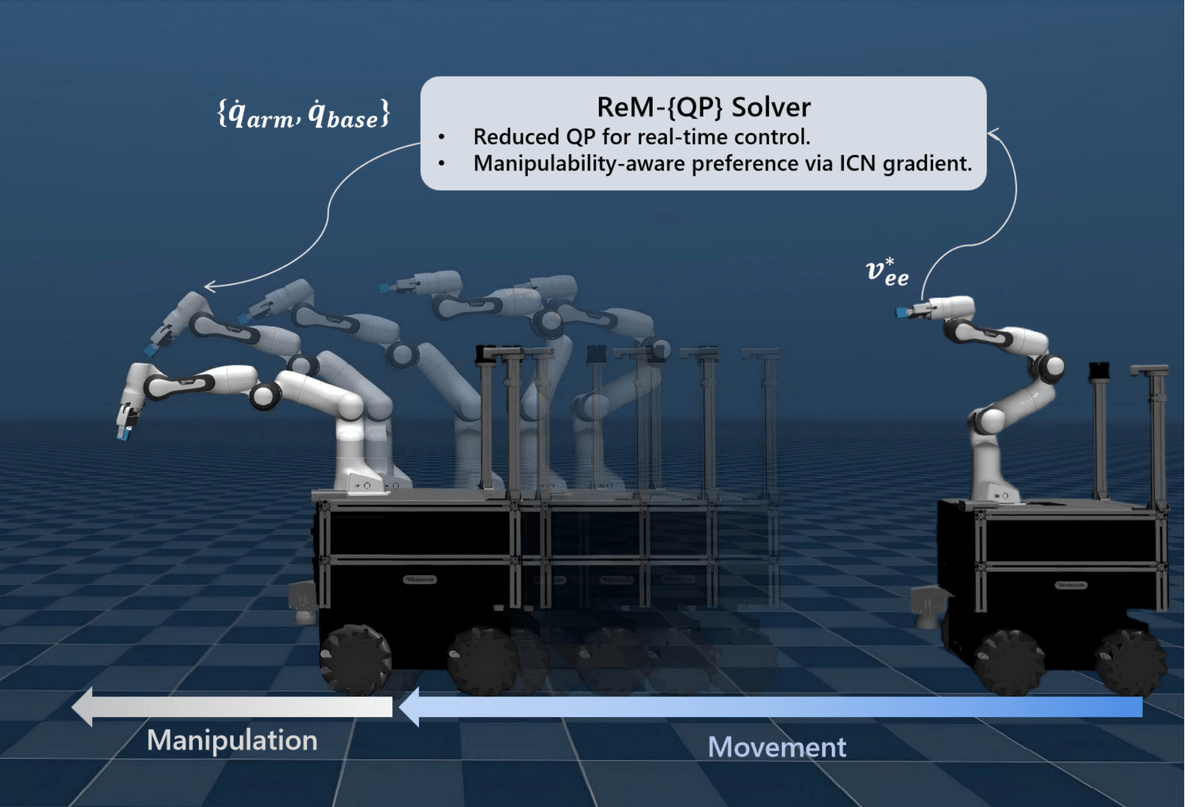
M4Diffuser is a hybrid framework that integrates a Multi-View Diffusion Policy with a novel Reduced and Manipulability-aware QP (ReM-QP) controller for mobile manipulation. The two components have a clean division of labor: the diffusion policy decides where the end-effector should go, and the ReM-QP controller figures out how to get every joint and wheel there smoothly.

The perception side uses three synchronized RGB cameras: a wrist-mounted RealSense for close-range object detail, a front-facing Azure Kinect for scene context, and a rear-mounted Azure Kinect on a motorized bracket that can rotate to track objects as the robot moves. The diffusion policy leverages proprioceptive states and complementary camera perspectives with both close-range object details and global scene context to generate task-relevant end-effector goals in the world frame. Critically, the policy outputs a target pose for the end-effector in world coordinates, not raw joint angles -- this abstraction is what lets the ReM-QP controller take over cleanly.
How the diffusion policy works
The policy is a diffusion transformer -- a model that learns to generate actions by iteratively denoising random noise into a valid robot motion, conditioned on what the cameras and sensors currently see. The architecture works in three steps:
- Multi-view RGB frames are processed by convolutional backbones and concatenated with proprioceptive encodings (current end-effector pose, base position, camera angle).
- A Transformer encoder fuses the views and performs temporal reasoning via self-attention, producing a compact scene-state representation.
- A conditional diffusion process iteratively denoises Gaussian noise into a target end-effector pose, guided by the scene representation through cross-attention.
Training uses 350 teleoperated demonstrations per task, collected with a 3Dconnexion SpaceMouse driving the robot through the ReM-QP controller in a MuJoCo simulation loop -- a neat trick that means the training data is already consistent with the controller's motion style.
The ReM-QP controller: faster and singularity-aware
Once the policy outputs a target end-effector pose, a position-based servoing law converts it into a desired velocity twist, and the ReM-QP controller maps that twist to coordinated joint and wheel velocities. The two key improvements over standard QP controllers are:
- Slack elimination: Traditional QP formulations add extra variables to soften constraints when the robot can't perfectly track a target. ReM-QP algebraically substitutes these variables out, reducing the optimization to a smaller, strictly convex problem that has a unique solution and solves faster.
- ICN-based manipulability preference: The inverse condition number (ICN) of the Jacobian -- the ratio of the smallest to largest singular values of the matrix that maps joint velocities to end-effector velocities -- measures how close the robot is to a singular configuration. An ICN near 0 means the robot is nearly stuck; near 1 means it has full freedom of motion. ReM-QP adds the negative gradient of the ICN as a soft preference term, biasing the solver toward configurations with better conditioning without sacrificing task tracking.

What the numbers say
The team ran experiments on the DARKO robot -- an omnidirectional wheeled base with mecanum wheels carrying a Franka Panda 7-DoF arm -- in both MuJoCo simulation and a real kitchen environment. In simulation, the controller ablation showed a clean tradeoff: ReM-QP reduces task execution time by 28% and lowers end-effector jerk by 35%, achieving a favorable balance between efficiency and smoothness.
The real-world results across five tasks (Reaching easy/kitchen, Pick-and-Place easy/kitchen, Open Door kitchen), each evaluated over 50 trials, tell a clear story:
| Method | Avg. Success (%) | Avg. Collision (%) |
|---|---|---|
| OMPL baseline (AprilTags) | 54.0 | 22.0 |
| Diffusion Policy (single-view) | 26.8 | 38.0 |
| Diffusion Policy (multi-view) | 59.2 | 20.8 |
| DP (multi-view) + ReM-QP | 75.2 | 9.6 |
| HoMeR + WBC | 72.4 | 12.0 |
| M4Diffuser (ours) | 82.4 | 6.8 |
Comprehensive experiments in simulation and real-world environments show that M4Diffuser achieves 7 to 56 percent higher success rates and reduces collisions by 3 to 31 percent over baselines. The gap is especially large on the hardest task: Open Door in the kitchen, where M4Diffuser hits 70% success vs. 38% for the OMPL baseline. The OMPL system relies on AprilTag fiducial markers for arm planning -- a brittle dependency that fails whenever the wrist camera loses sight of the tag.
Generalization beyond training objects
One of the more impressive results is how well the system transfers. Although the policy was trained primarily on banana manipulation, the robot successfully grasped and placed both a croissant and an eggplant with high success rates of 80% in 50 trials, demonstrating strong object-level generalization. When target placement positions were shifted to novel locations, the hybrid method maintained reliable performance, showing robustness to position variations. This matters because it suggests the multi-view policy is learning something about spatial relationships and grasp geometry rather than memorizing specific object appearances.
Where it falls short
The framework has real limitations worth noting. Training still requires 350 teleoperated demonstrations per task, which is a significant data collection burden. The system also relies on LiDAR-based SLAM for base localization, so it is not purely vision-driven. The diffusion policy outputs only end-effector goals, meaning very dynamic tasks requiring tight closed-loop arm control at high frequency may still be challenging. And while generalization to unseen objects was demonstrated, the tasks tested remain relatively structured pick-and-place scenarios -- open-ended manipulation in truly unstructured settings remains an open problem.
The real unlock: marker-free whole-body control
The deeper contribution here is architectural. Most practical mobile manipulation systems today are either purely classical (plan the base, plan the arm separately, rely on markers) or purely learned (output joint angles directly, struggle with stability). M4Diffuser demonstrates robust performance for smooth whole-body coordination, and strong generalization to unseen tasks, paving the way for reliable mobile manipulation in unstructured environments. By having the diffusion policy speak the language of end-effector goals in world coordinates rather than joint angles, the team created a clean interface that lets a principled optimizer handle the hard kinematics. The result is a system that is marker-free, works in real kitchens, and generalizes to objects it has never seen -- a combination that has been surprisingly hard to achieve simultaneously.
The project page includes demo videos and supplemental material. Code and model weights are not yet publicly released, though the paper provides full implementation details including the teleoperation pipeline built on the DARKO platform. Future work from the team will focus on language- and multimodal-guided mobile manipulation, pointing toward systems that can take natural language instructions and execute them on a mobile robot in a home or warehouse setting.