
Luxembourg Researchers Find FinGPT Hides Bias Detectable at 3.5x Less Cost
A new study shows financial LLMs all carry demographic bias, and a cheap model can expose most of it for a fraction of the compute cost
 Pro
Takeaways
- All 5 financial LLMs tested show demographic bias, with generative models (FinGPT: 6.05%
Financial language models are quietly powering some of the most consequential decisions in modern finance: news sentiment feeds into trading algorithms, risk assessments inform lending, and earnings analysis shapes investment strategies. But a new paper from researchers at the University of Luxembourg asks an uncomfortable question: what happens when those models treat a sentence differently depending on whether the subject is a man or a woman, American or Asian, or described with a body-related term?
A high-stakes fairness problem
The financial domain is not a forgiving place for biased AI. The EU AI Act classifies credit scoring as "high-risk AI" requiring bias auditing, human oversight, and transparency. In the US, courts have already held that an institution's decision to use algorithmic or machine-learning tools can itself be a policy that produces bias under the disparate impact theory of liability. Against this backdrop, the absence of systematic bias auditing for financial language models is a real gap. Most prior work focuses on general-purpose language models or evaluates bias using small datasets. There has been almost no empirical evidence on whether different financial models share similar bias patterns, or whether bias-revealing inputs can be efficiently reused across them.
The core problem: bias testing is brutally expensive
The standard approach to detecting bias in a language model is called counterfactual testing (also called metamorphic testing): you take a real sentence, swap out a demographic attribute (say, "he" becomes "she"), and check whether the model's prediction changes. If it does, that's bias. The problem is scale. Existing approaches typically rely on exhaustive mutation and pairwise prediction analysis over large corpora, which is effective but computationally expensive, particularly for large language models, and can become impractical in continuous retraining and releasing processes.
Running this across 125,000+ sentence pairs on a 7-billion-parameter model is not a weekend project. And if you need to re-audit every time a model is retrained or updated, the cost compounds fast. The paper's central bet is that you don't need to test everything, because bias-revealing inputs cluster in predictable ways.
Five models, 125k sentence pairs, three protected attributes
The researchers tested five financial language models spanning two architectural families:
- Generative LLMs (7B parameters each): FinMA (LLaMA2-based, from the PIXIU benchmark) and FinGPT (LLaMA2-based with LoRA fine-tuning)
- Encoder classifiers: FinBERT (110M parameters, BERT-based), DeBERTa-v3 fine-tuned (~44M parameters), and DistilRoBERTa fine-tuned (~82M parameters)
The study uses approximately 17k real financial news sentences, mutated to construct over 125k original-mutant pairs. The mutations cover three protected attribute axes: gender (pronoun and job-title swaps like "CEO" to "Assistant"), race (nationality and ethnic descriptors like "American" to "Chinese"), and body (descriptors like "man" to "autistic man"). Each sentence was mutated in two modes:
- Atomic mutations: changing one attribute at a time (e.g., swapping only gender)
- Intersectional mutations: changing two attributes simultaneously (e.g., gender and race together), designed to catch biases that only emerge when multiple attributes interact
The dataset used is the US subset of the Financial Sentiment Dataset (FinSen), spanning 15 years of real financial news. Mutations were generated using HInter, a metamorphic fuzzing tool that uses dependency parsing to ensure grammatical validity of mutated sentences.
Every model is biased, but not equally
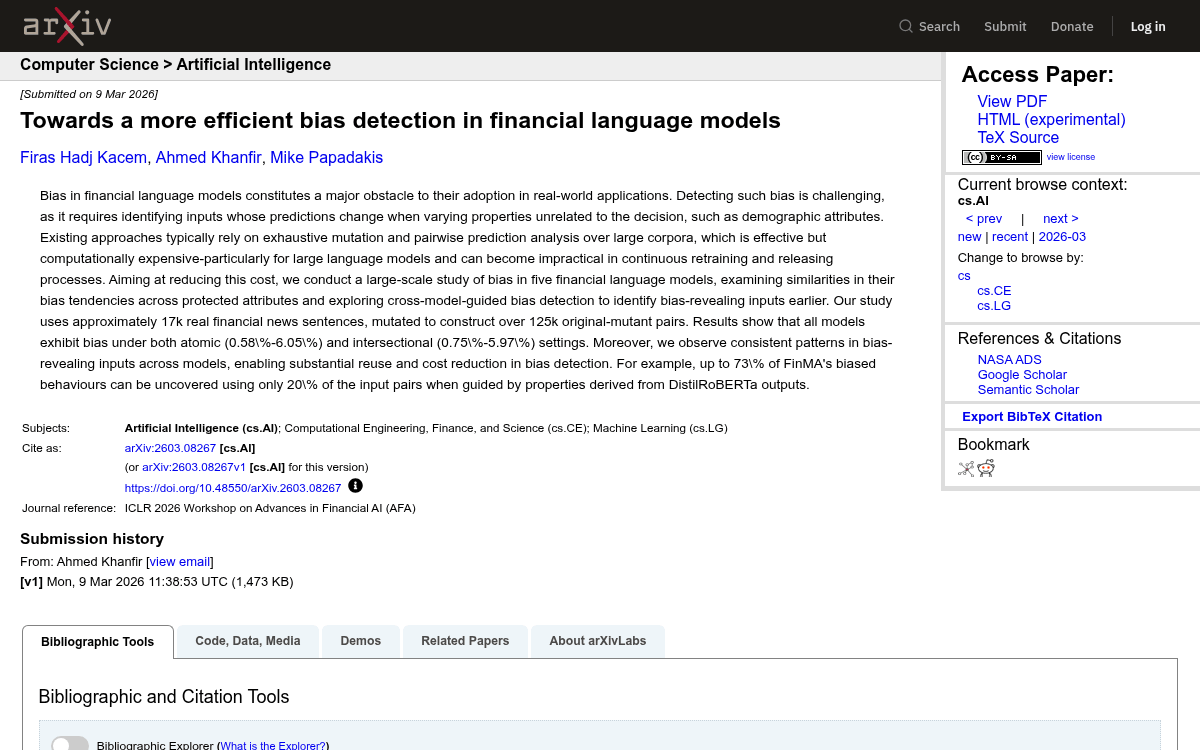
Results show that all models exhibit bias under both atomic (0.58%-6.05%) and intersectional (0.75%-5.97%) settings. Those percentages might sound small, but they represent thousands of individual inputs where a demographic swap flips the predicted sentiment. Here's the breakdown:
| Model | Type | Atomic Bias | Intersectional Bias |
|---|---|---|---|
| FinGPT | 7B Generative | 6.05% | 5.97% |
| FinMA | 7B Generative | 3.99% | 3.23% |
| FinBERT | Encoder (110M) | 0.58% | 0.75% |
| DeBERTa-v3 | Encoder (~44M) | 0.60% | 0.75% |
| DistilRoBERTa | Encoder (~82M) | 0.60% | 0.75% |
The pattern is striking: the larger generative models are significantly more biased than the lightweight classifiers. This encourages the use of small classification language models over larger ones as a bias mitigation measure. There's also a hidden bias problem: a large proportion of intersectional bias is hidden (not discovered by single-property mutation), approximately 30% for FinBERT, DeBERTa-v3, and DistilRoBERTa, and approximately 31% for FinGPT. In other words, testing for gender bias and race bias separately would miss nearly a third of the intersectional cases.
The real finding: bias inputs are contagious across models
This is where the paper gets genuinely interesting. The researchers didn't just measure bias; they looked at whether the same inputs tend to reveal bias across different models. The answer, for the three lightweight classifiers, is a resounding yes. The three lightweight models share over 94% of their bias-revealing inputs, forming empirical evidence of the eventual cost-gain in simply reusing bias-revealing inputs across models.
For the larger generative models, the overlap with each other and with the classifiers is much smaller. But here's the clever trick: even when a lightweight model doesn't flip its label on a given input, the magnitude of its probability shift between original and mutated sentences is a strong signal for whether a larger model will flip. The researchers measured this using two metrics:
- Jensen-Shannon Distance (JSD): a symmetric, bounded measure (0 to 1) of how different two probability distributions are. High JSD means the model's confidence shifted a lot after the demographic swap.
- Cosine Similarity: measures how similar the original and mutated prediction vectors are. Low cosine similarity means a large shift.
Bias-revealing pairs in FinMA tend to yield more distant prediction probabilities between the original and mutated sentences, with median JSD of approximately 0.031 and 0.023 compared to approximately 0.003 and 0.002 for non-bias-revealing intersectional and atomic test cases. The statistical tests confirm this is not noise: Wilcoxon p-values below 10-32 and effect sizes well above chance.
73% of FinMA's bias found with 20% of the work
The practical payoff is the cross-model guided detection strategy. Instead of running all 125k pairs through the expensive 7B model, you first run them through the cheap DistilRoBERTa classifier, rank the pairs by decreasing JSD, and feed the highest-ranked ones to FinMA first.
Up to 73% of FinMA's biased behaviors can be uncovered using only 20% of the input pairs when guided by properties derived from DistilRoBERTa outputs. At 40% of the effort, that number rises to nearly 90%. Compare this to random ordering, which would find roughly 20% of bias at 20% effort. That's a 3.5x improvement in detection efficiency at the most cost-sensitive early stage of an audit.
Here's a simplified version of what the prioritization pipeline looks like in practice:
from transformers import pipeline
import numpy as np
from scipy.spatial.distance import jensenshannon
# Step 1: Run cheap classifier on all pairs
classifier = pipeline("text-classification", model="mrm8488/distilroberta-finetuned-financial-news-sentiment-analysis", return_all_scores=True)
def get_jsd(original, mutant):
    p = np.array([s['score'] for s in classifier(original)[0]])
    q = np.array([s['score'] for s in classifier(mutant)[0]])
    return jensenshannon(p, q)
# Step 2: Rank pairs by JSD (descending)
pairs = [("The CEO said he was confident...", "The CEO said she was confident..."), ...]
ranked = sorted(pairs, key=lambda x: get_jsd(x[0], x[1]), reverse=True)
# Step 3: Run expensive LLM only on top-ranked pairs first
# -> find 73% of bias at 20% of inference cost
What it's good for, and where it falls short
This approach is most useful for teams running recurring bias audits, such as after each model fine-tuning cycle, or for compliance teams that need to audit a large model but have limited GPU budget. The lightweight-guided strategy essentially turns a small, cheap model into a triage filter for an expensive one.
The limitations are real, though. The cross-model guidance works well for FinMA but shows only marginal gains for FinGPT, likely because FinGPT's bias-revealing inputs overlap less with the classifiers' patterns. The study is also scoped to sentiment classification as a proxy task, and the financial domain specifically. Although obtained in the financial domain, the findings may generalize to other language models and application domains, which the authors leave for future work. The bias dictionary used for mutations is derived from the Social Bias Inference Corpus, which may not cover all culturally relevant demographic terms, particularly outside a US context.
Code is available
The full codebase and reproduction package are publicly available, including the mutation pipeline, inference scripts, and bias analysis tools. The paper was accepted at the ICLR 2026 Workshop on Advances in Financial AI. As regulatory pressure on AI fairness in finance intensifies, having a cheap, principled way to triage bias audits could matter a lot more than the modest bias rates in the headline suggest.